


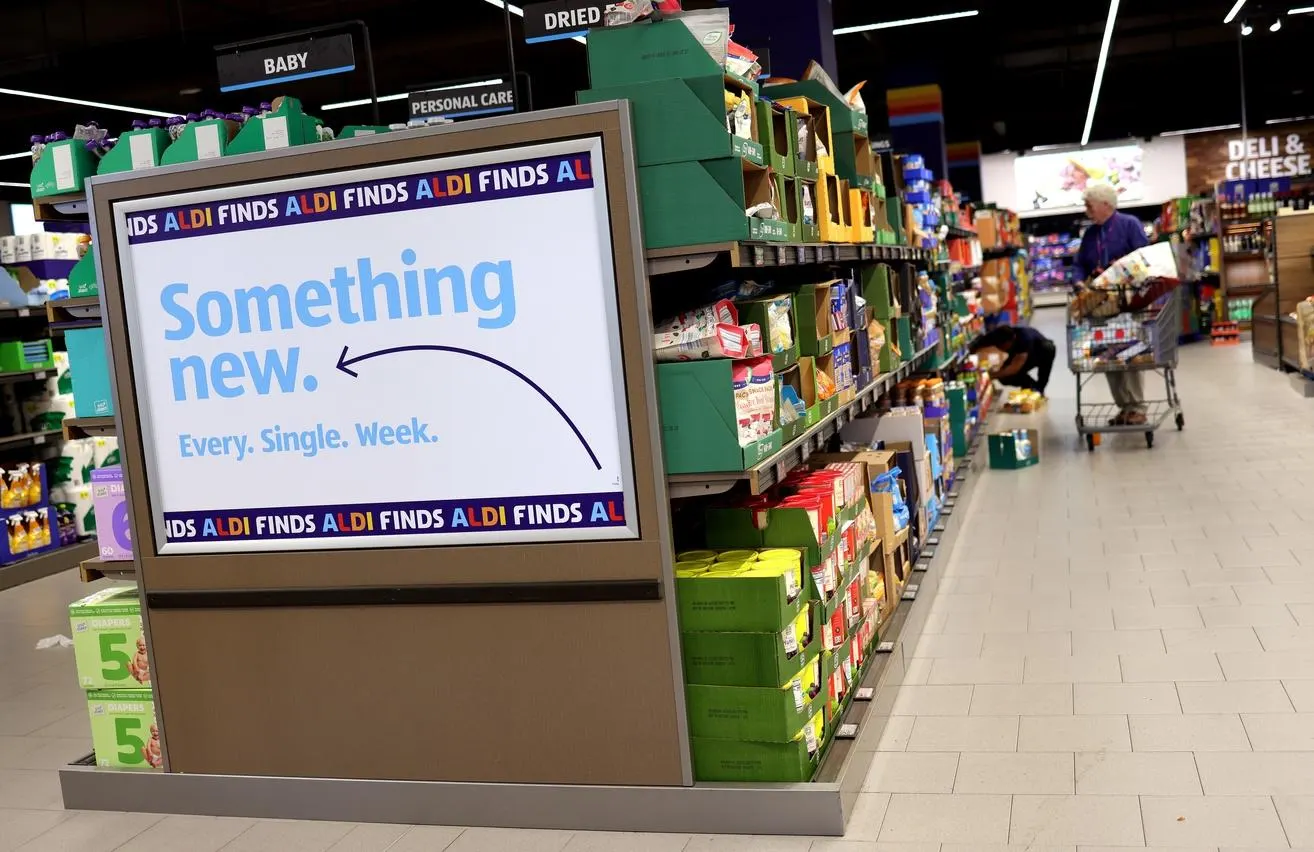

“It’s really fun to be a private label retailer,” said Joan Kavanaugh, Adli USA’s vice president of national buying. “That means we have a hands-on role in product development, so we take our consumer insights to our supplier partners to co-create offerings that tick all the boxes.” (Photo by Kevin Dietsch/Getty Images)
Getty Images
It’s been 50 years since discount grocer Aldi landed in the U.S., opening its first store in Iowa after expanding from its Germany homeland. Widely regarded as the nation’s fastest-growing grocery chain—some 2,700 stores today, on the road to 3,200 by the end of 2028—it became fixed in the popular imagination as the place for private-label “dupes” that match the quality of name brands at a lower price. For decades, Aldi was seen as a follower, not a setter of trends—identify a popular product, then engineer a cheaper knock off.
But Aldi isn’t waiting for trends any longer. It’s moving ahead of them, anticipating what shoppers want and meeting them at the moment of need. Its latest launch of fresh, ready-made meals—the largest new-product introduction of its milestone anniversary year—shows Aldi stepping decisively into its future.
The selections include five single-serve meals, like butter chicken and rice, beef brisket with mac & cheese and beef bolognese spaghetti, all priced under $8, plus two family-sized meals, including a meat lovers pizza bake for $15. They’re built to deliver a high-powered protein punch—up to 46 grams for single-serve and 22 grams for family-sized—and maximum convenience with restaurant-quality flavor.
“We’re evolving to meet our shoppers where they are by delivering fresh ingredients, great flavor and unbeatable value that they can always expect from ALDI,” said Joan Kavanaugh, Adli USA’s vice president of national buying. “This is a very purposeful innovation, responding to changing shopper needs by understanding how critical convenience is right now to the consumer.”
Kavanaugh partnered with Terry Jackson, head of food at the Kitchen Food Company, to produce the meals in its Kentucky manufacturing facility. “We’ve been on this journey for about 18 months, studying what shoppers are buying and the flavor trends, then testing lots of recipes,” he said.
“I’m a chef at heart, so the meals that you’re going to get are the way you’d make them at home—all fresh, never frozen ingredients and no artificial colors or flavors,” he continued.
The meals will begin to appear in selective markets in early October, followed by a nationwide rollout by January 2027. After that, new meal selections will be introduced each month.
Convenience Is The New Grocery Battleground
When it comes to the purchase decision for food, taste and price have remained the top drivers for the past two decades, according to the International Food Information Council’s “Food & Health Survey,” a longitudinal survey conducted annually among 3,000 consumers.
But for the first time in the IFIC study history, convenience rose above healthfulness as the third leading purchase driver in 2026. “The results reinforce the durability of taste and price as dominant considerations, while showing that ease, time and practicality have become especially salient,” the report states.
Aldi has nailed the price equation, named by 78% in the IFIC survey as a key driver. And taste—88% say it has the greatest impact on purchase—is a key contributor to Aldi’s success. Shoppers routinely rate Aldi’s store-brand products as equal to or better than national brands, as seen in numerous comparison articles and posts, like EatingWell’s “11 Aldi Dupes That Are Better than the Original, According to a Food Writer.”
Aldi expects the new ready-made meal lineup to satisfy the taste quotient, as it surely does price. Target just-announced the national launch of Factor ready-made meals, priced at $12.99 for a single serving. Aldi’s come in $4 under that. Factor meals include vegetables, while Aldi fills the center of the plate and leaves shoppers to add a quick steamed veggie side—a trade-off that still preserves a meaningful price difference.
“The convenience piece is absolutely enormous,” Kavanaugh said, noting that Aldi has long offered other ready-made selections, like deli pizzas and mac & cheese, with sales up 9% from 2024 to 2025. “These new ready-made meals tick all the boxes—taste, price, quality and value,” she added.
The broader market underscores the opportunity. The U.S. ready-made meal market, including frozen, chilled, shelf-stable and freeze-dried, reached $26.5 billion in 2025 and is expected to grow to $28.7 billion in 2026, with the refrigerated meals segment expanding the fastest as shoppers gravitate toward freshness.
Convenience also defines the overall Aldi shopping experience. With much smaller stores designed to satisfy 80% to 90% of a grocery shoppers’ weekly needs, Kavanaugh says the Aldi customer spends an average of 24 minutes in-store compared with the 41 minutes spent in the typical grocery store, according to the Food Marketing Institute.
Private Label Is The Hottest Ticket In Grocery
With affordability top of mind these days, private-label store brands are called a “bright beacon in the overall U.S. retailing landscape,” according to the Private Label Manufacturers Association.
“Store brands have moved from just another item on the shelf to whole lines competing head-to-head with national brands and even setting the pace in some food and nonfood categories,” PMLA president Peggy Davies said. “Retailers today are brand builders.”
Store-brand dollar sales increased nearly three times the rate of national brands in 2025, rising 3.3% compared with a 1.2% gain for their national-brand counterparts. Because store brands are typically priced well under national brands, the impact is even clearer in unit sales: private label units rose 0.6% while national brands declined 0.6%.
PLMA also notes that store brands accounted for 47% of all 2025 dollar-sales gains in U.S. retailing, with one of every four food and non-food grocery products purchased carrying the store’s name or one of its brands.
“Retailers are doubling down on private labels as a strategic asset for differentiation, brand building and creating emotional bonds with shoppers,” said Sally Lyons Wyatt, Circana’s global EVP and chief advisor, consumer goods and foodservice insights.
Staying Out In Front
On that score, Aldi is ahead of the pack: 90% of its product assortment is private label compared with less than 30% in a typical grocery store. And Aldi just announced that nearly one-third of its everyday in-store assortment is priced lower than last year—quite an achievement for a brand that claims it offers the lowest prices of any national grocer. Shoppers say they can save up to 22% by choosing Aldi private-label products over competitor’s private-label and they vote for Aldi as having the best quality store brands compared to competitors.
Much of that credit goes to Kavanaugh and her team, who oversee Aldi’s U.S. product selection. She also leads the company’s merchandising and quality control teams.
“It’s really fun to be a private label retailer,” she concluded, reflecting on her 35 years with Aldi, including 19 years in her current role. “That means we have a hands-on role in product development, so we take our consumer insights to our supplier partners to co-create offerings that tick all the boxes.”
After 50 years, Aldi isn’t just an industry disrupter—it’s one defining where the grocery sector goes next. Private label, convenience and value aren’t just its strategy; they are the signposts for the next era in grocery shopping.
See Also:















Leave a comment