


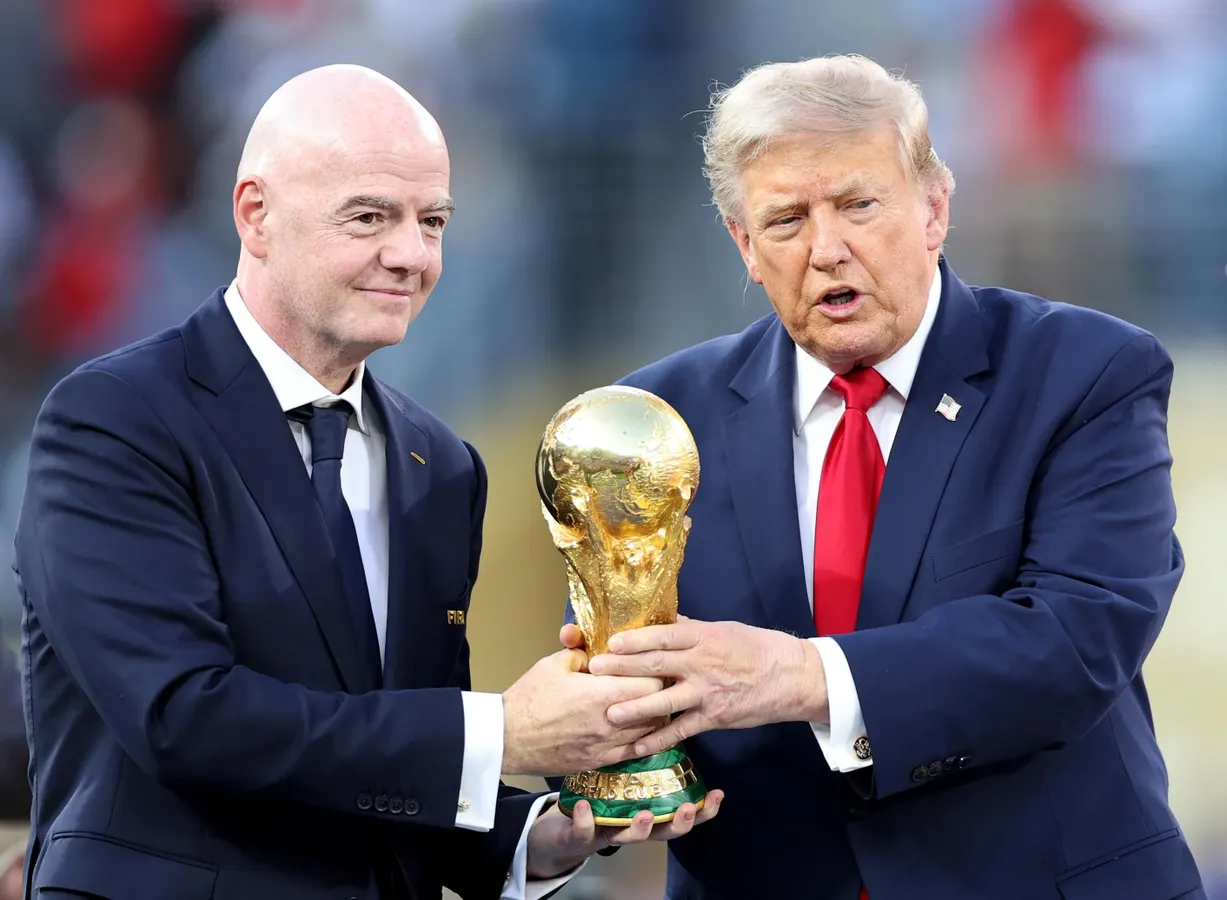

EAST RUTHERFORD, NEW JERSEY – JULY 19: U.S. President Donald Trump and FIFA President Gianni Infantino hold the FIFA World Cup Winner’s Trophy before handing over to captain Rodri #16 of Spain at the award ceremony following the FIFA World Cup 2026 Final match between Spain and Argentina at New York New Jersey Stadium on July 19, 2026 in East Rutherford, New Jersey. (Photo by Dan Mullan/Getty Images)
Getty Images
FIFA President Gianni Infantino has never lacked ambition. During his decade as head of soccer’s world governing body, he has expanded the World Cup, created an enlarged Club World Cup, increased prize money and transformed FIFA into one of the wealthiest organizations in global sports.
Now he is pursuing what could become the most consequential decision in FIFA’s history: Inviting private equity investors to own a stake in the commercial future of the World Cup.
The plan goes beyond financial restructuring. It represents a fundamental debate over who should control the game’s most valuable tournament and whether FIFA is evolving from a nonprofit organizations into something resembling a multinational entertainment brand.
The backlash has been swift. UEFA declared that “the World Cup is not FIFA’s to sell.” As a result, they have threatened to boycott the next World Cup in 2030. Other confederations have also publicly complained, including the AFC and CONCACAF.
The speed and intensity of the resistance shows that many of the world soccer’s power brokers view the plan as an existential challenge rather than merely another commercial initiative.
At the heart of the proposal is a new subsidiary valued at $20 billion that would manage FIFA’s commercial rights. Private investors would own 20% of the venture, led initially by Thrive Capital (the investment firm founded by Joshua Kushner, the brother of President Donald Trump’s son-in-law), with J.P. Morgan overseeing the fundraising process. In exchange, FIFA’s 211 member associations would each receive an immediate $20 million payment, if they approve the plan by Sept. 19.
The financial incentive is a way for Infantino to get this plan approved. For many smaller federations, the additional revenue over the next four-year cycle represents transformational money. It can fund youth academies, training centers, coaching education and infrastructure that otherwise would be impossible to finance.
Infantino understands FIFA’s political math better than anyone. Every member nation — 211 in total — receives one vote regardless of whether it is Spain or San Marino. The smallest federations collectively possess far greater electoral power than Europe’s traditional heavyweights.
Since his election in 2016, Infantino has consistently strengthened his position by increasing development funding to these smaller national associations. This proposal follows the same blueprint, only on a much bigger scale.
This dynamic helps explain why UEFA may struggle to stop the plan through FIFA’s democratic process. Europe generates much of soccer’s commercial value, but it controls only 55 of FIFA’s 211 votes. Unless other confederations unite in opposition, Infantino likely has the numbers to prevail.
The deeper concern among UEFA is that private equity changes the incentives governing world soccer. Investors expect returns. Once outside capital owns a portion of FIFA’s commercial rights, pressure inevitably grows to increase revenues, maximize broadcast value and create more inventory for sponsors.
That could accelerate trends already reshaping the sport. For example, the World Cup has expanded from 32 to 48 teams. The Club World Cup has become a month-long tournament featuring 32 clubs. Women’s tournaments also continue to grow. Calendar congestion has become one of the sport’s biggest issues, with clubs, leagues and players complaining about excessive workloads.
Private investors would encourage further expansion. More matches means higher TV revenues. Tournaments with more teams attracts more sponsorship. These objectives align with investment returns, not necessarily with competitive balance or player welfare.
What became the norm at this summer’s World Cup — dynamic ticket pricing, increased in-game advertising, more commercial interruptions and additional sponsor-driven innovations — would become easier to justify in the future when investors ask for more growth. The World Cup risks becoming less a sporting festival than a premium entertainment asset optimized for maximum profitability.
The plan has also intensified an ongoing power struggle within the sport. UEFA and South America’s CONMEBOL have long dominated soccer through competitions like the Champions League, European Championship and Copa America. FIFA, by contrast, has sought to expand its influence beyond the World Cup by creating new tournaments and increasing its commercial footprint.
The private equity proposal would give FIFA unprecedented financial resources to compete directly with these two confederations. That prospect alarms those in Europe, who fear FIFA could increasingly challenge their competitions for space on an already overcrowded calendar.
This is hardly the first time Infantino has tested the limits of his authority. In 2018, he backed a secretive $25 billion investment proposal to overhaul international competitions. UEFA helped block it. In 2021, he unsuccessfully pushed for a biennial World Cup before facing coordinated resistance from Europe and South America. Those battles revealed a recurring pattern: Infantino pursues transformative projects first, then seems to build consensus later.
Adding another layer to the debate is Infantino’s increasingly close relationship with figures in Trump’s political orbit. Thrive Capital’s involvement connects FIFA to Kushner, while Infantino has cultivated ties with the Trump administration through high-profile appearances and symbolic gestures, including the creation of a FIFA Peace Prize awarded last year to the president.
Whether those relationships influenced the investment proposal or instead reflect overlapping business networks, they reinforce perceptions that FIFA’s leadership is becoming intertwined with political and financial elites outside the traditional soccer establishment.
Infantino is seeking another term as FIFA president, which would run through 2031. Under this latest proposal, it is obvious that he envisions a longer future leading the commercial side of the game. A powerful FIFA subsidiary with private investors, structured more like a modern corporation, could eventually create an executive role for him resembling a commissioner not too dissimilar from the NBA or NFL.
Whether that scenario materializes remains speculative, but it underscores how the proposal extends beyond financing. It raises fundamental questions about FIFA’s future identity.










Leave a comment