


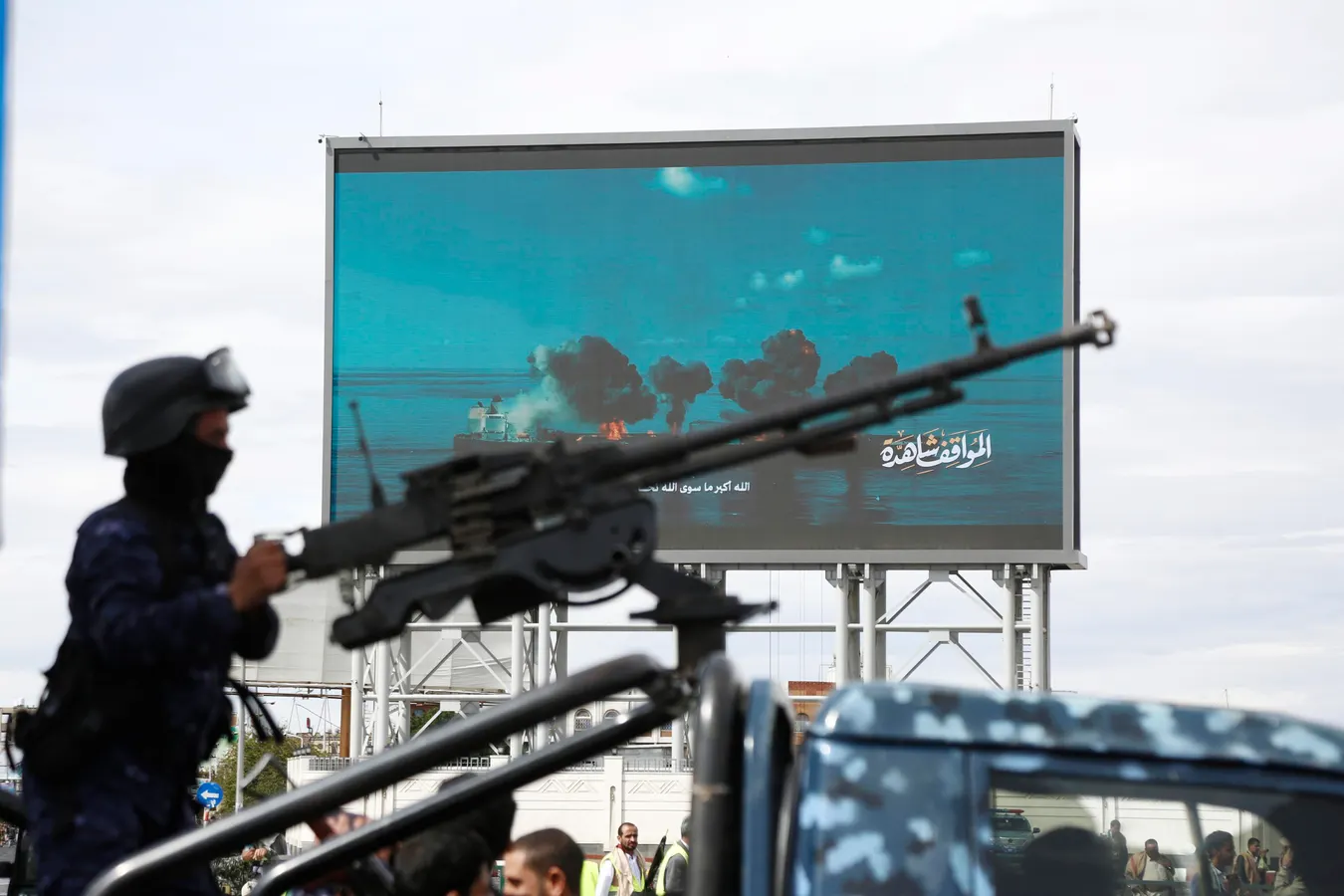

SANA’A, YEMEN – MARCH 27: A Yemen’s Houthi soldier mans a machine gun mounted on a police vehicle next to a billboard depicting Houthi launching missile and drone attacks, during a protest staged to show support to Iran against the U.S.-Israel war on March 27, 2026 in Sana’a, Yemen. (Photo by Mohammed Hamoud/Getty Images)
Getty Images
The war in the Middle East and the on-again, off-again closure of the Strait of Hormuz have dominated news cycles for months. The oft-predicted economic apocalypse hasn’t materialized. Yet.
For now, lower-than-expected Chinese demand, combined with the supply coming through the East-West pipeline in Saudi Arabia that unloaded oil in the Red Sea terminal at Yanbu while bypassing the Strait of Hormuz, staved off the worst-case scenario.
However, Tehran seems intent on inducing the worst-case scenario and is pursuing it with a two-fold strategy aimed at Saudi Arabia, which Iran has clearly identified as the weak link in the pro-U.S. Middle East alliance. And no, the recently signed Pakistan-Turkey-Saudi defense pact so far failed to protect Riyadh.
The September 10–11 drone attack, believed to have been carried out by pro-Iranian Shi’a militias in Iraq against vital Saudi oil infrastructure, combined with the mid-September military offensive by Yemen’s Houthi rebels that seized territory along the narrow southern entrance to the Red Sea and several islands in the Red Sea, has given Tehran even more leverage. The open question remains the level of autonomy and the agency of the Houthis. The jury is still out on that one.
Oil price fluctuations since February 2026 are revealing. Before the war began, prices hovered around $65 a barrel. They continued to climb until an April 7 high of $112. From there, prices trended downwards, reaching $68 a barrel by July 1. In between, blips came from intermittent ceasefire promises and rebuttals, but the trend remained steady. From July 1 onwards, prices climbed upward to $102 by September 16. Now with more accurate information and priced-in risk, the market was more consistent and less susceptible to panic. Iranian attacks and ceasefires were becoming less effective in swinging the markets. That may be about to change.
Map of East-West Pipeline or Petroline in Saudi Arabia, from Abqaiq across Arabian Peninsula to Yanbu at Red Sea, and Abu Dhabi Crude Oil Pipeline, from Habshan, in the UAE to Fujairah in Oman. Vector
getty
The East-West Pipeline and Other Options
Saudi Arabia’s East-West pipeline carries crude from the kingdom’s eastern oil fields near Abqaiq across the Arabian Peninsula to Yanbu on the Red Sea, allowing the kingdom to bypass the Strait of Hormuz. The 745-mile pipeline has a maximum capacity of 7 million barrels per day (bpd), although actual flows have hovered between 4 million and 5 million bpd, or roughly 4–5% of global supply. For comparison, before the war, roughly 20 million bpd passed through Hormuz.
The pipeline has become Saudi Arabia’s lifeline, offering an alternative to the Strait of Hormuz. As flows through Hormuz have been severely disrupted, Riyadh has increasingly relied on this route to move crude toward the Red Sea.
On Thursday, September 10, drones struck pumping stations along the pipeline near Riyadh and Medina, causing damage and injuring several people. Saudi Arabia subsequently suspended operations as a “precautionary measure”. Saudi authorities said the drones originated from Iraq, and Baghdad later confirmed that the attacks had been launched from Maysan province.
Following a call from Iraq’s prime minister, Saudi Arabia has said it would not retaliate for the attack at this time and would “support the efforts of the Iraqi government” to prevent attacks on neighboring states. This is not how things work in the Middle East. Inaction in the face of an attack on vital infrastructure is an admission of weakness. Saudi Arabia has spent hundreds of billions of dollars buying sophisticated military gear. It also signed an ominous-sounding defense agreement with Islamabad and Ankara. And… crickets.
Iran operates a network of proxies across the region that can be used on-again, off-again against key pressure points. Rather than shutting down each shipping route, Tehran appears to be using its regional proxies, particularly the Houthis, to attack alternatives to the already disrupted Strait of Hormuz.
Following the drone attacks, the Houthis advanced along Yemen’s Red Sea coast, seizing the port of Mokha from the pro-government Yemeni forces supported by Riyadh. Reportedly, IRGC officers directed the ragtag, Toyota Land Cruiser-riding Houthi militias. They also captured the islands of Greater and Lesser Hanish and Perim Island around the Bab el-Mandeb Strait. Perim Island sits at the narrowest point of Bab el-Mandeb. From that vantage point, it will be easier for the Houthis to strike vessels sailing the Red Sea. Meanwhile, control of the Hanish Islands gives the Houthis a commanding position overlooking vessels approaching the strait. Think of it as throwing up two roadblocks on a crucial access avenue to control entry to a city.
Cutting off Red Sea transit would put additional pressure not only on the Bab el-Mandeb Strait but also on the Suez Canal. The Canal, which has seen increased traffic this year, serves as the fastest route between Europe and Asia and carries about 12–15%of global trade. According to the U.S. Energy Information Administration (EIA), 4.9 million bpd of crude and petroleum products passed through the Suez Canal and Suez-Mediterranean pipeline in the first half of 2025. Prolonged disruption would therefore create a problem for global shipping and trade. While tankers could theoretically be rerouted around the Cape of Good Hope, the added distance would add days to voyages and consume more fuel.
Will Prices Climb?
This latest Iranian action will likely push up prices. The vulnerability of Saudi supply was already evident before the latest pipeline attack, with the International Energy Agency cutting Saudi Arabia’s 2026 crude supply forecast by 885,000 barrels per day to 7.6 million bpd. The kingdom’s crude loadings, which include Red Sea shipments and dark shipping transits by shadow-fleet tankers, fell by 1.1 million bpd from the previous month to 3.5 million bpd, while inventories declined by another 400,000 bpd.
Energy prices have not yet fully reflected these supply fluctuations. They will likely remain unchanged until current supplies are exhausted. The Port of Yanbu’s storage capacity is 35 million barrels. However, Saudi Arabia’s crude supply fell to 6 million bpd in August, its lowest level in more than three decades.
Reuters reported that Saudi Arabia had approximately five to seven days’ worth of export-ready oil stored at Yanbu, while additional crude stored in Egypt’s ports of Ain Sukhna and Sidi Kerir could provide several more days of supply. So, while existing inventories are temporarily cushioning the impact on energy prices, a prolonged disruption could make the effects more pronounced as reserves are drawn down.
U.S. Energy Secretary Chris Wright, speaking on September 15, said the Saudi pipeline should be back online within days, and that in the meantime, the kingdom is shipping more oil out of the Strait of Hormuz with the assistance of the U.S. military. If all goes according to the apparent plan, immediate disruptions may be contained. The Houthis reportedly said they will allow all ships through the Red Sea, including American ships, but not Saudi vessels. A prolonged shutdown would add havoc to an already constrained market. If the pipeline is closed for a month, absent adequate workarounds, the market could lose about 120 million barrels.
Reportedly, Saudi Arabian Crown Prince Mohammed bin Salman called U.S. President Donald Trump twice on September 10, urging him to intervene, but the administration declined to take direct military action and instead offered intelligence and targeting assistance. This marks a shift from Riyadh’s position back in July, when it told the U.S. it could handle the Houthi conflict without U.S. military involvement. Again, in the Middle East this does not make the Saudis look good.
Iran’s latest move aims to take the global economy hostage through coordinated military actions throughout the region: if they fail to fully block the Strait of Hormuz, they will try with Bab el-Mandeb. Alienated American allies from Europe and Asia are not rushing to Trump’s rescue, and even if they did, their naval and power projection assets are limited.
Nobody can cancel geography – even if they don’t teach that subject well in American schools. And if Tehran doesn’t succeed in keeping either the Red Sea or East-West pipeline closed, it intends to remind the world of its leverage and capacity to disrupt the oil, gas, and derivative markets, such as petrochemicals and fertilizers. Supply chain security is becoming a new commodity. The need to project power into unstable regions to ensure economic well-being is something both Trump and Xi Jinping will need to think hard about before they meet on September 24 in Washington, D.C.














Leave a comment