


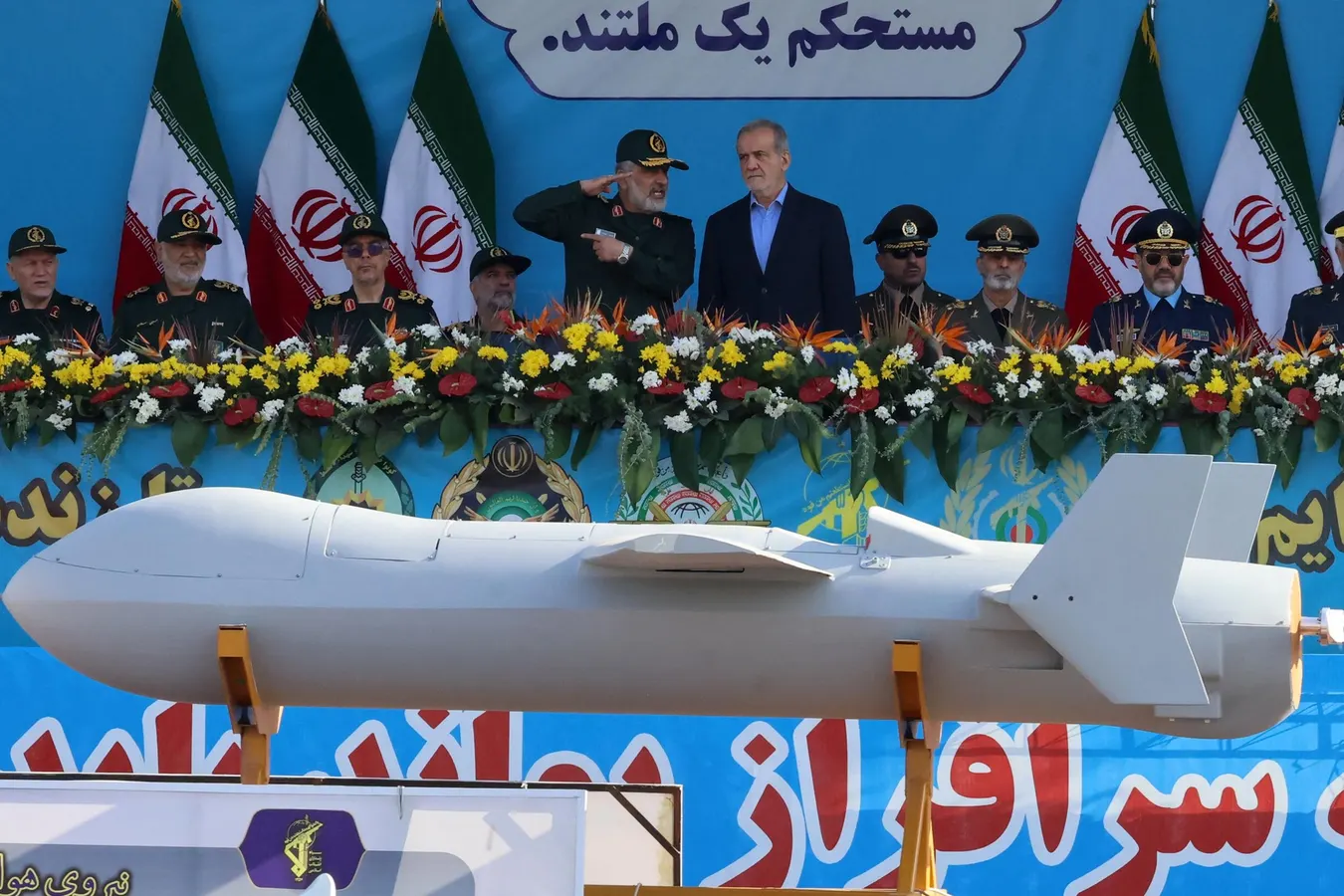

Iranian President Masoud Pezeshkian (R) and commander of the Islamic Revolutionary Guard Corps’ Aerospace Force Amir Ali Hajizadeh look on as Iran’s new Shahed 136-B drone is displayed during the annual military parade marking the anniversary of the outbreak of the 1980-1988 war with Saddam Hussein’s Iraq, Iran’s long nurtured defense industrial base has proven invaluable for Tehran.
AFP via Getty Images
Since June 7, Iran and its proxy, the Houthi rebels (with their rallying cry, “God is great, death to America, death to Israel, a curse upon the Jews, victory to Islam”), have launched more than 30 ballistic missiles at Israel, prompting the Israelis to retaliate with airstrikes, and setting the stage for renewed hostilities and escalating instability in the region. Iran’s Parliamentary Speaker, Mohammad Baqer Ghalibaf, said Iran’s response was tied to the U.S. naval blockade and alleged Israeli counterattacks against Hezbollah in Lebanon, and threatened further action against U.S. and Israeli targets. While the attacks have escalated tensions in the Middle East and exposed the fragility of diplomatic efforts, they also highlight the growing economic constraints shaping Iran’s position. Some analysts say that Iran wants a deal to lift the U.S. blockade and allow the export of oil already loaded on tankers stuck in the Gulf.
How the Latest Strikes Are Expanding Regional Instability
On June 7th, Iran launched three salvos against Israel in defense of Hezbollah, prompting Israeli retaliatory strikes on military targets across Iran — including sites near Tehran, Tabriz, Isfahan, Karaj, a petrochemical plant in Mahshahr, and a missile production facility.
Following the initial Iranian strike, U.S. President Donald Trump reportedly urged the Israeli prime minister not to retaliate against Iran, noting that the missiles were intercepted and no injuries were reported. He has since reiterated calls for both sides to halt further attacks and resume diplomatic efforts. Additional regional actors, including the Houthis in Yemen, also launched missiles at Israel, threatening to target Israeli ships in the Red Sea. According to Trump, Sunday’s events would not affect efforts to reach a deal with Iran over the Strait of Hormuz.
Iran’s Export Problem
There may be economic reasons for Iran’s escalation. Dan Linnaeus , Tel Aviv-based analyst, told FORBES in an interview, “In less than 90 days, Iran’s economy is going to start unwinding,” as the country’s supply of deliverable oil is rapidly being depleted.
To date, Iranian oil exports have fallen to their lowest level in six years, averaging about 209,000 barrels per day (bpd). Crude production is expected to fall from 2.75 million bpd to an estimated 1.2-1.3 million bpd in May. Storage capacity has also been increasingly constrained—the country may be out of capacity in just a few weeks. From Iran’s 147 million barrels of crude and condensate inventory, an estimated 67 million barrels remain effectively trapped due to shipping access and geopolitical pressures, Linneus said.
Because Iran’s export system depends on delayed settlement, with payments received roughly 2 months after delivery, the impact on revenue will lag behind the physical decline in shipments.
China remains Iran’s largest buyer. However, a continued blockage would mean the country would run out of oil to sell. Discharges of Iranian oil to China in May have already fallen to around 1.1 million bpd, eating into a small non-replenishing pool of roughly 80 million barrels.
The escalation in the Middle East is increasingly tied to Iran’s current economic doldrums. As exports decrease and capacity remains constrained, Iran is losing its main source of financial leverage. The impacts become more visible as regional tensions remain elevated. According to Linneus, Ghalibaf’s threats against the blockade stem from the regime operating under economic pressure and a narrowing timeframe. As he put it, “the regime is watching this clock and cannot wait to cash out.”
Faith, Morale and Other Intangibles
Export restrictions and other forms of economic coercion can go a long way toward pressuring governments and enabling change. However, they require additional conditions to succeed.
Unfortunately, the many intangibles that economic coercion relies on are hard to measure. Willingness to fight is famously fickle: the United States massively miscalculated the morale of the Afghan Taliban and of Ukraine. In the latter case, Putin did as well. There is no scientific way to quantify the utility of Iranian zealotry.
Even if an adversary is initially divided or unwilling to resist, coercive action may strengthen unity. The “rally around the flag phenomenon” has been observed historically and globally. Will Iranians who were hostile, protesting, apathetic toward, or afraid of the incumbent theocratic dictatorship support the oppressive Islamic Republic? If the U.S. blockade continues, we may well find out.
North Korea stands as a stark testimonial: without sufficient internal opposition and opposing “boots on the ground,” even incredibly impoverished and dysfunctional nations can endure for decades amid near-total isolation. Iran is a more complex case. On one hand, Iran has a millennia-old national identity. It operates a diversified economy and has a developed defense industrial base. As a state and a society, Iran could theoretically bear the burden of a continued blockade for a while, provided its multi-ethnic society’s internal cohesion remains intact, and the regime stays united.
Iran already faces near-economic collapse, with hyperinflation at 65%–73% and the rial at unprecedented lows. The maritime blockade has triggered food shortages. Millions go hungry every day. Five years of drought have depleted dams, causing critical water shortages, while structural underinvestment and wartime damage have forced widespread fuel rationing.
The question remains whether the Iranian people will continue to shoulder such sacrifices if and when the current economic disaster becomes an outright catastrophe.












Leave a comment