


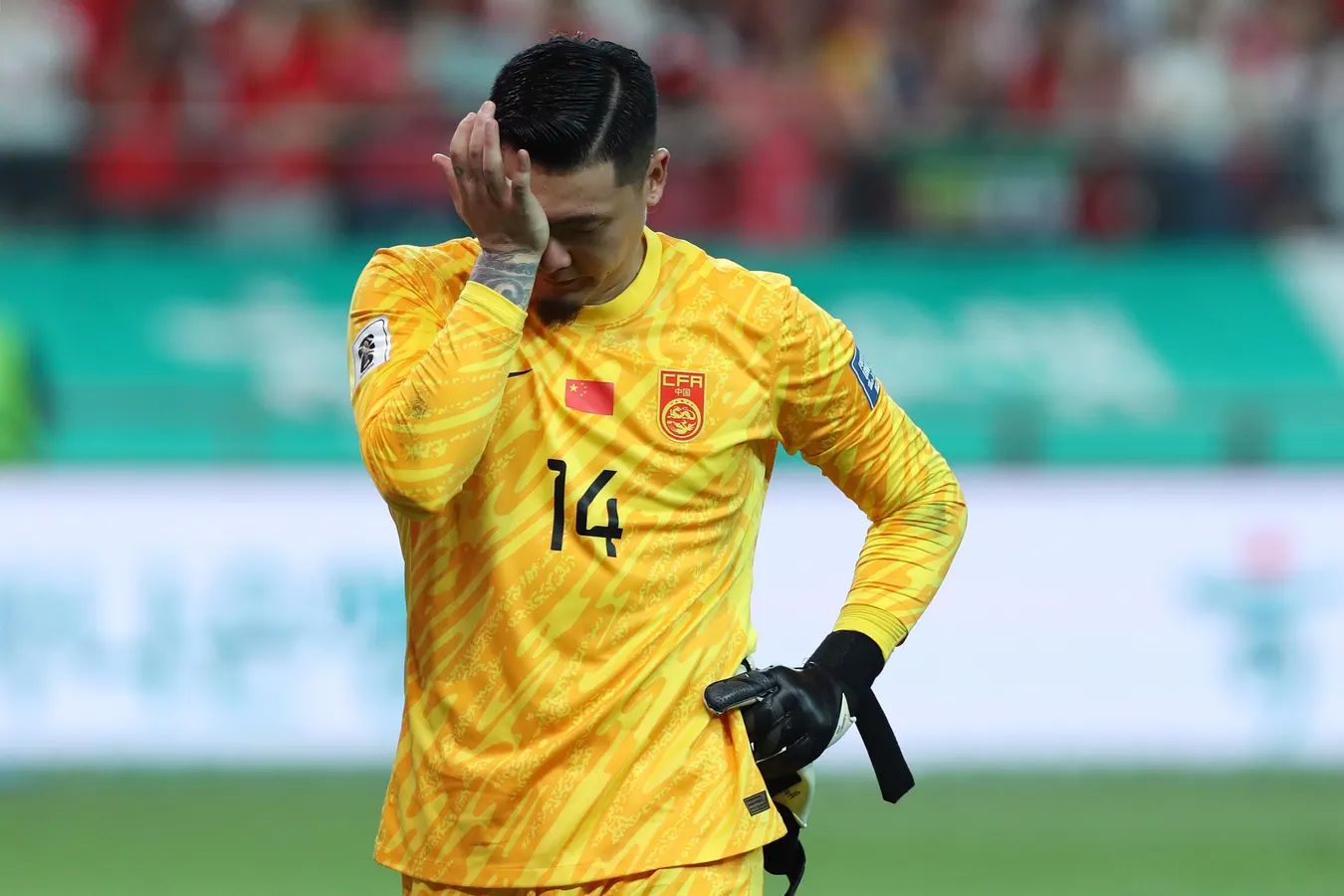

SEOUL, SOUTH KOREA – JUNE 11: Wang Dalei of China shows dejected after the team’s 0-1 defeat in the FIFA World Cup Asian second qualifier Group C match between South Korea and China at Seoul World Cup Stadium on June 11, 2024 in Seoul, South Korea. (Photo by Han Myung-Gu/Getty Images)
Getty Images
China’s national team didn’t qualify to compete in this summer’s men’s World Cup, although it never does.
Only once in the tournament’s history, back in 2002, did China qualify; even then, the team exited the tournament quickly and ignominiously after three defeats in three games.
It hasn’t always been bad news for the Chinese national team, indeed it ranked 37th in the world back in the late 1990s.
Since then, however, its ranking has once plummeted to 109th and, more recently, has stabilised in the 90s.
To be fair to China’s players and fans, its women’s team has fared much better; in the early 2000s, it was ranked 4th in the world, and nowadays it regularly occupies a top 20 spot in FIFA’s rankings.
A failed football revolution
Ten years ago, no doubt acutely aware of the country’s soccer failings, the government embarked on a President Xi Jinping-inspired programme of soccer investment, with the vision of ensuring that China becomes a leading FIFA nation by 2050.
The country’s Super League invested huge sums of money in overseas player acquisitions, cities began building soccer infrastructure, and even schools were encouraged to programme soccer classes into their timetables.
There was even talk of China staging the 2034 FIFA men’s World Cup; long before Gianni Infantino started cosying up to Donald Trump, the FIFA president regularly visited Beijing to meet with Xi.
Since then, a combination of excessive state interference in the sport, domestic economic turbulence, the pandemic, the impact of global football’s grifters and opportunists, and the emergence of powerful rivals (such as Saudi Arabia, which will host the tournament in 2034) has undermined what was supposed to be China’s soccer revolution.
Yet among observers and cynics, China’s ambition to become a FIFA superpower by 2050 was always interpreted both too literally and in very narrow terms, the assumption being that government policy was all about players and their development.
Instead, soccer development was situated within the context of China’s broader economic development and influence, indeed there is an argument that the country has already achieved its goals.
China’s growing sponsorship presence
Among FIFA’s global partners, China has the most deals, three – with Hisense, Mengniu and Lenovo, which compares with, for example, only one from Europe – Adidas.
Chinese industry isn’t just represented by these three deals; among the national teams competing at this summer’s competition, a multitude of Chinese companies and brands will be present.
For example, TCL International – a consumer electronics & display business – is sponsoring the Argentinian, Brazilian, and German national teams, while Vatti – a Chinese-owned kitchen & home appliances business – is associated with Spain.
All of them will be working hard to activate their sponsorship deals on U.S. soil; hence, many of us will become accustomed to seeing their names scrolling on pitch-side digital signage.
It isn’t just teams that have growing ties to China; players do as well.
One example is England’s star midfielder Declan Rice, who, just days before the tournament started, signed a deal with car manufacturer Xiaomi, a move that is not without geopolitical context.
During Donald Trump’s first term in office, the company was blacklisted by his administration amid concerns about its ties to the Chinese government (though Joe Biden removed this sanction).
Such anxieties are not without foundation; China’s soccer game is not simply about business and commerce, there are geopolitical dimensions as well.
Stadium diplomacy in Africa
This may be one reason why, in 2023, then-U.S. Secretary of State Anthony Blinken made a surprise appearance at the African Cup of Nations soccer tournament in the Ivory Coast.
Though he claimed to be a lifelong soccer fan, Blinken was no doubt drawn to a country whose tournament stadium infrastructure had been gifted to it by China, a regular occurrence across the continent over the last two decades.
Beijing’s government playbook is based on stadium diplomacy, whereby, in return for the construction of stadiums, African nations enter into strategic agreements with China that grant preferential access to natural resources such as oil, lithium and rare earths.
Ivory Coast is participating in this summer’s World Cup, as are countries such as Ghana, where the massive Chinese state-owned Shanghai Construction Group built the stadiums where national team qualifying games were played.
Chinese fans’ football passion
Despite the Chinese national team’s absence from this year’s tournament, it’s likely that there will still be plenty of fans from the country watching the event.
The pandemic lockdown scuppered their chances of travelling to the last World Cup, but in 2018, 60,000 of them travelled to Russia, which exceeded the number of England fans whose team progressed to the semi-finals that year.
With a Chinese diaspora in the U.S. numbering more than 5 million people, and others set to travel from East Asia, it won’t be surprising if we witness significant attendance at the event.
If only the country had a decent football team, although there’s still some hope.
The Jiangsu Super League has become a national phenomenon and a benchmark for other Chinese provinces, which are now replicating its success.
The League features teams representing thirteen prefecture-level cities across Jiangsu province and involves amateur and grassroots players.
Single-match attendance has sometimes exceeded 60,000 spectators, setting new attendance records for amateur football in China.
Who knows, perhaps it will help Chinese football to achieve its on-field goals and secure a second-ever World Cup qualification.









Leave a comment