


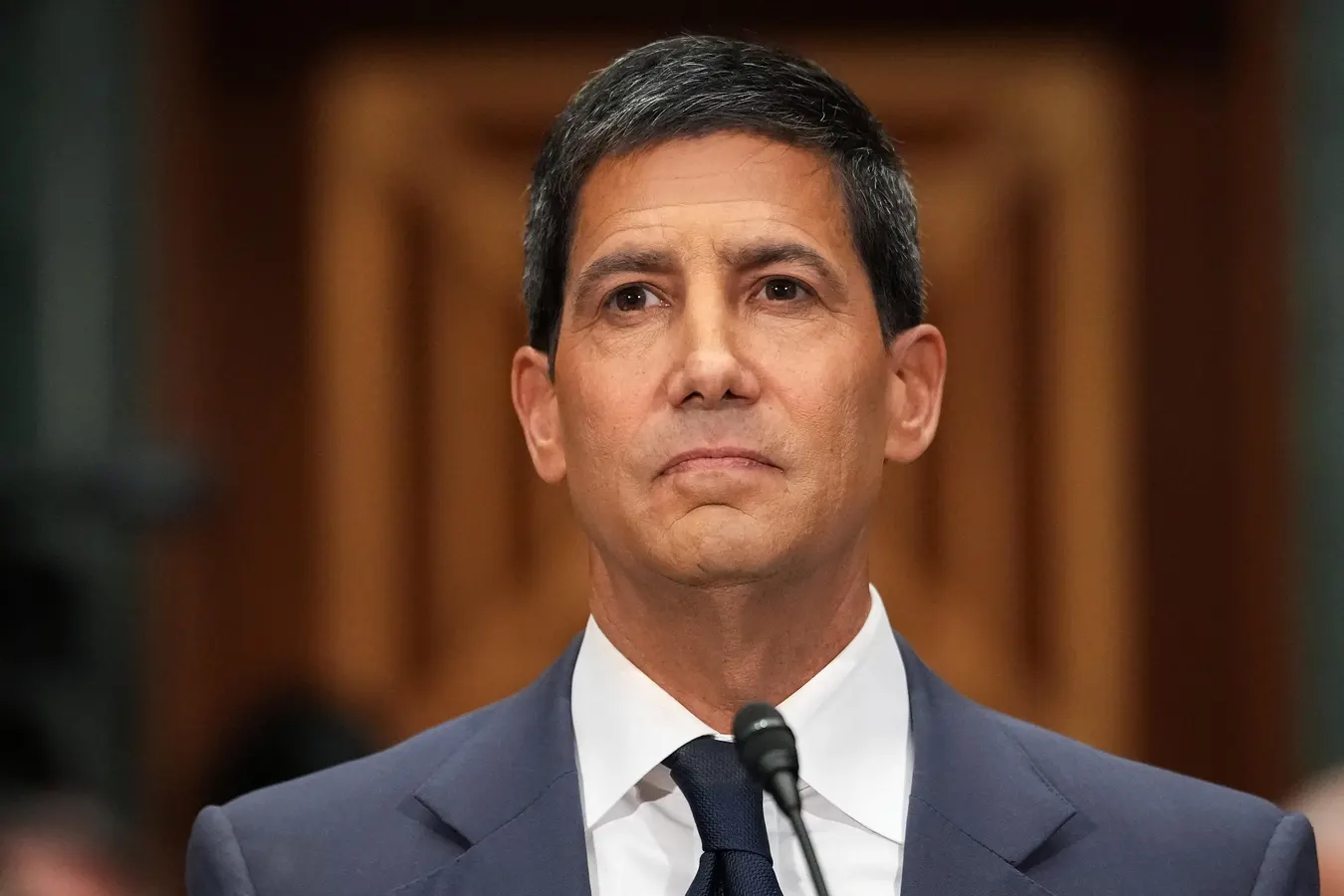

WASHINGTON, DC – APRIL 21: Kevin Warsh, U.S. President Donald Trump’s nominee for Chair of the Federal Reserve, prepares to testify during his Senate Committee on Banking, Housing, and Urban Affairs confirmation hearing in the Dirksen Senate Office Building on April 21, 2026 in Washington, DC. President Trump nominated Warsh, a former member of the Federal Reserve Board of Governors, to replace Jerome Powell amid bipartisan concerns over the Justice Department’s criminal investigation into the central bank’s current leader. (Photo by Andrew Harnik/Getty Images)
Getty Images
Kevin Warsh is talking himself out of a job. He routinely expresses the correct view that markets operate more smoothly when responding to economic data, as opposed to them anticipating how the Fed will react to the data. So, while Warsh arguably well overstates the value of economic data that is invariably a look backward as is, the fact that he would seemingly prefer markets not having to fear a backward-looking Fed’s reactions is seemingly a positive.
Assuming a do-nothing Fed, it won’t change much for the same reason that abolishing the Fed wouldn’t make the sun shine 365 days a year as members of the Austrian School figuratively promise. The Fed’s power to influence interest rates one way or the other has always been overstated. Evidence supporting this claim can be found in Warsh’s interest in the job, get it?
If the Fed really controlled interest rates as is commonly assumed, the U.S. economy would be too small to matter. That’s because central planning always and everywhere fails, and would be economically disastrous if one of the most important prices in the world (credit) were controlled from the Commanding Heights.
What’s the most important price in the world? The dollar. The Austrian School types who think the Fed is the source of nearly every global economic ill claim the Fed controls the value of the dollar that it allegedly persistently devalues, but it doesn’t. And never has. The dollar’s exchange value has never been part of the Fed’s portfolio by design, but also in practice. Specifically, see 1933 and 1971 when Presidents Roosevelt and Nixon devalued the dollar. They did so in the face of toothless pushback from Fed Chairs Meyer and Burns.
Back to Warsh, his quietude is once again wise. See above, but also consider what the Fed is empowered to do. It’s required to oversee banks, but history is clear that the Fed’s regulators are always last to discover problems inside banks, which is logical. If they were routinely first, they wouldn’t be at the Fed.
Price stability? The very notion insults market logic. Prices are supposed to be erratic as a reflection of constantly changing consumer wants, needs, and priorities. Furthermore, prices are the remarkably sophisticated effect of infinite decisions made by billions of humans and machines every millisecond of every day. In other words, the Fed couldn’t achieve “price stability” (whatever that is) even if it wanted to.
Interest rates? The Fed is charged with influencing the overnight lending rate among banks, and uses resources extracted from the private sector to exert its influence. Except that an overnight lending rate is a price like any other, and hardly requires the Fed.
Lender of last resort? The health of the banking system requires that myriad private actors decide which financial institutions do and do not survive. Very simple.
So-called “monetary policy.” Some wedded to Milton Friedman’s “monetarism” hope Warsh takes control of so-called “money supply.” It would be comical if the notion weren’t so sad: money in circulation is a reflection of production, nothing else. Imagine the Fed trying to mirror global economic dynamism. As with prices, the Fed couldn’t pursue policies that even Friedman admitted were bogus even if it wanted to.
It all speaks to why Warsh is right about markets operating more capably absent the government intervention that the Fed represents, while at the same time questioning Warsh’s aim here.
If he reveals that the Fed was never necessary, and it wasn’t, what of the future Fed? While it’s hard to believe Warsh would be the first Fed Chair in history to laudably shrink the Fed’s overstated reputation, it’s worrisome to consider where Warsh might pivot a central bank he politicked so heavily to run. Time will tell.








Leave a comment