


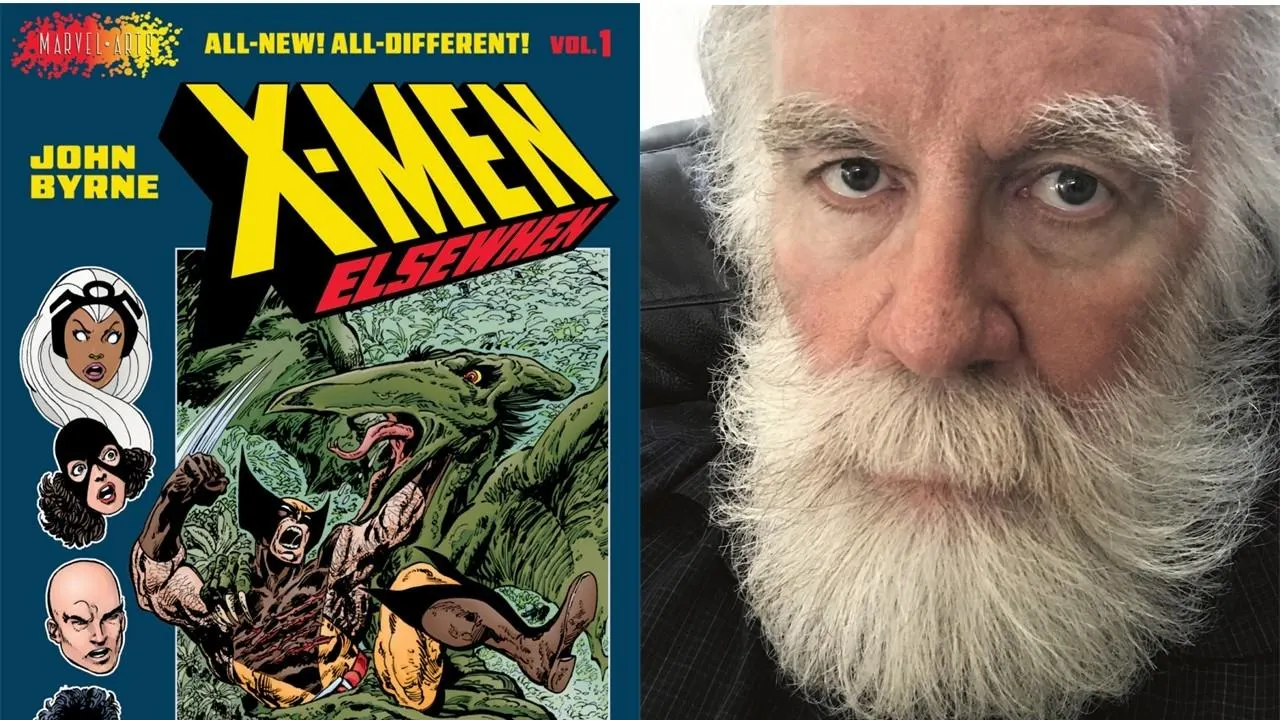

X-Men: Elseworlds by John Byrne (right), published June 23, 2026 by Abrams ComicArts
Courtesy of Abrams ComicArts
In American superhero comics, few creative runs on characters hold as lofty a place in the history of the medium and the hearts of fans than the John Byrne-Chris Claremont Uncanny X-Men of the late 1970s and early 1980s. At a time when comics were at a creative and commercial low, the series brought in fans by the boatload and helped the fledgling direct market of independent comic book retail stores get to its feet.
And then, suddenly, it was over. Following a series of creative disagreements with then Marvel editor-in-chief Jim Shooter that derailed the team’s direction for the book, Byrne left, never to return, a move that he says was his own decision.
X-Men continued its rise and so did Byrne, becoming the signature superhero artist of the 1980s with his work on Fantastic Four, Hulk and then Superman at DC. But for nearly half a century fans were left to wonder where he might have taken the series if things had worked out differently, and if Byrne, rather than Claremont, had taken over direction of the title.
Now, thanks to a very unlikely series of events, we all get to find out. All-New, All-Different X-Men: Elsewhen, written and drawn by Byrne, inked in part by Paul Willis, and edited by Chris Ryall, comes out today from Abrams ComicArts, part of the imprint’s collaboration with Marvel on prestige projects. Running over 200 pages in full color, it is the first of three volumes of material that Byrne created as a personal project between 2019 and 2022 that he quietly posted on his website.
Early response has been tremendous. The book’s first printing is reportedly sold out before its official release date.
Byrne, 75, has been sporadically active in comics in the 21st century but nowhere near the towering presence he had been in the 80s and 90s. He almost never does interviews or convention appearances, and this book represents his first commercial project in more than a decade.
Page 23 of X-Men: Elsewhen Volume 1 by John Byrne, Abrams ComicArts
Art by John Byrne
Byrne on making the book
Earlier this month, he sat down for an exclusive Q&A to discuss X-Men: Elsewhen. Our conversation has been edited for length and clarity.
Rob Salkowitz: You’ve worked on a lot of marquee characters throughout your career. What is it about the X-Men that continues to inspire you all these years later?
John Byrne: I honestly wonder. I did not expect this to turn out to be as much as it was. There were obviously some itches to scratch. There were obviously a few bumps in the road that I felt like flattening out. And it just seemed so incredibly natural once I started doing it. It was like slipping back into my old skin. There were the pages, there were the characters. I didn’t even have to reread any of the old stuff. It was all there, and I knew who they all were.
Salkowitz: What was it like to get your head back into that space of the early 1980s and conjure up not just the characters and the vibe, but the whole storytelling style of that era that you capture?
Byrne: Astonishingly, astonishingly easy. I was really amazed that it felt like I’d never left. I didn’t have to think about anything. The phrase I always use is, “I just let it fall out of the pencil.” And there it was, page after page after page, and that was why I was disinclined to stop it. There was a point when I said, “You know, I don’t really have to keep doing this.” But I wanted to keep doing it. Because it was revisiting old friends and revisiting old rhythms and just a whole bunch of stuff. Plus, I think the art is considerably better than it was in 1980.
Salkowitz: How long did the project take?
Byrne: I’m not sure exactly, maybe three years. think I was doing a little more than one a month, but there were breaks and gaps and I tossed out the whole issues and started over.
Salkowitz: So there’s a pile of outtakes somewhere in addition to everything that’s being published?
Byrne: Yep. I was wondering if I should ask Abrams to put together like an epilogue, a slim little epilogue volume.
Salkowitz: It’s mind-boggling that an artist of your stature is doing fan art on a title that Marvel probably would have you back in a heartbeat to draw if you wanted to. At this stage of your career, was the freedom just worth more than the money?
Byrne: Pretty much, yeah. I mean, I’m financially independent. And the project just kind of took me over. I tried a couple of pages to see how it worked, and then I did a couple more, and then I did a couple more, and then suddenly it was 32 issues. It’s got away from me.
Salkowitz: What you describe sounds very improvisational. Were you just cranking out the pages and saying, “OK, now it’s time to see Magneto,” and “let’s work the Sentinels in here,” and that sort of thing? Or did you develop a master plan at some point?
Byrne: No, not really. My whole approach to writing, right from the very start, has been to just let the stories tell themselves. Stan Lee used to say that the characters will tell you the stories they want to be in. And it’s very literal, really. It really does feel like the characters are saying, “no, I’m going to go over here.” And the couple of times that I did try to direct the stories to where I wanted them to go, that’s the stuff that got taken out.
X-Men: Elsewhen Volume 1 page 24 by John Byrne, Abrams ComicArts
Art by John Byrne
Salkowitz: This story takes off from the premise that Jean Grey survived the Dark Phoenix episode but was set back in her character. Is that a jumping-off point that you had had in your head all of this time that was like, this is where this story should have gone?
Byrne: That’s where we originally went. And that’s when, you know, Jim Shooter stepped in and said, “No, she must be punished. She must be sent to a prison asteroid and tortured for all eternity.” And I said, “blank that!” I’d rather kill her. So we redrew the last six or eight pages of X-Men #137, and we killed her instead. And then the next issue became the funeral, instead of just Scott and Jean hanging out in the ruins. But that was always there. That was there from 1980 or ’81, whatever.
Salkowitz: Is this a story you were waiting to tell all this time or did it all just emerge in that moment when you started working on it?
Byrne: It started when somebody on my website had asked if I felt like I could pencil for someone else to ink after so many years of penciling, of inking my own stuff. And I said, “Well, let’s give it a try.” So I drew a page. And I decided that my starting point should probably be sometime very close to the Phoenix, from X-Men #137, not after I left, which was #143, but back it up a little bit. And once I did that, it really started to click along, especially once I got to the stuff with Jean actually in it.
Salkowitz: Was there ever a point when you thought, as you were doing it, that, hey, this could be a commercial project? What was your thought process around that?
Byrne: There was no point at which I thought about pitching it to Marvel, because I knew doing that sort of “back in the old harness” thing wasn’t really appealing to me. So I did it on my own, and then Marvel got in touch with me eventually to see if I wanted to publish it. And I talked to them twice about it, and they just couldn’t get together on it. So I just continued doing it on my own.
X-Men: Elsewhen Volume 1 page 25 by John Byrne, Abrams ComicArts
Art by John Byrne
Completing the Project
To complete the project, Byrne brought on inker Paul Wills, who had impressed him with samples posted to Byrne’s website, along with colorists Lovern Kindzierski, Leonard O’Grady, Ruth Resmond and Carlos Lopez, with letterer Patrick Brosseau. Byrne says he will take a greater role in the production of the next volumes.
Byrne says editor Chris Ryall had approached Terry Austin, the legendary inker who had inked Byrne’s pencils on the original X-Men run as well, but he had politely declined. Several others expressed interest as well, but Byrne says “maybe I need to be a total egotist to keep this fully in my control. And so that’s what we ended up doing, using Paul, and he did, I think, a fine job with clean inks. It was almost accidental the way it came together. But a happy answer.”
The first volume contains a big chunk of story to delight X-Men fans past and present. Byrne says there’s a lot more to come, but that the story ends on a cliffhanger at the end of Volume 3. After that, Byrne says not to expect any more.
“I’ve often said that I’d like to go like Charles Dickens with my hand trailing off across the manuscript page, but I don’t know if I’ll accomplish that,” he said. “Once I finish inking this project, I really do feel like I’ll be done. I’ll have accomplished everything I need to accomplish. And unless something amazing comes along, I can’t see doing more. So maybe I really am finished.”
X-Men: Elsewhen Volume 1 page 26 by John Byrne, Abrams ComicArts
Art by John Byrne
X-Men: Elsewhen Volume 1 page 27 by John Byrne, Abrams ComicArts
Art by John Byrne














Leave a comment