


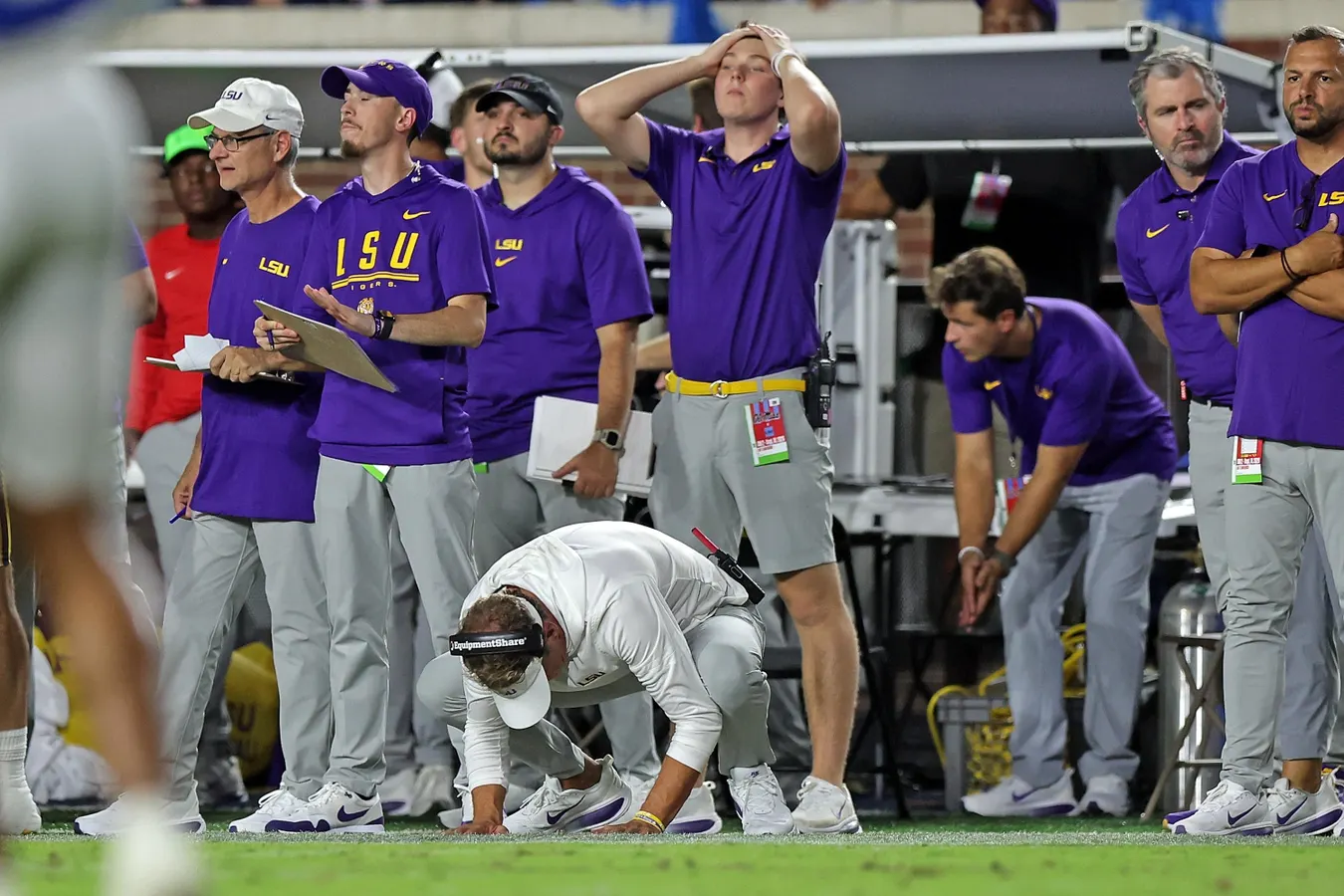

OXFORD, MISSISSIPPI – SEPTEMBER 19: Lane Kiffin of the Louisiana State Tigers reacts during the first half against the Mississippi Rebels at Vaught-Hemingway Stadium on September 19, 2026 in Oxford, Mississippi. (Photo by Justin Ford/Getty Images)
Getty Images
As much as the Bayou Nation gives financially to head coach Lane Kiffin and to everything else around Baton Rouge, Louisiana regarding LSU football, the Tigers aren’t allowed to lose.
They just aren’t.
If they do – which they did last weekend on the road around Kiffin’s old stomping grounds of Ole Miss – it will only accelerate the need to ask a couple of questions for the ages. Those questions involve, not only LSU and the Bayou Nation, but the state of Louisiana.
Why?
And where?
As for “why,” why do LSU officials have so much money for their athletics department in general and football program in particular?
According to The Athletic, LSU boasts the fourth-largest NIL (name, images and likeness) budget among Power 4 teams at $47 million to $50 million to trail only Ohio State ($49 million to $54 million), Oregon ($48 million to $54 million) and Texas ($45 million to $55 million.
If you go by nilstandard.com, the total value of the LSU football roster is $40.8 million, which is the third most expensive team in the country behind Texas ($47.5 million) and Oregon ($41.3 million).
Tiger Stadium also received $19.8 million in renovations heading into its 100th season in 2024. In addition, LSU pumped $28 million into a players lounge. Along with a movie theatre and a four-way air hockey table beyond the video games everywhere, each cubicle has a chair that can become a bed, and under each locker, there is ventilated storage for shoes.
Did I say the Tigers (2-1) aren’t allowed to lose? Not Saturday at home against Texas A&M, not the rest of the season, not ever.
And get this: While CNBC.com says LSU owns the nation’s 12th most valuable athletics department in the country at $1.05 billion, the latest research by U.S. News & World Report ranks Louisiana among the worst states in the country in opportunity (45th out of 50 states), natural environment (49th), infrastructure (46th), healthcare (45th), fiscal stability (43th), education (46th), economy (49th) and crime and corrections (50th).
Wait.
What?
Which bring us to “where.”
NORMAN, OKLAHOMA – OCTOBER 25: Head coach Lane Kiffen of the Ole Miss Rebels teases defensive lineman David Stone #0 of the Oklahoma Sooners for being ‘more quiet’ once the game was over at Gaylord Family Oklahoma Memorial Stadium on October 25, 2025 in Norman, Oklahoma. Mississippi won 34-26. (Photo by Brian Bahr/Getty Images)
Getty Images
Given those U.S. News & World Report numbers, especially involving financial matters, where does LSU get what appears to be an endless stream of revenue to do, well, um, whatever university officials wish to do regarding athletics, particular when it comes to blocking and tackling?
If you believe Louisiana governor Jeff Landry, his state and the taxpayers are a huge chunk of that money piece for LSU athletics.
Huh?
Since Kiffin’s Tigers remain the people’s choice among those with large and small pocketbooks around the Bayou Nation – despite everything (see those U.S. News and World Report rankings) – they have to keep winning and winning (and winning some more).
Either that, or the Tigers must figure out a way to transfer all of those waisted dollars on football to the public welfare.
So much for dreaming. LSU officials decided to snatch Kiffin away from College Football Playoff-bound Ole Miss in November after his 11-1 regular season with the Rebels. All it took for the nomadic coach to join the Tigers was a seven-year contract worth $91 million.
Kiffin also got an additional $500,000 since LSU agreed to pay the bonuses involved with his Ole Miss contract if Ole Miss made the CFP semifinals.
Ole Miss made the CFP semifinals.
Then there was this from Forbes.com:
* LSU offered Kiffin lucrative bonuses, including $750,000 for making the College Football Playoff, $1 million for winning the Southeastern Conference’s championship, and $3 million for winning the national championship.
* Another clause in the term sheet would bump Kiffin’s salary up to make him the highest paid coach in the NCAA if he wins a national championship (University of Georgia head coach Kirby Smart’s $13.3 million salary is currently the highest in college football).
* LSU offered to cover the difference for buying a new home in Louisiana, up to $500,000, according to ESPN.
This whole thing gets more baffling, but only if you’re still wondering about “why” and “where.”
Consider that weeks before LSU officials hired Kiffin, they whacked previous coach Brian Kelly after three-plus seasons. Landry told ESPN’s Pat McAfee that the state of Louisiana and its taxpayers were responsible for Kelly’s $54 million buyout, but an LSU board director later insisted to WDSU-TV in New Orleans that private funds would take care of the amount.
Whatever.
Private funds, university officials, the state of Louisiana, taxpayers, Santa Claus or the ghost of LSU legend Billy Cannon.
NEW ORLEANS, LOUISIANA – JANUARY 13: Head coach Ed Orgeron of the LSU Tigers reacts prior to the College Football Playoff National Championship game against the Clemson Tigers at Mercedes Benz Superdome on January 13, 2020 in New Orleans, Louisiana. (Photo by Jonathan Bachman/Getty Images)
Getty Images
Somehow, despite LSU residing inside one of the poorest states in the country (see U.S. News & World Report above), two former coaches for the Tigers and an incoming one were getting massive bucks at the same time from late November through the end of December when Ed Orgeron pocketed the final dollars of his $17 million buyout after he was fired before Kelly.
Sportico.com determined only Indiana’s Curt Cignetti at $13.2 million per season makes more as a college football coach these days than Georgia’s Kirby Smart and Kiffin at $13 million.
Now consider this:
* The USA Today says South Carolina’s Dawn Staley is the highest paid women’s college basketball coach at $4.2 million per year, and after UConn’s Geno Auriemma at $3.79 million, there is LSU’s Kim Mulkey at $3.35 million.
* No college baseball coach gets more per season than LSU’s Jay Johnson at $3.35 million.
* In March, LSU gave Matt McMahon an $8 million buyout to quit coaching its men’s basketball team, then the Tigers paid another $1 million to get rid of his assistants, and then they brought Will Wade back to town with a seven-year deal worth $30 million. They (private funds, university officials, the state of Louisiana, taxpayers, Santa Claus or the ghost of LSU legend Billy Cannon) also took care of Wade’s $4 million buyout at North Carolina State.
* Last September, when the other LSU departments compensated for lost federal research funds by returning 2% of the budgets they were given on July 1, the LSU Board of Supervisors voted to give a $1.67 million raise to Johnson and a contract to Julie Cromer as the Tigers’ new executive deputy athletics director and chief operating officer.
So where is LSU getting all of this money?
ATLANTA, GEORGIA – JANUARY 09: Indiana Hoosiers alumni Mark Cuban stands on the sidelines during the fourth quarter of the 2025 College Football Playoff Semifinal at the Chick-fil-A Peach Bowl at Mercedes-Benz Stadium on January 09, 2026 in Atlanta, Georgia. (Photo by Kevin C. Cox/Getty Images)
Getty Images
Let’s start with the endowment, which tells you the wealth and the influence of your average American university.
Never mind.
According to The USA Today’s Longhornswire, LSU’s endowment ranks 14th out of the 16 SEC schools at $1 billion.
Well, let’s go to alumni giving, where U.S. News & World Report placed the national average for universities at 8.6%.
The Advocate in Baton Rouge wrote LSU is at 6%.
That said, LSU gets huge donations from famous alums for its athletic department overall. Former Tigers football stars Tyrann Mathieu and Patrick Peterson each contributed $1 million toward that players lounge, and Shaquille O’Neal said he’s giving $400 million toward the building of a new basketball arena.
It’s just that a slew of others are as (or more) financially impressive with their colleges, including Mark Cuban, who helped to bankroll Indiana’s quick rise in football glory with undisclosed millions and millions.
Ever hear of Phil Knight? He’s the co-owner of Nike. He has given more than $1 billion to Oregon, his alma mater, and with a monster jolt from his NIL company for the Ducks called Division Street, he has made them a perennial CFP contender while supplying them with an everchanging wardrobe.
Here’s the bottom line for LSU: When it comes to athletics overall and football in particular, the Tigers have more folks per capita willing to throw pennies, nickels and dimes their way than anybody.
You know, despite everything.
Like those U.S. News & World Report rankings.













Leave a comment