


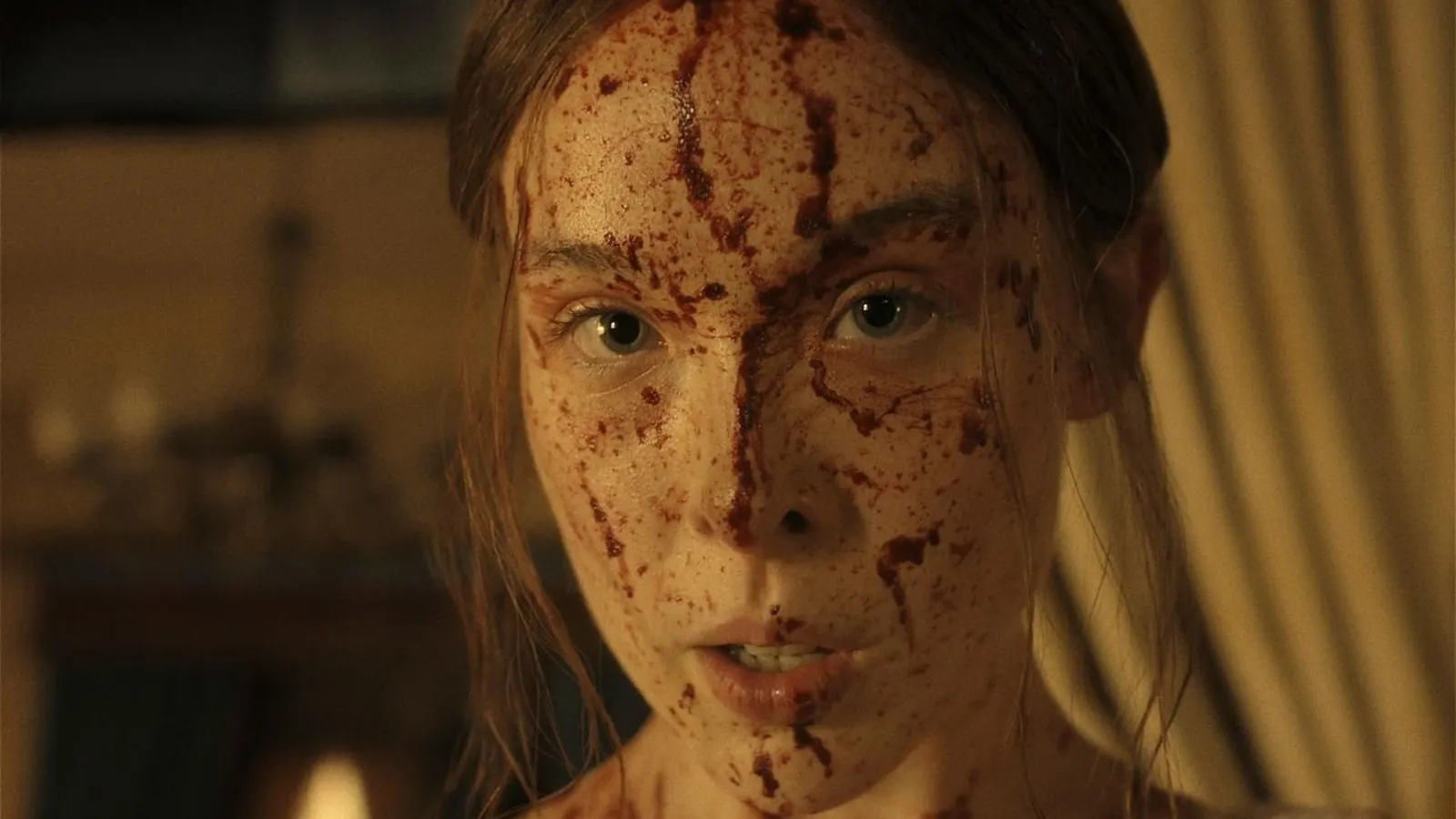

Ella Beatty in ‘Monster: The Lizzie Borden Story’ on Netflix.
PHOTO COURTESY OF NETFLIX
Max Winkler has become a familiar presence behind the camera in Ryan Murphy and Ian Brennan’s Monster universe, directing some of its most gruesome murder scenes. But despite his work depicting horrific crimes, Winkler’s fascination lies beyond the blood and brutality. He’s more interested in understanding what drives people to violence.
The son of Emmy-winning actor Henry Winkler, he has carved out his own career as a director, writer, and producer, becoming a mainstay in Murphy and Brennan’s TV empire.
It’s easy to see why. Whether or not Winkler considers himself a perfectionist, his meticulous work speaks for itself.
“I’m not super interested in violence. I don’t like horror. I don’t like scary things. I don’t watch scary things,” Winkler, who also served as an executive producer, said in an interview before the September 17 premiere of Monster: The Lizzie Borden Story.
This is the fourth installment of Murphy and Brennan’s Monster anthology series. The eight-episode season explores the infamous Lizzie Borden case. Brennan created and wrote the season, which follows previous installments focused on Jeffrey Dahmer, Lyle and Erik Menendez, and Ed Gein.
Director Max Winkler and Ella Beatty behind the scenes while filming ‘Monster: The Lizzie Borden Story’ for Netflix.
PHOTO BY SUZANNE TENNER/NETFLIX
“What I’m interested in when I’m directing are the characters and how to get there and how to make it feel like it’s character-driven,” added Winkler. For him, the real fascination lies in the trajectory of a person’s life: what shapes them, what drives them, and ultimately, what leads them to kill.
“It’s about what it takes for somebody to get to the point of violence. I don’t believe people are born violent. It’s the transformation of what a person is capable of once pushed to their limits. That’s what I find interesting. It’s a slow boil. You feel that. It’s an evolution.”
This season focuses on Lizzie Borden, the 32-year-old Massachusetts woman accused of brutally murdering her father, Andrew Borden, and her stepmother, Abby Borden, with an ax inside their Fall River home on August 4, 1892.
Ella Beatty as Lizzie Borden in ‘Monster: The Lizzie Borden Story’ on Netflix.
SUZANNE TENNER/NETFLIX
Lizzie was portrayed as the repressed daughter of a wealthy New England family, trapped in a house where she was constantly ridiculed and abused by a cruel stepmother and a father who failed to protect her. Everything changed when her parents hired a new maid who helped bring out her rebelliousness and fight back, and she did so with an ax.
Lizzie was arrested and charged with the killings, sending shockwaves across the nation. But one question fascinated the public: Could a woman really have been capable of such heinous crimes? The case would become one of the most notorious murder trials in American history. At her 1893 trial, prosecutors argued that Lizzie had both the motive and opportunity to kill her father and stepmother, but the evidence against her was largely circumstantial.
The jury deliberated for only 90 minutes before acquitting her. No one else was ever convicted of the murders, leaving the case officially unsolved to this day. Lizzie lived out her life in Fall River, eventually moving into a home with her sister, Emma, where she died in 1927 at age 66.
Winkler, who has become a go-to director for Murphy and Brennan’s Monster franchise, directed six of the eight episodes of Lizzie Borden’s story, with Sarah Adina Smith directing two episodes.
Winkler also directed an episode of Monsters: The Lyle and Erik Menendez Story in 2024 and six episodes of Monster: The Ed Gein Story in 2025. But he did get a break from murder, directing the pilot of Love Story: John F. Kennedy Jr. & Carolyn Bessette.
For Winkler, bringing Lizzie’s story to the screen began with a massive undertaking. The opening sequence, depicting the killing of her father and stepmother, took several days to film. Rather than build toward the murders and show the audience why and how Lizzie reached that point, the series thrusts viewers directly into the violence.
Winkler explained the thinking behind that creative choice. “We know Lizzie Borden from this nursery rhyme. We know the legend of it and the heightened version of this crazy girl who killed both of her parents. Starting with the little toy piano and the nursery rhyme itself was the heightened version of that. It’s what we think a murder looks like. This is the most idealized version of how she did it.”
He described the series as an origin story of a woman accused of one of the most horrific crimes imaginable, with the opening scenes depicting how people might imagine the murders happened.
“This is the best, most heightened version of this brutal experience. And then you actually see who the person is who did it and how she got there. You see the murders again in the show, and it will be much sloppier and in a realistic way.”
Ella Beatty in ‘Monster: The Lizzie Borden Story’ on Netflix.
PHOTO COURTESY OF NETFLIX
We watch the killings and then flash back to Lizzie’s life before and what led her down this path. We see a sweet, innocent young woman who has been relentlessly verbally abused by her stepmother. Her father fails to protect her, basically turning a blind eye.
When asked what he learned about Lizzie Borden in his preparation and research, Winkler told me that he empathized with how she was treated. “There was the societal madness of treating women like oxen. I’m aware of inherent sexism in, you know, almost every culture and society in the world since time began, obviously.”
He especially sympathized with women of that era who were forced out of their family homes and into oftentimes undesirable marriages. “Having to be someone else for the very hope that somebody in town that’s not even desirable will marry you and take you off your parents’ hands is devastating and dehumanizing. It takes away anything about you that is alive and turns you into a blunt object. It shows what societal cages and constraints can do to a person. That can gaslight you and make you feel crazy.”
When asked how he prepared to direct such physically violent scenes, Winkler credited his team, including Academy Award-nominated cinematographer Michael Bauman, who served as director of photography on the limited series. It marked their fifth collaboration. “He’s a genius,” said Winkler of Bauman.
Winkler also noted how incredible his producer and AD were to work with, as well as the scripts and talented cast. “I am neurotic, so I prepare, prepare, prepare. The opening sequence is probably the most ambitious thing I’ve ever done with a camera, and required lots of old tricks that we did, because it was all done practically. You know, descending the stairs, the handoff of the cameras, and going from upstairs to downstairs.”
Charlie Hunnam as Andrew Borden and Rebecca Hall as Abby Borden in ‘Monster: The Lizzie Borden Story’ on Netflix.
PHOTO COURTESY OF NETFLIX
The series stars Ella Beatty as Lizzie Borden, alongside Charlie Hunnam as Lizzie’s father, Andrew, and Rebecca Hall as her stepmother, Abby.
Rounding out the cast are Vicky Krieps as the Bordens’ new, and very eccentric, live-in maid, Bridget “Maggie” Sullivan; Billie Lourd as Lizzie’s older sister, Emma Borden; Jessica Barden as Lizzie’s close friend, Nance O’Neill; Sarah Paulson as notorious serial killer Aileen Wuornos; and Joey Pollari as John Morse, Lizzie’s maternal uncle and a historical suspect in the murders.
Winkler also credited Brennan’s writing for drawing him into the series. “The scripts made my head explode. I thought the writing was so alive and funny.”
Ella Beatty and Vicky Krieps in ‘Monster: The Lizzie Borden Story’ on Netflix.
PHOTO COURTESY OF NETFLIX
Of Lizzie Borden’s story, Winkler recalled a favorite play, Noises Off, written by English playwright Michael Frayn. The farce follows a chaotic touring theater troupe attempting to stage a cheesy sex comedy, with the backstage drama becoming as unruly as the play itself.
“I always felt like there was this Noises Off quality to this, almost like The Age of Innocence on acid or something like that, where we’re getting to see a little bit more behind the curtain of the hysteria that everybody was living by having to pretend to be fine for so much of it.”
Ultimately, this telling looks beyond the legend to the woman behind it and asks what happens when a lifetime of repression, cruelty, and being silenced finally reaches a breaking point.










Leave a comment