


Topline
Meta’s personal artificial intelligence agent Muse has reached 5 million downloads in 22 days, new data shows, outpacing rival AI assistants to establish the social media giant as the early frontrunner in consumer personal agents and setting Meta up to rake in billions of dollars in new subscription and transaction fees.
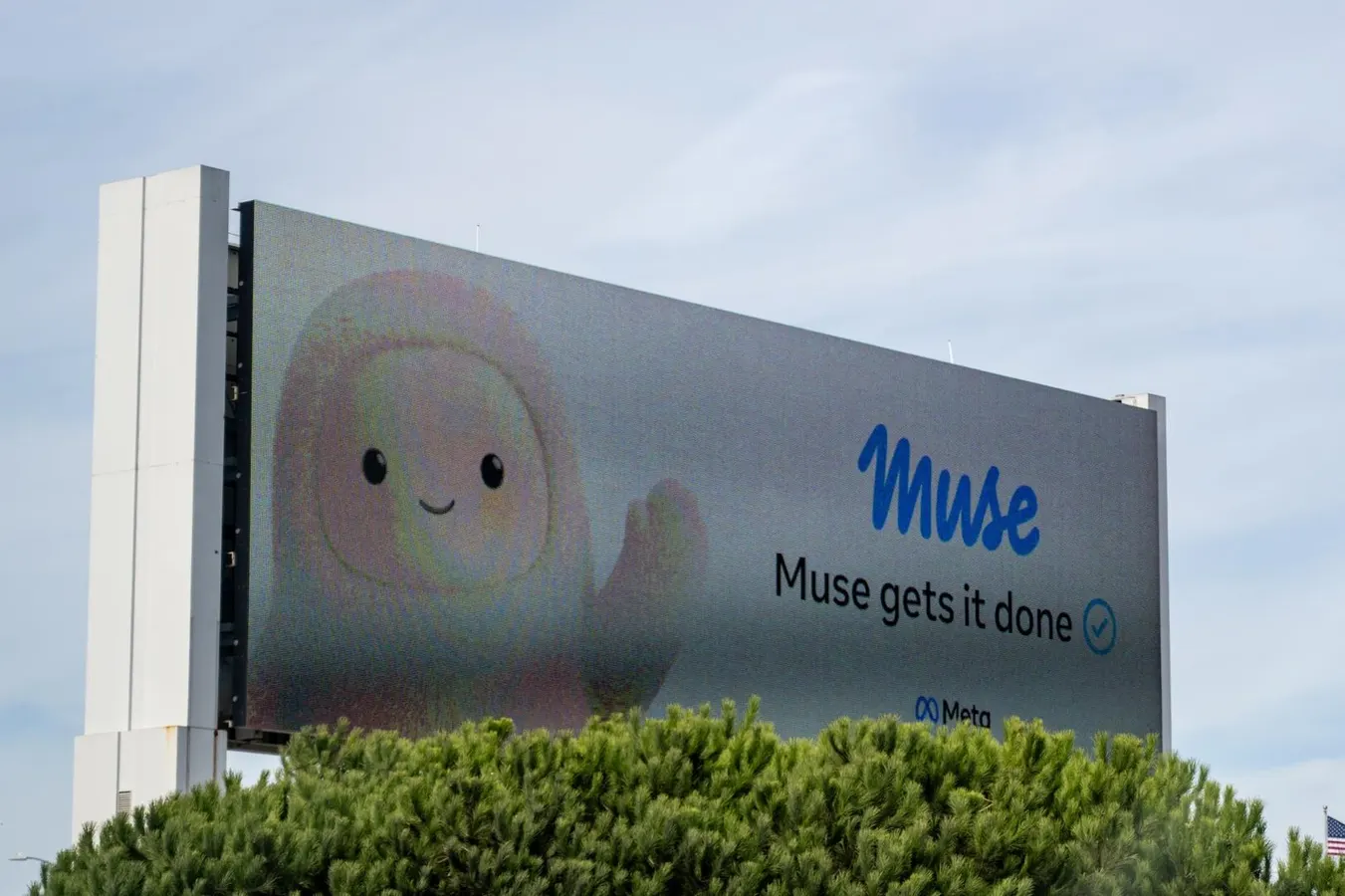
Digital billboard showing an advertisement for Meta Muse.
Gado via Getty Images
Key Facts
Data from Sensor Tower, a market intelligence firm, shows Muse has amassed over 5 million U.S. downloads since its launch on Sept. 8, when it immediately jumped to the top of the U.S. Apple App Store charts.
The feat places it well ahead of OpenAI’s ChatGPT, X’s Grok and Anthropic’s Claude (which hit the milestone in 56, 103 and 492 days, respectively) and makes it one of only 23 apps to have hit 5 million downloads within 22 days of launch, per Sensor Tower.
The firm’s data shows that Meta worked overtime to push Muse ahead of its peers with an aggressive advertising push that allocated up to 50% of Meta’s daily house ad inventory to the app and positioned it among the top 15 U.S. brands by advertising impressions last week.
The success of Muse is a major boon for Meta, which was struggling under the weight of its massive AI infrastructure spending—the company expects $130 billion to $145 billion in capital expenditures this year, mostly on AI, which spooked investors earlier this year.
But the short term success of Muse, which can cost users up to $100 per month, gives concrete evidence that Meta can generate immediate subscription returns and lays the groundwork for other recurring revenue streams.
SURPRISING FACT
Of the 23 apps have reached over 5 million U.S. downloads within 22 days, about 85% were mobile gaming apps, including Fortnite, Pokemon GO and Candy Crush. Only three apps on the list aren’t for gaming: Disney+, HBO Max and Threads, which received about 20 million, 18 million and 14 million downloads over the same time frame, respectively, according to Sensor Tower.
WHAT TO WATCH FOR
How Meta monetizes Muse. The AI assistant does have a free tier for everyday use but offers two paid subscriptions for power users: $20 per month for users who need higher usage limits for continuous background tasks and automations and $100 per month for users with constant agent activity. Meta has also said it plans to monetize Muse in part by taking small affiliate cuts when Muse executes purchases, bookings or financial deals on a user’s behalf. Meta can also monetize its enterprise ecosystem by charging other businesses per-action fees to integrate Muse with business productivity platforms like Zoom, Intuit and Slack.
BIG NUMBER
$28.5 billion. That’s how much Muse could generate for Meta by 2030, according to the Wall Street Journal.
CONTRA
Skeptics and tech analysts have raised doubts about whether Muse’s initial popularity is sustainable. Jason Aten, a tech columnist at Inc. Magazine, argued the rapid downloads are driven by curiosity and that initial consumer fascination could drop off as user friction sets in. Business of Apps, an industry data platform, said Muse could go the route of Amazon’s Alexa—noting that while tech giants expect users to adopt AI for shopping and commerce, consumers frequently default to simple, non-monetizable uses instead. Market analysts writing for Seeking Alpha said the early hype could be driven by Meta spamming its billions of existing social media users with links, not by users that will translate into paying subscribers or recurring active users.
Key background
Meta launched Muse earlier this month as an autonomous AI assistant that can book travel, send emails and manage connected home devices. The company’s billionaire CEO, Mark Zuckerberg, described Muse as a step toward delivering “personal superintelligence” across Meta platforms. The product rollout comes amid Meta’s broader strategic shift toward high-margin software subscriptions and agentic commerce, but has also drawn scrutiny from analysts and corporate rivals over data privacy, user retention and web-crawling friction. Amazon last week blocked Muse from making purchases or browsing on Amazon.com, citing unauthorized automated browsing and security risks. Open AI on Tuesday launched Dots, its “always-on” AI agent app, as a direct Muse competitor.
TANGENT
Meta’s stock has rallied about 30% in the lead up to and launch of Muse, and the company is inching toward hitting a $2 trillion market cap, which would put it in the company of only a few tech giants (including Apple, Microsoft, Nvidia and Alphabet) to have hit the milestone. Meta shares were trading at $578.54 on Sept. 1, which rose to $613.48 on the day of the Muse launch and hit $731.61 on Wednesday, a 27.8% rise from the start of the month.
FORBES VALUATION
Zuckerberg, who owns about 13% of Meta, has seen his personal wealth rise along with the company’s stock price. Zuckerberg’s net worth sat at about $203 billion on Sept. 7, the day before Muse’s launch, and he’s now worth an estimated $250.2 billion as the sixth richest person in the world.
















Leave a comment