


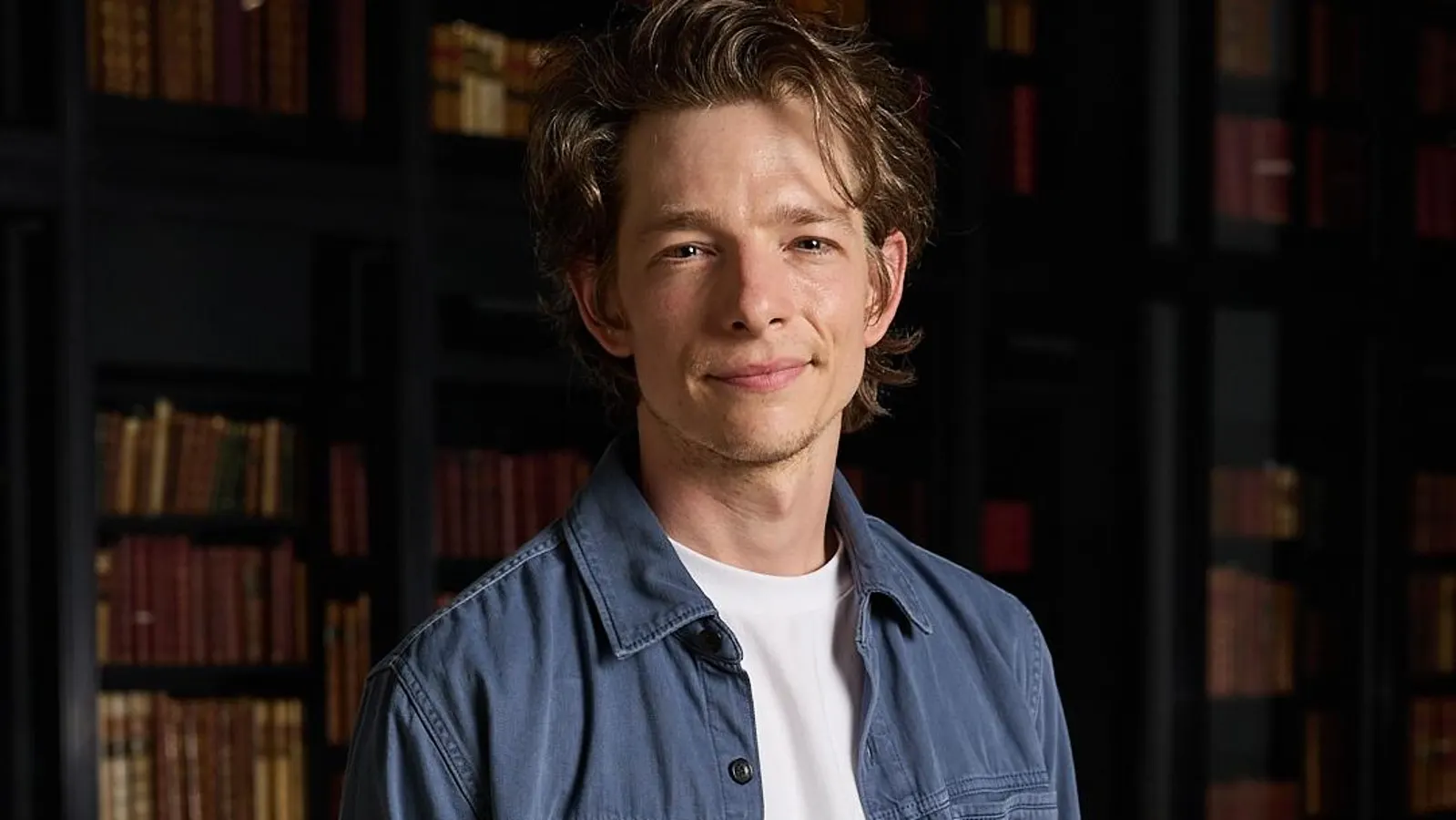

Mike Faist in a photocall for Netflix’s “East of Eden.”
John Phillips/Getty Images for Netflix
Warning: Spoilers ahead for Netflix’s East of Eden.
Mike Faist is the first to admit he doesn’t have a carefully calculated career plan.
“The reality is that I always knew I wanted to be an actor,” Faist, who stars as Charles Trask in Netflix’s new East of Eden adaptation, says. “I moved to New York when I was 17 years old, and one of the first things that’s almost mandatory as an actor in New York is to watch East of Eden because of two things: Elia Kazan and his legacy of the films that he’s directed, that whole era of filmmaking and all of the actors that that man found and put on screen for cinema in general, — and James Dean. James Dean was this actor that I was absolutely enamored by, and Giant, to this day, remains one of my favorite of his films.”
So, when actor and writer Zoe Kazan, the granddaughter of Elia Kazan, approached Faist about a role in her reinterpretation of John Steinbeck’s bestselling multigenerational novel, the answer was obvious.
“There’s two things that go through your mind,” Faist says. “There’s the ‘Hell yeah, let’s do this and let’s get to work.’ And then the other one is fear, because you don’t want to mess up. That’s the reality. And honestly, that is kind of the only feeling that I’m really searching for within any of this. You want things that are exciting to you and that are going to push you, and also that terrify you.”
Mike Faist in “East of Eden.”
Netflix
Faist enjoys playing complicated, sometimes contradictory, characters.
He made his Broadway debut as Connor Murphy, a lonely, angry high schooler with a drug addiction, in Dear Evan Hansen, earning a Tony nomination and a Grammy win. Then, in Steven Spielberg’s 2021 West Side Story remake, Faist starred as Riff, the impulsive but charismatic and loyal leader of the Jets gang, and earned a BAFTA nomination for his performance.
Luca Guadagnino’s heart-racing tennis drama Challengers, co-starring Zendaya and Josh O’Connor, took Faist’s career to the next level (and arguably boosted public interest in the sport). In the 2024 movie, he played Art Donaldson, a Grand Slam winner and perfectionist who, off-court, is a yearner riddled with insecurities.
With East of Eden, Faist is adding to his collection of complex characters. In the seven-episode limited series, Faist plays Charles, the story’s volatile, wounded equivalent of Cain from the biblical story of Cain and Abel. East of Eden explores the dynamic between Charles and his brother Adam (Christopher Abbott), the embodiment of good and the Abel figure, and how schemer and manipulator Cathy Ames (Florence Pugh) drives a wedge between them.
Faist points to the first episode as establishing how Charles’ childhood shaped him into a man quick to anger and violence toward his brother. The favoritism their father shows Adam, combined with Charles’ desperate need for love and validation, drives him to act on jealousy and lash out at his brother. While Adam is sent away to the army against his will, Charles becomes isolated, forced to stay behind and run their cold childhood home and farmland.
Faist says that playing a character consumed by violence or anger is “simple.” But someone like Charles, raised to believe he has an innate badness within and actively working to be anything but, makes for a “compelling wrestling match.” And for all Charles’ unfavorable traits, the fact that he’s trying to be better felt “very human” to Faist.
When Adam returns home years later, Charles sees it as an opportunity to make amends and repair the damage he did as a child. That intention of repairing their brotherly bond is thrown into disarray by the arrival of a bloody and bruised Cathy on their doorstep one night.
Florence Pugh and Mike Faist in “East of Eden.”
Netflix
Charles immediately grabs a gun and points it at her, while Adam springs into action, picking her up and later nursing her back to health. Cathy ends up overstaying her welcome, ingratiating herself into their home, and marrying Adam — despite Charles’ warning that Cathy will tear Adam to shreds and he doesn’t want to witness it.
Faist says Charles’ icy dynamic with Cathy goes back to a key concept from Steinbeck’s novel: kind recognizes kind.
“I’m not sure if Charles can necessarily pinpoint exactly what that is in terms of words, but there is an aura, there’s something there,” he says, explaining that his character works hard to be a good person, but he sees his own darkness mirrored in Cathy.
Charles is drawn to Cathy, and they have a brief affair at the end of episode two.
“It probably is this shared recognition of each other,” Faist explains. “I think there is this other thing in humans, this desire to see and be seen is a very real thing.”
Faist says that acceptance and feeling seen for who you are can be misconstrued as genuine love. Throughout the story, his character searches for love, whether from his father or his brother. When Cathy enters the picture and relates to Charles, that desire overtakes him.
Mike Faist as Charles Trask, Christopher Abbott as Adam Trask and Florence Pugh as Cathy Ames in “East of Eden.”
Netflix
Although Charles dies off camera due to a lung illness, he comes back as a voice inside Cathy’s head, near the end of her life, as she begins losing her authority and her grasp of reality. Eventually, Charles’ presence disappears entirely, leaving Cathy utterly alone.
“I wanted to be there on set with Florence to do these voices because when you’re acting, you really want to make sure that you’re giving everything you can to the person that is there so you can capture on film everything that you want to,” Faist recalls, explaining that as conversations continued with Kazan, it evolved into Charles being there not just as a voice, but as a full-blown hallucination.
Kazan’s adaptation is framed around Cathy’s experience, and the series is bookended by Cathy being likened to Alice from Alice in Wonderland, falling into a rabbit hole. In a full-circle moment, Faist recalls Pugh comparing Charles to the mischievous, grinning Cheshire Cat as they filmed the later scenes as a figment of Cathy’s imagination.
“I think she was right, but it wasn’t necessarily intentional,” he says.
As for Faist’s next move after East of Eden, your guess is as good as his.
“I don’t have too much thought about it,” Faist says. What always ends up happening is that a project will come along one day — and this is just what has happened every single time — and then I’ll be faced with the choice where it’s either: I can’t believe that I’m excited about this and I can’t believe how terrified I am to do it.”
“When I met Charles, I felt that immediately,” he adds. “You just know upon meeting the character and the project and the people that you want to work with, what it is in the moment. All you can just try to do is stay open and be present, and allow that to come in when the time is right.”
East of Eden is streaming on Netflix.














Leave a comment