


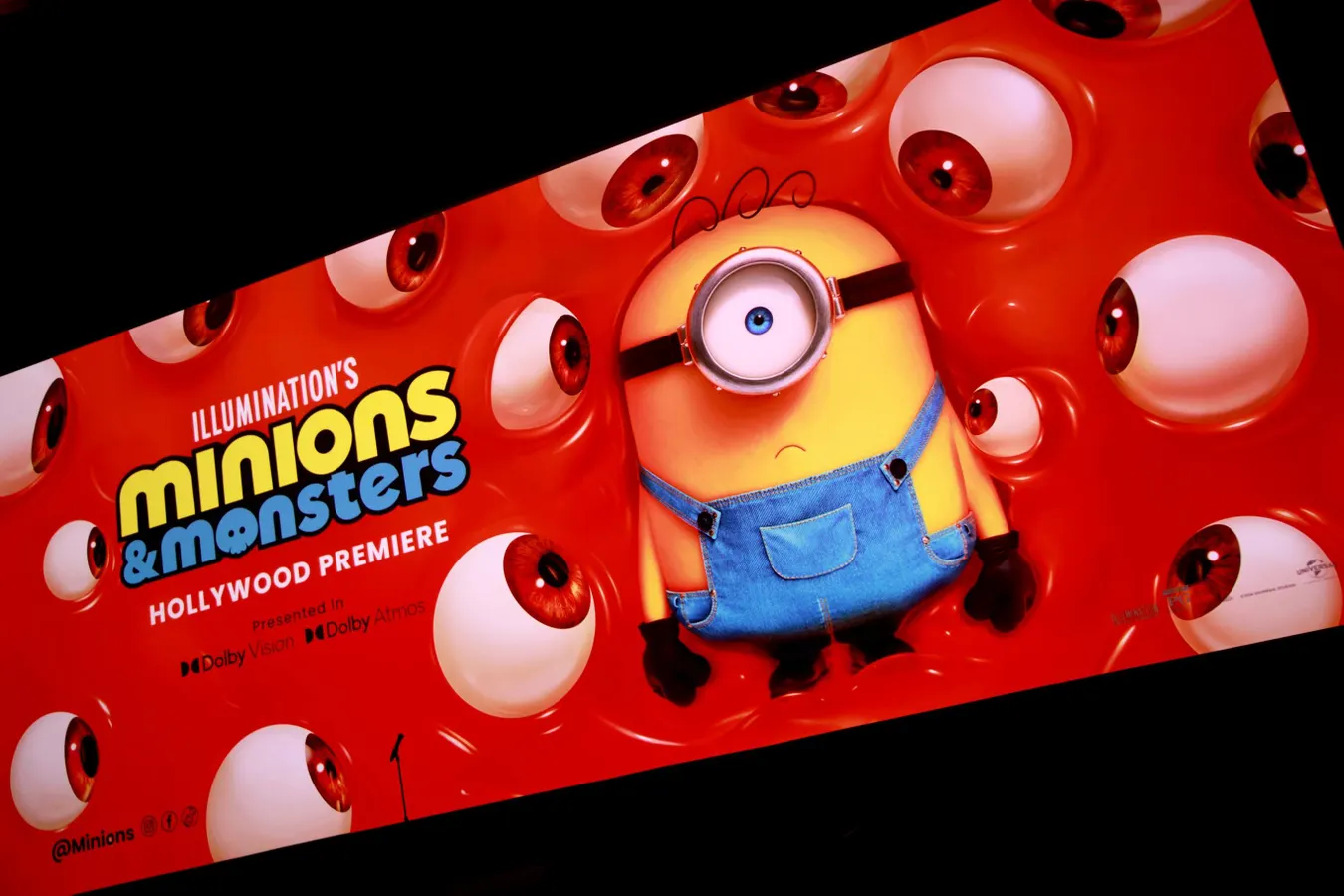

HOLLYWOOD, CALIFORNIA – JUNE 28: Signage is seen as Illumination and Universal Pictures presents the premiere for “Minions & Monsters” at Dolby Theatre on June 28, 2026 in Hollywood, California. (Photo by Savion Washington/Getty Images for Illumination And Universal Pictures)
Getty Images for Illumination And Universal Pictures
The appeal of the popular Minions characters may be fading in the United States. The latest installment of the franchise, Minions & Monsters, is failing at home and thriving everywhere else, which underscores the appeal of pop culture as an American export even as domestic audiences are indifferent to the movie’s themes steeped in Hollywood lore.
The film opened to a franchise-low $61.4 million over five days domestically, a steep drop from Despicable Me 4’s $120 million and Minions: The Rise of Gru’s $122 million over the same July 4th frame. Internationally, it pulled in roughly $98 million in that same window, pushing its global box office near $160 million and outgrossing its domestic haul by a wide margin.
Minions & Monsters is a love letter to Old Hollywood, and that pitch is connecting with audiences outside the United States who don’t already live inside the mythology the movie is selling. The film is on track to turn a healthy profit against its $85 million budget, driven almost entirely by that overseas performance, while the domestic numbers read as a shrug.
Hollywood Is America’s Best Story About Itself
The popularity of Americana with U.S. visitors during the 2026 FIFA World Cup is a reminder that one of America’s strongest exports is American culture. Hollywood is shorthand for America itself. The idea that anyone can show up with nothing and become a star is a story America tells about itself constantly. To someone standing outside that story, it plays as legend.
Minions & Monsters follows the Minions rising to stardom as silent film actors in 1920s Hollywood, then losing everything when sound arrives and audiences can no longer understand a word they say. A German or Mexican audience watching that story is watching a foreign country’s founding myth dramatized. An American audience watching the same thing is watching their own wallpaper if they are expecting another playful Minions movie without the subtext.
Minions & Monsters may have appealed to a narrower audience at home, too. A film built on sincere affection for Old Hollywood can charm critics and studio executives if done well, but that kind of reverence might be sitting awkwardly inside a franchise defined by slapstick and toilet humor. Minions & Monsters kept its familiar chaos intact, but its turn toward sentiment may have left behind some of the pure silliness that built its core audience at home. Families looking for a story about kids and animated toys had Toy Story 5 playing next door. Leaning into nostalgia meant setting aside the goofiness that had always been this franchise’s biggest advantage domestically.
The Minions Never Needed Subtitles
The appeal of the Minions characters outside the United States may also come down to something as fundamental as how the characters communicate, almost entirely through slapstick and nonsense syllables, which sidesteps the dubbing and translation problems that limit how far most American comedy can travel abroad.
The choice was deliberate, according to the franchise’s creative team. Minionese blends fragments of half a dozen languages, English, French, Spanish, Japanese, Chinese, and others, so the dialogue would feel familiar to audiences everywhere rather than tied to any one country. The meaning was never meant to live in the words themselves but in tone, pace, and rhythm, the same way a listener can tell an argument from a joke without understanding a language at all.
That approach asks something similar of the audience: a small amount of active attention that a screen playing in the background can’t earn. That demand turned into an asset. Because the Minions rarely say anything a viewer can pin down, audiences have spent a decade filling in the blanks themselves, turning the characters into a blank canvas for whatever emotion or joke a meme needs them to carry, a habit that has made them equally beloved by toddlers and grandparents scrolling Facebook.
In Minions & Monsters, that design choice becomes the plot. The Minions lose their Hollywood careers because sound arrives and nobody can understand their language, the same problem the real franchise solved 16 years ago by never giving its characters intelligible dialogue in the first place. The workaround is the joke, and the joke is the point, which translates well to a non-U.S. market.
‘Minions & Monsters’ Could Be A Slow Burn
Minions & Monsters carries a 90% Rotten Tomatoes score and an A- CinemaScore, marks that suggest the film may find a wider audience over time. Critics have pointed to a more layered, satirical tone than past entries, paired with visuals stocked with references to Hollywood’s golden age.
A more ambitious, more emotionally grounded Minions movie may simply take longer to find its audience, particularly once it reaches streaming.
Whatever the film’s final domestic tally, the Minions remain one of the most reliable merchandising engines in family entertainment, a business that will keep generating toy, apparel, and licensing revenue long after this movie leaves theaters.















Leave a comment