


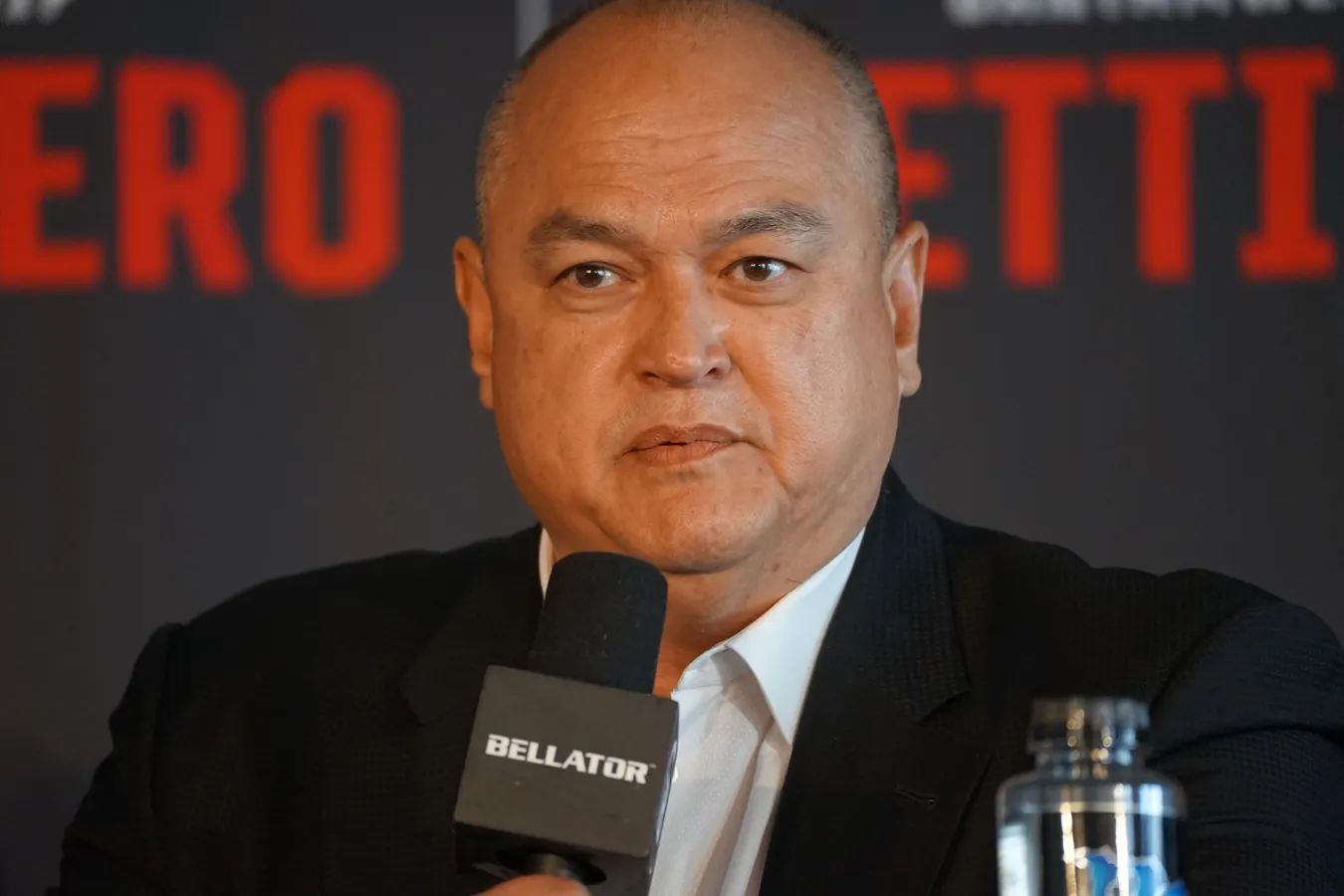

CHICAGO, IL – JUNE 14: Bellator president Scott Coker speaks to the media at the Bellator 297 pre-fight press conference on June 14, 2023, at the Willis Tower Sky Deck in Chicago, IL. (Photo by Amy Kaplan/Icon Sportswire via Getty Images)
Icon Sportswire via Getty Images
Scott Coker is a legend in the business of MMA promotion. Coker is the man behind the successful Strikeforce brand and he led Bellator up until the promotion was acquired by the Professional Fighters League. After taking some time away, Coker has decided to get back into MMA promotion.
I spoke with Coker to discuss the plans and structure for his new global MMA league which has raised $60 million in funds with investors like Tony Hawk and others, per information provided to me and other members of the media.
Why Is Scott Coker Returning To MMA?
I asked Coker what made him come back after stepping away from Bellator. He said the decision started with serious reflection about his legacy.
“When I finished my relationship at Bellator, I took about six months off and I really thought about what is it that I want to do,” Coker told me. “Is it nothing? Maybe I just don’t do anything and just go to the golf course every day and hit some balls and retire. But I just felt like I had so much energy left.”
The pull back in came from the co-founder of his new league, Peter Levin of Griffin Gaming Partners, who, as Coker explained, kept pushing him to map out a plan and run it again.
Once he committed, the pieces came together quickly
“We took it to market and, surprisingly, it was 90 days later, 100 days later, we were fully ready to go,” he said. His stated motivation is a sense that the sport has cooled, and the remedy is the thing he believes he does best. “MMA’s in a little bit of a downward period,” Coker said. “We got to go build some new stars and that’s really what it comes down to.”
This is the area where he believes his track record at Strikeforce and Bellator speaks loudest.
What Will Scott Coker’s New MMA League Look Like?
When I asked about structure — seasons, teams, promotion and relegation — Coker first wanted to clarify his terminology.
“When I say league, I just want to clarify that what I mean by that is, I look at the UFC, I look at all these other companies, in my mind I call them a league,” he explained. “So it’s really a promotional company. This will be a super fight division and there will be a tournament component to it.”
I asked Coker about structure. Is this a league in the same sense as a traditional sports league with teams or something else? Coker was careful to clarify his use of the word “league.”
That hearkens back to the tournament-and-champion model that defined his Bellator years. Coker said the finer details are still being settled, adding, “give us a couple more weeks and we’ll have something else to tell you.” He was most animated about the investor group’s reach into collectibles and gaming.
“I’m a collector myself. I love the sports card industry and I love all the collectibles,” he said of the planned Upper Deck collaboration. He also pointed to video games and toys as future verticals: “There’s going to be a license opportunity for the video game, there’ll be a licensing opportunity for toys, and there’ll be the trading card piece.”
The investor mix spans traditional sports, gaming, betting and collectibles, and Coker is openly excited about a creative collaboration with trading card company Upper Deck.
Trading cards and collectibles are seeing a rise in popularity, but stars are a major piece of that puzzle. The league will need fighters the public cares about to fuel interest for collectibles.
He also pointed to video game licensing and toys as verticals the company intends to explore, given Levin’s background in the gaming space. The video game avenue is an interesting one because it creates an opportunity for Coker’s league to make a splash adjacent to the direct product.
If Coker and his group can partner with a development team capable of producing a stellar MMA game that does everything EA UFC does and things it cannot because of the license to the TKO group, there’s something real worth exploring.
The game’s popularity could help aid the building of stars while also producing revenue attached to the promotion’s brand.
How Will Fighter Pay And Freedom Be Different?
This is a big one for fighters and thus for fans too.
Given that fighters across the sport — particularly in the UFC — frequently say they feel underpaid, I asked Coker how his pay structure would beat the market. He pointed to his Strikeforce template.
“The one thing we did in Strikeforce that we’re talking about is, we paid 58% of the revenue into fighter purses,” Coker said. He framed the new venture as a check on any single promotion’s power. “If you’re the only player left in town, you can kind of dictate the pay scale. Now we’re going to add more money into the pool, so fighters will have some options of where they want to go.”
On whether fighters would get freedom to box or co-promote — the kind of freedom Francis Ngannou once sought — Coker positioned himself as an early adopter of collaboration.
“If you look at my background, I’m probably one of the first adapters to co-promote and do fighter sharing with Pride way back in the day,” he said. “Collaborating with other leagues definitely is going to happen. Fighters first — that’s what we’re going to do.”
That openness lines up with where the broader market is heading. MVP co-founder Nakisa Bidarian recently told me he’s open to co-promoting with the PFL and others after the promotion’s record-setting Netflix debut, and Ngannou’s own highlight-reel knockout under the MVP banner showed how crossover stars thrive with room to move.
How Will Coker Build The Next MMA Stars?
Star identification is the part of the business Coker believes he does better than anyone, and I asked what a 22-year-old prospect’s path would look like in his promotion. He answered with a roster of names he built from scratch.
“Daniel Cormier, no fights. Tyron Woodley, no fights. Luke Rockhold, no fights,” Coker said. “I’ve taken these kids from no fights and eventually built them up to where they’re some of the biggest stars of the sport.”
He was also the first person to give Ronda Rousey a chance on a major stage when he signed her in 2011 after just two pro MMA fights.
For Coker, the formula goes beyond fighting ability — it’s charisma and the intangible he learned to value in Japan.
“It’s more than just fighting to me. Can they speak well? Do they have that certain charisma, that X factor?” he said. He compared it to what made him sign Cormier after a single conversation: “He started talking and I said, you should be a commentator. There was something about him I could feel.”
A scout team is forming now to, as Coker put it, “scour the planet” for the next star — and the promotion’s name, he said, will be revealed soon.
Coker shared the origin story of meeting Cormier at a restaurant with no fights to his name, telling him he should be a commentator before ever seeing him compete. Coker says he knew Cormier would be a star early on.
The company is assembling a global scout team now, with Coker describing the process as “mining” the planet for the next star. The promotion’s name has not been revealed yet, but Coker said that announcement is coming soon.
I’m intrigued as there can never be too many viable MMA promotions to cover and for fans to watch.












Leave a comment