


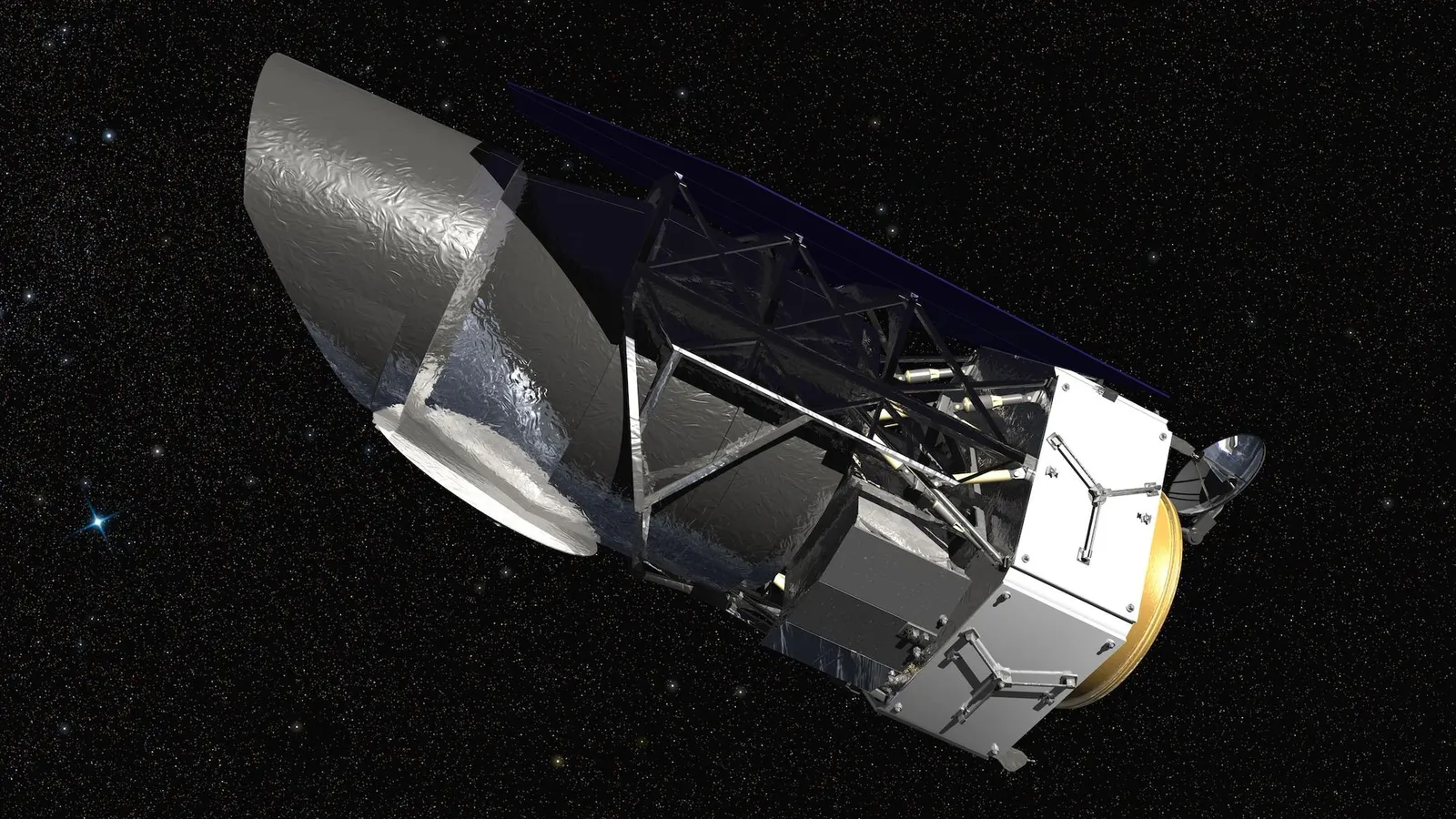

WFIRST, shown here in an artist’s rendering, will carry a Wide Field Instrument to provide astronomers with Hubble-quality images covering large swaths of the sky, enabling several studies of cosmic evolution. Its Coronagraph Instrument will directly image exoplanets similar to those in our own solar system and make detailed measurements of the chemical makeup of their atmospheres.
NASA’s Goddard Space Flight Center/Conceptual Image Lab
NASA’s next flagship observatory, often described as a successor to the Hubble Space Telescope, is about to leave NASA’s Goddard Space Flight Center in Maryland and head to Kennedy Space Center in Florida for final launch preparations ahead of a planned launch as early as September aboard a SpaceX Falcon Heavy rocket.
In an announcement on Monday, June1, NASA said that the recently completed Roman Space Telescope would travel aboard NASA’s Pegasus barge, with its eventual lift-off planned for Launch Complex 39A.
The journey marks the beginning of the final chapter before launch for a mission that could fundamentally change astronomers’ understanding of both the universe and the planets that populate our galaxy.
A New Era Beyond Hubble
Named after NASA’s first chief astronomer and the woman often called the “Mother of Hubble,” the Roman Space Telescope combines a Hubble-sized 2.4-meter mirror with a field of view roughly 100 times larger than Hubble’s.
That unique combination will allow Roman to generate the first sweeping panoramic views of the universe, helping scientists investigate dark energy, study cosmic evolution and search for planets beyond our solar system.
While Hubble has transformed astronomy with its deep, narrow observations of objects, Roman will be able to scan enormous regions of the sky, potentially revealing millions of previously unseen cosmic objects. A key goal for Roman will be to discover a new kind of exoplanet.
This plot shows currently known exoplanets, with different categories highlighted. Roman will help fill in the bottom-right of the plot by finding small worlds in large orbits.
NASA/Ames Research Center/Natalie Batalha/Wendy Stenzel
Searching For 100,000 New Worlds
Scientists expect the mission to identify around 100,000 new planets, a dramatic increase over the nearly 6,300 exoplanets discovered to date. Many of them will be small worlds in large orbits — a category of exoplanet that has so far eluded astronomers — and in regions of the Milky Way that astronomers have barely explored.
“Our galaxy is home to a variety of different environments, but when it comes to hunting for exoplanets, we’ve really only explored one: our own neighborhood,” said Elisa Quintana, an exoplanet researcher at NASA’s Goddard Space Flight Center in Greenbelt, Maryland, in late May. “Roman will extend the search far enough to encompass other galactic habitats, which could help us learn how planet formation varies across different regions of the Milky Way.”
Roman will search for planets using both transit observations and gravitational microlensing, a technique capable of detecting worlds that are difficult or impossible to find using other methods. Scientists expect the mission to discover planets ranging from giant gas worlds to rocky planets similar in size to Earth and Mars.
Roman vs Kepler vs Gaia
Once in space, Roman is expected to become one of the most powerful astronomical survey instruments ever built. It’s essentially a much more capable follow-up to NASA’s Kepler mission, which surveyed 100,000 stars and found thousands of exoplanets from 2009 to 2018. “Roman’s galactic bulge survey will observe around 100 million stars and probe underexplored areas of our galaxy, which will provide a foundational dataset that will likewise revolutionize what we know about other worlds and our place in the universe,” said Jorge Martínez-Palomera, an astronomer at NASA Goddard, preparing for Roman’s exoplanet data.
Roman is also complementary to the European Space Agency’s Gaia spacecraft, which, from 2013-2025, made three trillion observations of two billion stars in the Milky Way in visible light. Roman will detect infrared light to see beyond the stars, allowing astronomers to peer through the densest part of the galaxy for the first time.
This infographic shows the two major subsystems that make up NASA’s Nancy Grace Roman Space Telescope. The subsystems are each undergoing testing prior to being joined together this fall.
NASA’s Goddard Space Flight Center
From WFIRST To Roman
Roman’s journey to the launch pad has not been straightforward. Before being renamed in 2020, the mission was known as the Wide Field Infrared Survey Telescope (WFIRST). It faced an uncertain future when the Trump administration proposed canceling the project in its 2019 and 2020 budget requests.
At the time, concerns centered on the mission’s cost and NASA’s focus on completing the James Webb Space Telescope. Congress ultimately rejected the proposed cancellation and continued funding development, preserving what many astronomers viewed as one of the agency’s most important future science missions. JWST was successfully launched on Dec. 25, 2021.
Expected to become one of the most productive astronomical observatories ever built, Roman could transform humanity’s understanding of exoplanets, dark energy and the structure of the cosmos — and be just as iconic as Hubble was and still is.
Wishing you clear skies and wide eyes
















Leave a comment