


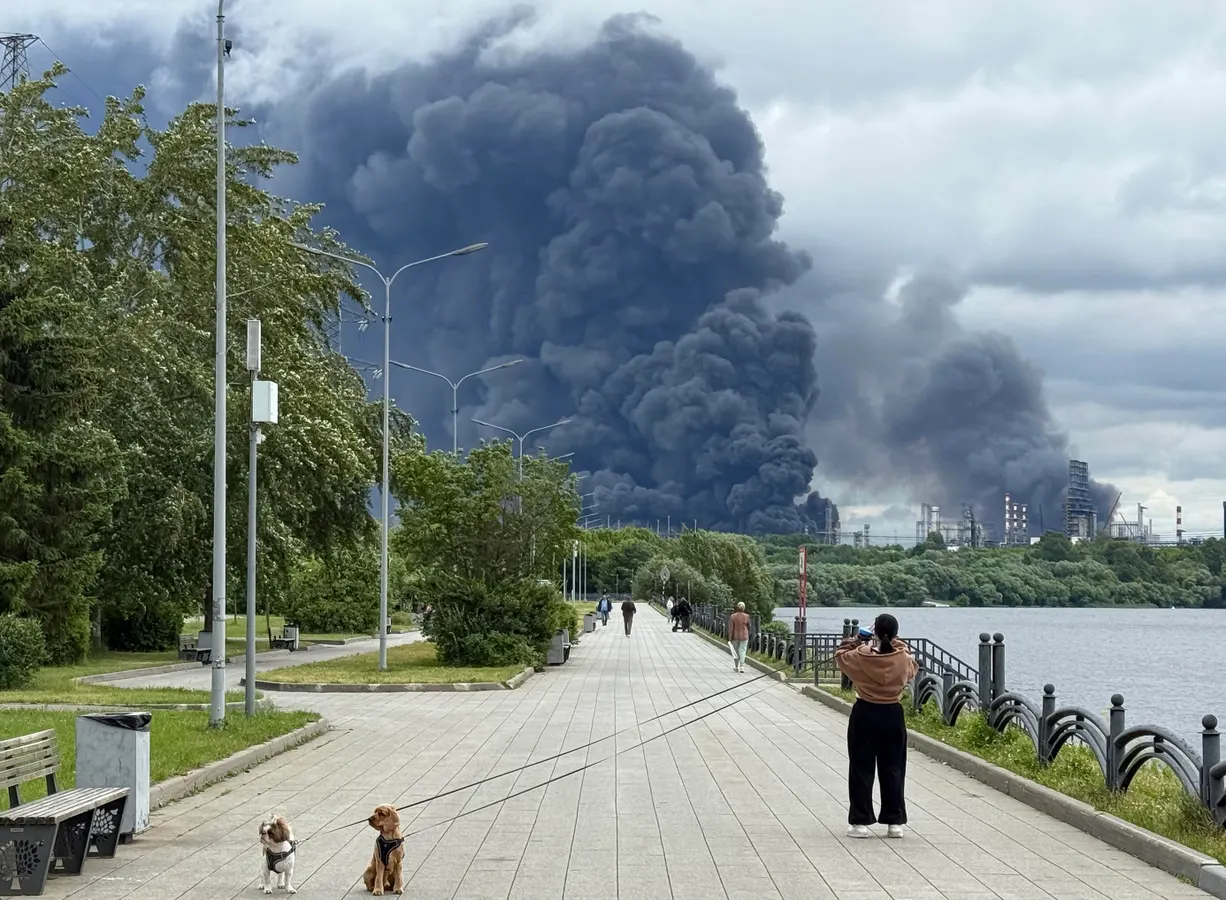

MOSCOW, RUSSIA – JUNE 18: The Moscow Oil Refinery has been damaged again in an attack by unmanned aerial vehicles (UAVs) in Russia. (Photo by Sefa Karacan/Anadolu via Getty Images)
Anadolu via Getty Images
Dispatches from Ukraine. Day 1577.
Ukraine Strikes Moscow Oil Refinery
Three days after Russia bombed Kyiv’s historic cultural sites, including the Kyiv-Pechersk Lavra, a UNESCO-listed site that marks its 975th anniversary this year, Ukraine struck back. On June 18, Ukraine launched its largest drone attack since the beginning of the full-scale war.
The attack set off massive fires at the Moscow Oil Refinery, one of Russia’s most important energy assets that supplies some 40% of Moscow’s fuel market, for the second time in a week. Residents in southeastern districts adjacent to the facility awoke to thick columns of black smoke rising above the city skyline, while local environmental authorities advised city residents to limit time outdoors amid concerns over air quality.
Russian oil refineries have become a favored target of Ukraine’s long-range drone campaign. Despite the Kremlin’s persistent rhetoric questioning the effectiveness of such strikes, dozens of Russian regions, including illegally annexed Crimea and even some provinces in Siberia, have recently seen long queues at gas stations.
President Zelenskyy described it as “an entirely justified response to Russian strikes.” Days earlier, commenting on damage inflicted on the Lavra in Kyiv, he had warned that “if Ukraine burns, so will Moscow.”
It was not the first strike to hit the historic monastery during the war. However, unlike a less destructive attack in January 2026, the latest barrage сased losses valued at some $10 million and prompted the hurried evacuation of 17th- and 18th-century icons from the site. Maksym Ostapenko, the Lavra’s director, told Forbes Ukraine that “irreversible losses were avoided,” while repairs to the heart of Eastern European Christianity could drag on for up to two years.
Eurosatory Defense Fair in Paris
More than 50 Ukrainian defense companies exhibited their products at Eurosatory 2026, Europe’s largest defense fair, taking place on June 16-19 in Paris. Ukraine fielded the fifth-largest national delegation, trailing only the U.S., France, Germany, and Australia.
Fire Point, one of the most prominent Ukrainian defense firms and a manufacturer of long-range drones and missiles, attended Eurosatory for the first time with its own stand. The company presented a new generation of drones that are capable of reaching targets up to 1,675 miles away.
Fire Point boasted its growing family of missiles, including the Flamingo cruise missile and the FP-7 ballistic missile. Ukraine, however, still lacks a mass-produced ballistic missile; those publicly presented so far remain prototypes at different stages of development and testing.
The company signed a memorandum with Germany’s HENSOLDT, one of Europe’s leading defense-electronics firms, to jointly develop FREYJA, a ballistic-missile-defense system.
Another notable deal was cut between Ukrainian Unmanned Technologies and France’s Haulotte Group. The two companies announced plans to manufacture the “Ravlyk” ground robotic platform, a system designed to perform logistics, evacuation, and other support missions in dangerous frontline environments.
More than that, other Ukrainian firms showcased electronic warfare systems, counter-drone technologies, and robotic ground vehicles. Several companies showcased systems that had already been deployed on the battlefield against Russia.
Following the latest 35th Ramstein meeting, Defense Minister Mykhailo Fedorov said that, on June 18, partners had pledged roughly $4 billion in new military assistance, much of it focused on capabilities that have proven most effective on the battlefield. Nearly $1 billion will go towards the purchase of American Patriot missiles, while more than $1 billion will be allocated to drones, including 150,000 units financed by the UK.
G7 Summit
Ukraine was once again at the center of discussions at the G7 summit in Évian, France, after attention had shifted to the Middle East in recent months. Following the ceasefire between the U.S. and Iran, Western leaders turned back to the question of how to end Europe’s largest war since 1945.
President Donald Trump said he was ready to become more involved in peace efforts and had already spoken with both Presidents Zelenskyy and Putin. His renewed interest, however, unsettled some European governments, which fear that Washington can dominate the diplomatic process and push Kyiv towards painful concessions.
















Leave a comment