


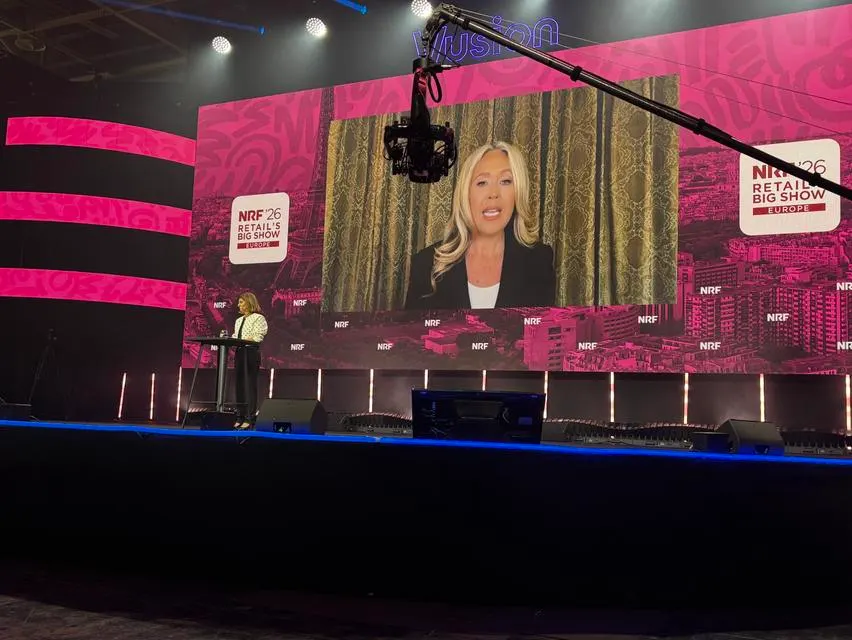

California dreaming: Brieane Olson, CEO of Pacsun
Mark Faithfull
Pacsun’s strategy for staying relevant with Gen Z and Gen A is based on a deceptively simple idea, stop treating young consumers as an audience and give them a role in building the brand.
Speaking at NRF 2026: Retail’s Big Show Europe in Paris this week, Brieane Olson, CEO of Pacsun, described the shift as one of the most important decisions in the company’s recent history.
“Ten years ago, the most important decision we made was changing from retailer to a true brand,” Olson said. “When we think about what we’re faced with today, from AI to economic challenges, the answer is not simply another technology investment or marketing campaign, but a deeper relationship with its customer.”
Pacsun, founded in California in 1980 and historically tied-up with surf, skate and beach culture, has spent the past decade rebuilding itself around youth culture rather than simply selling apparel to young people.
Sales have increased by about 10% in each of the past two years, reaching just under $1 billion in 2025 and the company operates more than 300 U.S. stores and, after years of reducing its physical footprint, has started adding stores again.
Olson’s contention is that traditional customer research is no longer enough and so Pacsun has created a Youth Advisory Council, bringing Gen Z and Gen A consumers directly into discussions with its leadership.
The first council was launched last year and a second cohort was announced this August after almost 1,000 young people applied. The latest group comprises 15 consumers aged 12 to 22 who will work with Pacsun teams on products, campaigns and community initiatives that includes the Youth Report and what Pacsun calls cultural touchpoints.
The Youth Report, produced with GlobalData, surveyed more than 6,000 Gen Z and Gen A respondents aged 11 to 24 and, rather than simply asking what they intend to buy, Pacsun says the research is designed to understand the emotional motivations behind their behaviour.
“It’s really important not to play into misconceptions of Gen Z and Gen A,” Olson said. “We do a report to get to the emotive why. The start would be to really listen authentically and openly, give young people a seat at the table.”
How Pacsun Works With Gen A and Gen Z
Olson said the company involves young consumers in everything from marketing and the logo to store layouts, websites and product development.
“Brand affinity through co-creation,” is the objective, she said. “It’s to meet with the younger cohort and make an intentional choice to listen and learn without bias.”
The result is a feedback loop in which Pacsun can compare what its community is saying with actual sales and engagement data. “Communication and dialogue, a constant flow that you can use to compare with data and numbers,” Olson stressed, as she pointed to Pacsun’s early adoption of TikTok, and its creator strategy has already shown how community participation can translate directly into sales.
Pacsun started to expand its store network again in 2025 and has now opened in Dubai.
getty
Its Casey jean, for example, generated $20 million in TikTok sales in 2024 after creator Lyla Biggs helped turn the product into a viral hit. Pacsun subsequently sold 11,000 pairs in 48 hours and 60,000 pairs through TikTok.
Pacsun said that store traffic in the U.S. has been growing at double-digit rates and that it opened nine new stores in 2025, its first net increase in the domestic store base in 18 years. It plans to add between 20 and 35 stores over the following three years, with locations targeted at malls, high-traffic streets and college towns.
“We have activations every week around our stores. Retail is moving into lifestyle,” she said, highlighting collaborations and pop-ups to reinforce that positioning, including a Levi’s activation in New York, while its current product offer includes collaborations such as Play Palm Angels.
Pacsun has also launched its PS Community Hub, a social-commerce platform where creators can produce content, build audiences and earn affiliate commissions, while top-performing creators can potentially move into co-creation.
Pacsun Debuts In Dubai
The next test will come as Pacsun moves outside its home market. In May, it opened its first international store at Mall of the Emirates in Dubai. The store is the beginning of a partnership with Majid Al Futtaim that could deliver up to 20 Pacsun stores across the GCC over five years, including Abu Dhabi, albeit that it is not the easiest time to be setting up store in the troubled Middle East.
Pacsun has spent years building a very specific California identity and now has to determine how much of that identity travels and Olson’s answer is that the brand should not be changed for every market, but the way it is expressed can be local.
“What resonates about Pacsun doesn’t need to change but co-collaboration in different parts of the world means we can be thoughtful outside the U.S.,” she said.
In Dubai the opening was developed around a UAE-based Pacsun Launch Lab comprising 55 Gen Z creatives, who helped shape the visuals, content and activation. And the launch itself was built around music, creators and local culture rather than simply importing a U.S. store format.
For Pacsun, that community is increasingly being asked not simply what it wants to buy, but what the brand should become and how its consumers can be part of it.











Leave a comment