


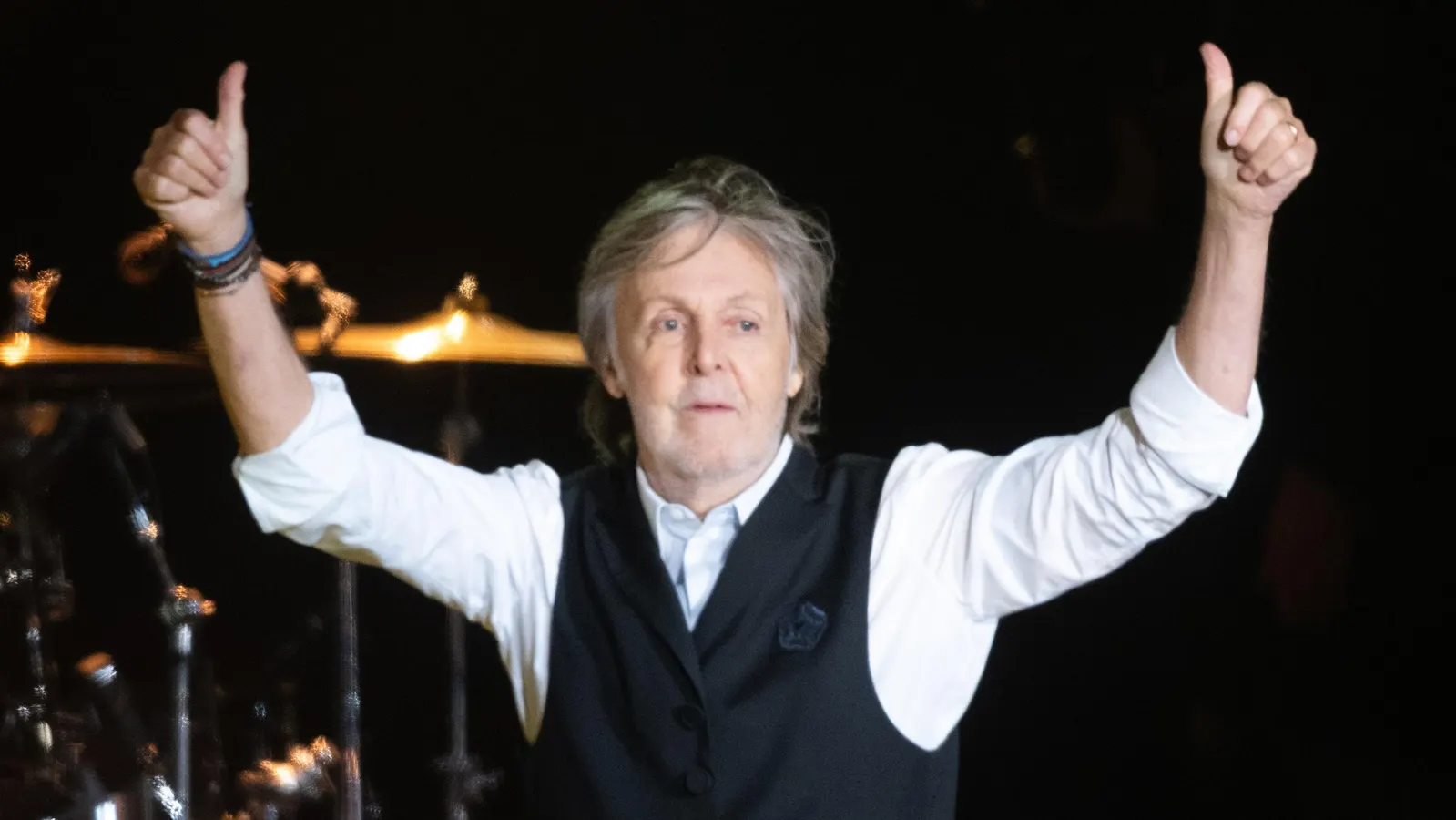

Paul McCartney revisits his bitter battle with Allen Klein in Man on the Run, explaining why he ultimately sued the other Beatles. GLASTONBURY, ENGLAND – JUNE 25: Paul McCartney performs as he headlines the Pyramid Stage during day four of Glastonbury Festival at Worthy Farm, Pilton on June 25, 2022 in Glastonbury, England. (Photo by Samir Hussein/WireImage)
Samir Hussein/WireImage
Paul McCartney has spent decades talking about the end of the Beatles, but more than half a century after the most successful band of all time split, the rocker is still finding new ways to explain just how ugly the group’s collapse became behind the scenes.
While promoting Man on the Run, the 2026 documentary centered on his post-Beatles reinvention and the rise of Wings, McCartney has again spoken about the business battle that helped turn a crumbling musical partnership into a legal war. His comments, made only a few days ago, are certainly blunt – especially when it comes to Allen Klein, the manager McCartney refused to trust even as his bandmates John Lennon, George Harrison and Ringo Starr embraced him.
Paul McCartney Says Allen Klein “Didn’t Deliver”
Klein “just promised the earth and didn’t deliver it,” McCartney recently stated while discussing the period surrounding Man on the Run with director Morgan Neville and moderator Judd Apatow. The legendary songwriter remembers believing that “all the money we’d ever earned was going to go in this guy’s bank account,” framing the management fight not as another disagreement between four musicians who were already growing apart, but as a threat to the juggernaut they had built together.
Klein entered the Beatles’ world after longtime manager Brian Epstein died in 1967. He arrived at a time when the band’s company Apple Corps was hemorrhaging money and the group badly needed someone to take control of all business affairs. Lennon quickly warmed to Klein, and Harrison and Starr followed, but McCartney never came around – and for good reason. He favored Linda McCartney’s father and brother, Lee and John Eastman, who were both attorneys, and refused to sign the management agreement that the other three Beatles accepted in 1969.
Decades later, McCartney’s suspicions form part of the mythology surrounding the band’s breakup, but the story is too complicated to simply call Klein nothing more than a useless villain. The manager did cut costs at Apple and negotiated an extremely lucrative new record deal for the Beatles. The problem was how much control he wielded over the act and what monies he earned from that work.
Paul McCartney Had to Sue His Beatles Bandmates
By the time the Beatles stopped functioning as a group, McCartney faced another problem: walking away musically did not automatically disentangle him financially. The Beatles remained tied together through their business partnership, which meant money generated by the four increasingly separate careers could still flow through structures they all controlled collectively. McCartney has stated that he believed that he could not move forward on his own while Klein was still in the picture.
McCartney’s lawyers eventually told him that suing Klein directly would not solve the problem. If the superstar wanted to dissolve the Beatles partnership, the people he had to sue were Lennon, Harrison and Starr.
On stage, McCartney remembered realizing exactly how disastrous that would look. “The world will go against me,” he said of his thinking at the time, and he was right, at least partially. There was a time when millions of people around the world blamed him for the break-up, but that didn’t stop him from filing suit.
McCartney’s difficult decision is remembered as one of the defining moments of the Beatles’ breakup, and that business move set up the beginning of Man on the Run. The documentary is about McCartney attempting to invent a new life after the band, but legally and financially, he was still trapped.
(Original Caption) The Beatles are shown at a press conference at the Warwick Hotel. Standing left to right are: Ringo Starr, (wearing polka dot shirt), Paul McCartney, John Lennon, and George Harrison.
Bettmann Archive
Did Allen Klein Really “Steal” From The Beatles?
McCartney now characterizes Klein’s behavior in even harsher terms, saying he was “basically stealing from the Beatles,” though that’s not exactly correct. Klein was not found guilty of literally taking Beatles partnership money for himself, though court findings of his actions did paint him out as the bad guy.
Klein’s company had received commissions well beyond what was expected under parts of its arrangement. The Beatles’ financial accounts were confusing and unreliable and McCartney’s mistrust was considered justified. The partnership’s finances were eventually placed under an independent receiver.
The Other Beatles Eventually Turned Against Allen Klein
McCartney was initially the odd man out, but the united front against him from his once-time bandmates did not last. Lennon, Harrison and Starr all declined to renew Klein’s management agreement when it expired in 1973. They also later became embroiled in their own litigation with Klein and his company, ABKCO.
John Lennon (1940 – 1980) of the Beatles plays the guitar in a hotel room in Paris, 16th January 1964. (Photo by Harry Benson/Express/Hulton Archive/Getty Images)
Getty Images
Lennon even acknowledged publicly that McCartney may have seen the problem first, saying in 1973 that “possibly Paul’s suspicions were right.”
McCartney has returned to that comment repeatedly over the years. Asked at the Man on the Run event how it felt when his former bandmates eventually recognized that his concerns were entirely valid, his answer was remarkably simple: “It was nice.”
Paul McCartney Was Fighting Over More Than Money
BROOKLYN, NEW YORK – APRIL 29: (Exclusive Coverage) (Editorial Use Only) (No use in photography exhibitions) In this image released on May 3, Sir Paul McCartney visits Paul McCartney Photographs 1963-64: Eyes of the Storm at Brooklyn Museum on April 29, 2024 in Brooklyn, New York. (Photo by Theo Wargo/Getty Images for MPL)
Getty Images for MPL
The Beatles business was not formally dissolved until 1975, years after the group itself effectively ended. Even then, litigation involving Klein and the former members continued.
Looking back at the battle in 2026, the fight looks less like ancient music industry gossip and more like an early version of disputes that continue to appear everywhere throughout the business to this day. Catalogs, trademarks, publishing, likeness rights and artist brands can now be worth hundreds of millions or even billions of dollars, and who controls those assets after a band breaks apart matters greatly – and people will seemingly never tire of hearing McCartney talk about his time with the group and how it all ended.










Leave a comment