


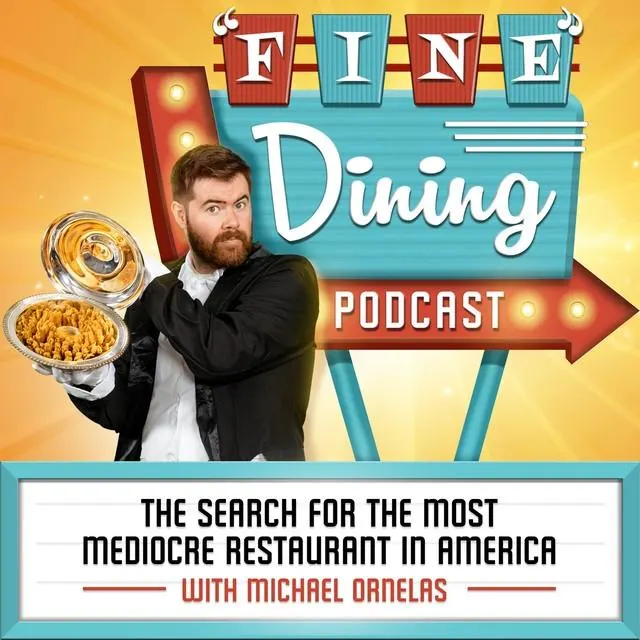

The “Fine” Dining Podcast is a comedy show hosted by Michael Ornelas where every fast-food joint and casual chain restaurant is humorously compared to Chili’s—the ultimate bar of American mediocrity. How do people find a show like this using the new discovery tools available today?
Fine dining Podcast
“There’s nothing on TV,” was, and for some still hooked to cable, a common refrain despite our 400-channel universe. Of course, on TV we were subject to “bundles” which force us to consider channels on topics we have no interest in.
Radio has dials, buttons or touchscreens. You go up the dials and back down for your music or other content. If you go to AM radio, you can listen to angry white men rant about wokeness, books that turn people gay, and the specter of socialism. On FM, you can listen to almost any genre of music and a bunch of ads.
Books have libraries, Amazon, and independent bookstores. Movies have theaters, streaming channels, and TV.
What about podcasts? How do people find podcasts? Since podcasting began in the early 2000s, the discovery channels have been standard yet limited. Before the advent of video podcasting, audio podcasters marketed their shows via podcast apps and websites that played their RSS feeds. For a long time, the prime real estate for podcast discovery was Apple’s iTunes, where new podcasts were allotted their own row for a week.
The other discovery method was decidedly low-tech, with word of mouth recommendations from a friend, acquaintance, family member, a podcast review site, such as Bingeworthy, Great Pods, or Greg’s LI Monday Podcast Recommendations, or podcast newsletters like Podnews or EarBuds Podcast Collective.
In this article, we will review and examine new avenues for podcast discovery and how those newer processes are impacting the podcasting industry.
Needle meet Haystack
When you ask indie podcasters how listeners and viewers find their excellent podcasts, they express righteous indignation.
As one indie podcaster explained, “It’s so much worse than finding a needle in a haystack. It’s more like finding one needle among 1,000 haystacks.”
Podcast networks have the funds, resources, and connections to advertise their new podcasts. iHeart, for example, lets listeners know a new podcast is being released, especially in a genre in which they’ve shown past interest.
iHeart has a sophisticated architecture in place to market their large slate of podcasts.
iHeart
It’s good business that networks like iHeart advertise and market their podcasts. After all, the company has invested a significant amount of money to start and maintain the podcast. If it’s a celebrity, then an expensive contract has already been sealed in legal blood.
How about indie podcasters? After all, indie podcasters are in danger of being sidelined by the large podcast networks, even though indie podcasters are overwhelmingly responsible for the creatively masterful podcasts.
Examples include: Another F*cking Horror Podcast, The White Vault, Adoption: The Making Of Me, Surfing Corporate, Conspiracy She Wrote, Trashy Divorces, and Why Wars Happened.
For a decade, indie podcasters used social media, podcast marketing companies with modest budgets, and podcast review sites. It’s a difficult process trying to build an audience to a point that the podcast can: 1. cover its costs 2. make money for the indie podcaster 3. make so much money that the indie podcaster can quit their current job and do podcasting full-time.
New Research, New Avenues
Recent research from Sounds Profitable and JAR Podcast Solutions highlights how audiences find and listen to new shows. First, the study identified key discovery channels, such as YouTube, which the study found dominates as the leading single platform for finding and consuming podcasts.
There this is Social Media, and these accounts for a massive share of organic recommendations, especially through content shared by followed accounts. Finally, there is still Word of Mouth, which constitutes traditional recommendations from friends, family, and colleagues remain a powerful driver when people act on suggestions.
What’s interesting in this graph is that not all social media has the same impact on podcast discovery. Facebook, for all its lack of trust on accuracy, stills scores high as a legitimate discovery method.
Sounds Profitable
Podcast discovery is dominated by YouTube and social media, with YouTube alone accounting for 40% of show discoveries. Together, YouTube and social platforms drive 61% of how listeners find new audio programs
Social media, and podcast feeds (especially Apple) help listeners locate podcasts via a genre list, and legacy media are now much more likely to have a podcast review section.
This graph, which reveals where consumers look for their next podcast, is remarkably similar to the first graph, although podcast host recommendations trended much higher.
Sounds Profitable
The research also found that discovery is increasingly driven by organic content rather than paid promotion. Among listeners who discovered a favorite podcast through social media, 60% found it through content shared by someone they follow, compared to 33% who discovered it through sponsored content.
“Podcasting has spent years optimizing for podcast apps while audience behavior has been shifting elsewhere,” said Tom Webster, Partner at Sounds Profitable. “What this research makes clear is that discovery is happening where people already spend their time. YouTube, social feeds, search, and personal recommendations have become the front door to podcasting. If you’re relying primarily on trailers, chart positions, or cross-promotion within podcast apps, you’re missing where most new listeners are actually entering the medium.”
The study revealed that podcast discovery was a monthly habit. Because of the sheer number of podcasts available, consumers always have that feeling of FOMO (Fear Of Missing Out).
Sounds Profitable
One area where this study can help indie podcasters, who produce the bulk of the limited-series, usually narrative, podcasts, is for these independent creators to have a new podcast option ready to go, or to recommend, as their current limited series is ending.
Suspicious Minds investigates issues around AI-fueled delusions, and aims to understand where it fits into humanity’s history of delusional thinking.
Suspicious Minds
For example, a show such as Suspicious Minds asks key questions about AI. Are we delusional for trusting AI technology? Or has AI already warped our thinking patterns? The podcast documentary was made by Agoric Media and Wondermind, and, given this new data, perhaps these two companies should have another limited-series podcast ready to go.
The study also revealed significant differences between discovery channels, demonstrating that platforms function not only as distribution channels but also as audience segments.
These findings include TikTok discovery is nearly seven times more common among listeners ages 18–34 than among those 55 and older. Spotify-discovered listeners represent one of podcasting’s most engaged and brand-responsive audiences, with 61% listening weekly. Apple Podcasts browsing remains a key discovery mechanism among affluent, audio-first listeners, particularly in news and technology categories. TikTok-discovered audiences are among the youngest and most diverse listener groups.
Host recommendations continue to deliver highly engaged “super-fan” audiences, despite representing a smaller share of overall discovery. The report also revealed the powerful role that personal recommendations continue to play in podcasting. Nearly two-thirds (64%) of podcast listeners receive recommendations from friends, family members, or colleagues, while 72% say they are likely to act on those recommendations.
“Discovery isn’t one challenge anymore, it’s many different challenges depending on who you’re trying to reach,” said Roger Nairn, Co-Founder and CEO of JAR Podcast Solutions. “What excites us about these findings is that they give brands and creators a much clearer roadmap. The audience discovering podcasts on TikTok behaves differently than the audience discovering them through Apple Podcasts, YouTube search, or host recommendations. Understanding those differences allows marketers to build smarter strategies and invest in the channels that actually align with their goals.”
For advertisers, the study found that listeners are increasingly receptive to branded podcast content. Brand-produced podcasts generated a 27-point net lift in trial intent overall, with significantly higher performance among highly engaged podcast audiences.
The full report explores how discovery channels shape audience behavior, which platforms deliver scale versus engagement, and what publishers, creators, and brands should prioritize when launching and growing podcasts in today’s fragmented media environment.
Are there podcast couch potatoes?
Recent industry studies and data reports from firms like Amplifi Media, Edison Research, Signal Hill Insights, and YouTube show that smart TVs have rapidly emerged as a primary screen for watching podcasts, transforming the living room into a major hub for video podcast consumption.
How does this trend relate t0 podcast discovery?
“Cable and broadcast TV have always been successful at promoting their own shows on TV, “ says digital media expert Carl Wickensham. ”People now watching podcasts on smart TVs are very accustomed to receiving recommendations on other podcasts to watch.”
According to DigiDay, Amplifi Media, viewers in 2025 watched over 400 million hours of podcasts per month on YouTube’s TV app, according to a February YouTube blog post. Those figures continue to track upwards in 2025, individual podcasters and podcast production companies anecdotally told Digiday.
Pocket Casts has over 1.5 million active users every month, according to official data shared by its parent company Automattic. The platform also accounts for roughly 1.5% to 3% of total global podcast app market share and streams over 10 million hours of listening content every week.
Pocket Casts
In another interesting announcement that happened last week, Pocket Casts reported that it would be on Apple TV. A presence on Android TV is coming soon, the company also announced in a press release.
In its press release, Pocket Casts said, “Your podcasts, your Up Next, your place in every episode, right on the screen in front of you. Start something on your phone at the bus stop. Finish it on the couch that night, exactly where you left it. Nothing to re-find. Nothing to sync by hand.”
A new landscape?
The report from Sounds Profitable and JAR Podcast Solutions posits why “podcasting” is no longer one channel, one behavior, or one creative format, and why that single shift reorders almost everything about how a podcast is launched and then marketed.
“Everything we thought we knew on podcast discovery has been thrown into flux,” notes digital media expert Carl Wickensham. “It isn’t simply the advent of video podcasting and inclusion, or intrusion, of YouTube, it’s the evolution of formats such as social media clips.”
According to Command Your Brand, short-form video clips are essential for modern podcast marketing, acting as a primary discovery engine on platforms like TikTok, Instagram Reels, and YouTube Shorts. They capture attention with visual and auditory hooks, build personal connection through human emotion, and drive long-term brand growth.
Social platforms favor short, vertical video formats, giving your content much higher organic reach than text or static images. A 15-to-60-second clip bypasses the friction of asking someone to commit to a full one-hour episode. Clips account for a large percentage of new listener discovery, acting as the front door to your broader ecosystem. Higher follower counts and active social engagement attract major brand sponsors, even if a viewer consumes clips rather than full episodes.
We began this article discussing the relative stability of podcast marketing since its inception. Then, we reviewed several studies on the impact of new tools for podcast discovery, such as YouTube and smart TVs.
There is no doubt that the large podcast networks are embracing the new methods. What we cannot forget is the impact these new discovery tools will have on independent podcasters, who do not have the resources of these corporate giants.
However, the battle is not lost. Independent, often niche, podcasts have their specialized set of skills, as Liam Nesson might say. Rather than competing for mass audiences, specialized shows build deeply loyal communities, yield higher listener intent, and attract targeted monetization that broad shows miss. Moreover, listeners of targeted shows report stronger personal connections and trust the host’s recommendations more than general listeners do.
According to Cue Productions, niche podcasts have smaller, focused audiences are often actively trying to solve specific problems, making their attention more valuable to precise advertisers. Listeners of these niche podcasts report stronger personal connections and trust the host’s recommendations more than general listeners do.
Despite all the latest methods for podcast discovery, I personally still use the old-fashioned method. I ask people who listen to a lot of podcasts. In fact, I’ve been given podcast recommendations by Wil Williams and Devin Andrade for several years, and they have yet to be wrong.














Leave a comment