



Podcast studios are getting more complex. What used to require just a quiet room and a single microphone has evolved into a multi-discipline broadcast environment. Platforms like YouTube and Spotify have shifted listener habits toward video, requiring multi-camera setups, switchers, lighting grids, and synchronized recording.
ThirdWheel Podcast Studio
Where are podcasts produced?
A professional studio like at Spotify or Wondery? A local “mom and pop” studio? An in-home studio, which could be anything from a “tricked-out” studio in the basement or office to a walk-in closet for good acoustics.
Ten years ago, the answer to that question would most likely be an independent podcast creators office, bedroom, or even a closet. There is a temptation to belive that podcast studios have grown more intricate, well-equipped and bougie soley due to the advent of video podcasting.
According to podcast sound consultant Danny Catalano, podcast studios have been undergoing a transformation in the last decade.
“Even when podcasting was strictly audio, ”Catalano begins, “studios were becoming more technologically sophisticated. It used to be that the network-supported podcasts had exclusivity to great sound design, while indies often had inferior mics and recorded in rooms not designed for audio recording.”
Catalano continues: “Find me an indie podcast that doesn’t have sound quality that matches, and even exceeds, Spotify or iHeart. You’d be hard-pressed to do that. The reason is that podcasting audio equipment is lights years ahead of where it was 10 years ago. Now we have The Shure MV7, the Beyerdynamic DT 770 Pro headphones, the Riverside online recording studio, an all-in-one production console like the RØDECaster Duo, Mic Stands or Boom Arms, and Pop Filters and Windscreens.”
“That’s before any video cameras,” Catalano adds. “Just for an audio podcast.”
In this article, we’ll look at what’s happening with podcast studios and how the advent of video podcasting has impacted the size, compexity, design, and even location of podcast studios.
The transition with studios of indie creators
Let’s begin with an award-winning independent podcaster/creator Matt Gilhooly from Florida. Matt is the creator/host of The Life Shift podcast, which is a long-form interview show that focuses on defining, life-altering moments that split a person’s life into a “before” and “after,” such as major trauma, loss, grief, burnout, and unexpected identity changes.
Matt began podcasting in video and audio in March 2022.
Matt tells us: “I love my evolution of the studio. It’s changed a lot over the years. I actually didn’t add video until episode 22, and I’m closing in on 300 episodes now, so it’s had a lot of time to evolve. Video kind of forced my hand in the best way, and it allowed my creative brain to do some other fun stuff. I had to actually think about what I wanted people to see, which made me think about what I wanted to feel when I sat down to record.”
The Life Shift creator/host Matt Gilhooly says: “Because before I can hold space for someone else’s story on The Life Shift, I have to feel ready. Calm. Present. So the space behind me isn’t fully about aesthetics. It’s about setting a tone for myself. The plants, the warm light, the wood panels. I wanted to build an environment where I can actually show up for my guests the way they deserve.”
The life Shift
Matt adds: “I know that the neon sign is a little extra. But I love it. And the shelf behind me has things that actually mean something to me, like a drawing I made of my late dog, Mikey.”
Another option is a local studio, and, according to the U.S. Chamber Of Commerce, podcast studios have increased in number by 250 percent in the last four years. Just like hiring any vendor, ask for references and check with podcasters who have used the studio before signing anything.
There is another option and that is a remote studio. according to Just Push Record, the most popular remote podcast recording studios (virtual recording platforms) are Riverside.fm, SquadCast, and Zencastr. These platforms use local “double-ender” recording to capture high-resolution audio and video directly on each participant’s device before uploading it, bypassing internet lag and quality drops.
We spoke to Cast Craft, which is a remote Texas-based podcast studio.
Cast Craft explains: “Previously this agency was a social media marketing agency, but I wanted to find something that resonates, so I started this podcast production agency with the aim to help podcasters in creating and developing high quality audio and video.”
Going pro with a Studio
There’s no doubt that video has upended the podcast studio setup,” says Danny Catalano. “Even a few years ago, video podcasts were looked more like research labs with wires, intrusive mics, and soundboards dotting the visual landscape. ”
Today, podcast studios are designed more like someone’s den or office than a recording studio.
Let’s travel to Miami, Florida where The Chat Room is located on iconic Lincoln Road in the heart of Miami Beach, just steps from the Miami Beach Convention Center. The Chat Room is billed as “a premium podcast and content creation studio built for founders, brands, creators, executives, and thought leaders who have something worth saying.”
Pictured here is The Lincoln Set in The Chat Room, a high-end podcast production studio located in the heart of Miami Beach and owned and run by former CNN journalist/producer Haley Draznin.
The Chat Room
Before launching her own studios, Haley Draznin spent nearly a decade at CNN as a reporter and producer. Notably, she helped launch the acclaimed Boss Files with Poppy Harlow series for CNN Business, where she produced in-depth interviews with global leaders and founders like Mark Zuckerberg, Sundar Pichai, Sheryl Sandberg, and Richard Branson.
Her work interviewing influential leaders, founders, creatives, and changemakers gave her a front-row seat to one undeniable truth: authentic conversations are one of the most powerful ways to build trust, credibility, and connection.
Pictured here is The Winwood Set in The Chat Room, a high-end podcast production studio located in the heart of Miami Beach and owned and run by former CNN journalist/producer Haley Draznin.
The Chat Room
Haley Draznin says: “So I built the studio I wished existed: a beautiful, professional space where creating high-quality content feels effortless. At The Chat Room, we handle the technical details so you can focus on what matters most: showing up, sharing your story, and connecting with the people who need to hear it.”
Lest you think that all production studio are in Florida, let me mention a studio in Voorhees, Southern New Jersey, right outside Philadelphia.
Suite Recording is run by Mathew Passy and Joe Gangemi, Suite Recording has an impressive local client base, including CooperTalk, and regional real estate professionals. What makes them unique is their ability to expand from in-studio recording to mobile and event recording.
“As podcasting grew from a niche hobby into a mainstream medium, and as more businesses and individuals recognized the power of high-quality audio and video content, the demand for accessible, professional recording services grew with it. SuiteRecording was built to meet that demand,” says Mathew Passy.
The advantages of belonging to a large podcast network
The professional studios like the large podcast networks need no description. They are expensive, well-equipped with professional sound people, producers, writers, and other support people.
When I asked Vox’s Switched On Pop co-host Charlie Harding several years ago in a Q&A how he liked working with an established podcast network like Vox, he replied: “They’ve taken ownership of the production process. That allows us to do more ambitious work. I’m now able to talk with two key expert sources and do more reporting and investigative work and still maintain the essence of the show, which is personality-driven between Nate (Sloan) and I. Before Vox and Panoply, we worked our tail off. I think we produced only 14 episodes, but now we have been producing an episode bi-weekly with few breaks.”
Spotify has two major major studio footprints in Los Angeles, California. They have two here. This includes the high-tech Spotify Sycamore Studios in the Hollywood/Sycamore media district (an 11,000-square-foot facility focused heavily on video podcasts and home to The Ringer), as well as its creative studio complex in the Downtown Arts District.
In London, Spotify operates localized creator and podcast recording spaces, and in Stockholm, Sweden, the company maintains dedicated studio and development spaces near the company’s historic roots.
owley
In New York City, Spotify has internal corporate and production studio spaces integrated into their regional office headquarters.
IHeart Media has a different studio setup. In Los Angeles, it has co-branded and high-tech facilities used for creator partnerships and celebrity recordings. Atlanta is a key studio location integrated for regional and national podcast production. Because of its structure, regional recording rooms and compact production setups are embedded inside iHeart radio station footprints across major markets like Chicago, Austin, and Nashville.
Podcast Studio Baha Mar
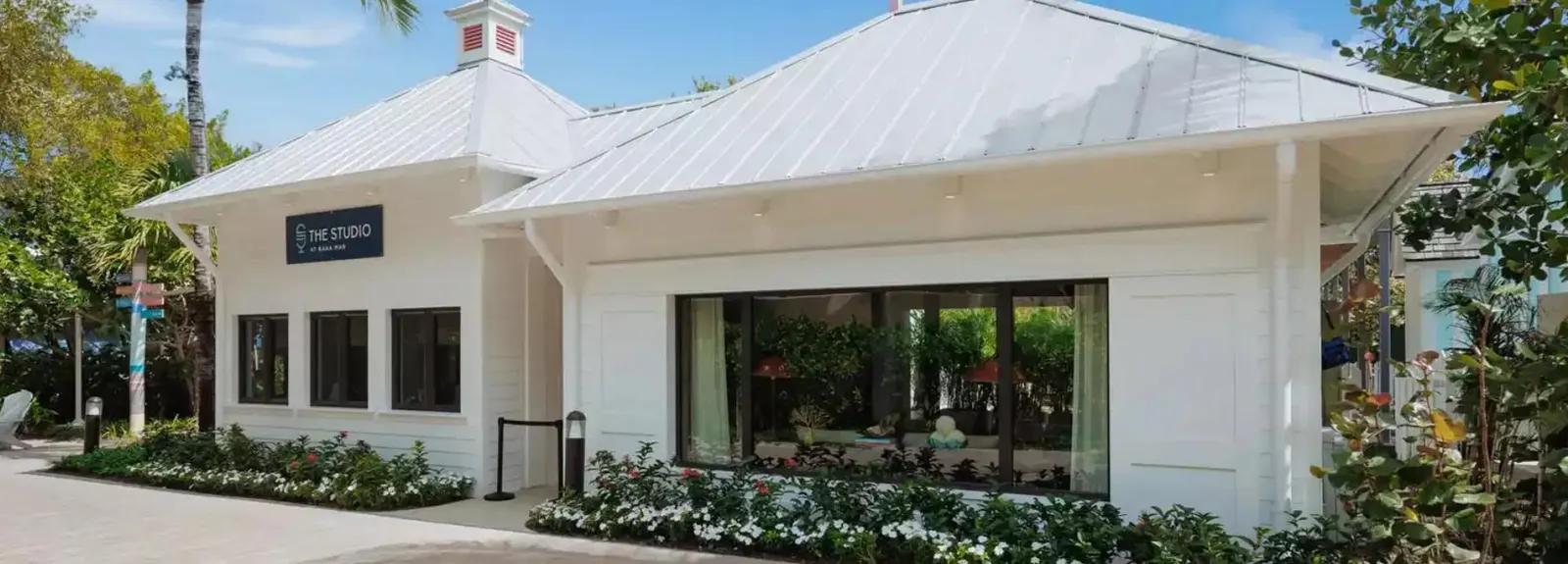
Perhaps the most interesting location for a podcast studio comes from Podcast Hall Of Fame Member Arielle Nissenblatt. Attending a bachelorette party in May in the Bahamas at an exclusive resort called Baha Mar, Arielle discovered a podcast studio built by iHeart.
In an interview, Arielle told us: “While I was at Baha Mar, I got a tour of The Studio, the resort’s dedicated podcast and video production space. It’s not tucked away in a convention center or hidden backstage. Rather, it’s built right into the heart of the property, alongside the many pools and about a 1 minute walk from the ocean. It’s inside a cafe, so hotel guests might stumble upon podcast recordings during their breakfast.”
Arielle continues: “Sure, the studio’s mics, cameras, sound treatment, and overall look are impressive, but what was more interesting to me is what the studio represents. As podcasting grows and gets more taken seriously within the media landscape, hotels and major hospitality brands seem to get it. Baha Mar is treating podcasting as part of the guest experience, a marketing channel, an events business, and a creative amenity all at once.”
The Studio at Baha Mar is described as a resort-centric podcasting facility located in Nassau, Bahamas. Situated on the West Beach Walkway adjacent to the Drift Pool, it features a soundproofed recording environment, an Aputure cinematic lighting system, live audience seating, and an on-site café and bar. At the The Studio’s café and bar, guests can enjoy expertly crafted coffee and espresso drinks, elevated breakfast and lunch offerings, as well as a full-service bar with curated cocktails.
It was also recently announced (in Podnews!) that Mercury and The Studio are launching an exclusive creator residency. Podcasters can apply for a chance to win a three-night stay at the resort, a bunch of perks, and a four-hour recording session.
Baha Mar
The studio at Baha Mar is marketed as, “Designed for both inspiration and indulgence, guests can choose between the energy of our stylishly modern indoor lounge or the breezy vibe of our al fresco terraces.”
Baha Mar
Ariell spoke with Baha Mar President Graeme Davis about why the resort invested in a podcast studio, who it’s for, and what success looks like.
Graeme Davis told her: The Studio sits in the heart of our poolscape, which is one of the most vibrant areas of Baha Mar. We intentionally built The Studio there to immerse our podcasters, their show guests and the audiences at home in the beauty of the resort destination. The Studio, surrounded by palm trees and flowering Bougainvillea, opens into an outdoor cafe open to all resort guests. This way, our guests are also invited to discover The Studio, while enjoying breakfast or lunch, and feel connected to the recordings happening inside.”
When Arielle asked who runs the studio, Mr. Davis answered: “The Studio is owned and operated directly by Baha Mar. We have a dedicated team who oversee everything from day-to-day operations and programming to creator support and live recordings. We are fortunate to work with iHeartRadio this inaugural year, and their expertise and reach have been invaluable to us while introducing a completely one-of-a-kind destination podcasting experience.”
Graeme Davis continued: “Some guests come to Baha Mar specifically for a recording or an event with integrated podcasting. Having just opened in March 2026, many of our guests are discovering The Studio during their stays. That’s part of the fun. In the near future, we’ll be rolling out more ways for our leisure guests to get involved with The Studio, including workshops and activities for kids and families.”
When Arielle asked him about the usage of the studio, Mr. Davis said: “Right now, we’re hosting numerous podcasts each month, and we’re continuing to build the recording calendar as awareness for The Studio grows. In addition to our visiting podcast program, The Studio is bookable. We’ve had resort guests who happen to be podcasters arrive, discover The Studio, and book time to record their shows while on vacation. It is truly a state of the art experience. As part of our visiting podcast program, hosts can decide if they’d like to record privately or broadcast aloud (live!) to The Studio Cafe.
The Podcast Arms Race
There is no doubt that the advent of video is driving much of the design and tech upgrades in podcast studios.
Still, Matt Gilhooly, creator/host of The Life Shift podcast admits: “Video made me more intentional about all of it. But honestly, even if nobody ever saw it on camera, I think it would still look exactly like this.”
Video studios have morphed into rooms you’d see in a HGTV home renovation show. Depending on the podcast, the vibe in the studio is so homey and warm that you can smell the chocolate chip cookies right out of the oven, or hanging out at a friend’s nicely apportioned den.
For indie podcasters like Matt Gilhooly, an arms race building podcast studios is a losing proposition. Spotify, iHeart, SiriusXM, and Tenderfoot can outspend any indie podcaster on podcast studio amenities.
I Shaved My Vag For this Creator/host Katie Thompson has embraced the video format and used it to her advantage.
I Shaved My Vag For This
Yet, resourceful as ever in the face of corporate domination, indie podcasters have fought back with high-quality video shows. Take, for example, I Shaved My Vag For This, which is an educational, humorous, and candid podcast hosted by writer/producer Katie Thompson that tackles women’s health, wellness, and the complexities of female anatomy, motherhood, and identity.
There’s no doubt that Mara Dorne, creator/host of the Boss I’d like To Follow podcast (BILF), has invested time and money into her video podcast. Her studio looks like it was designed by Chip and Joanna Gaines from Fixer Upper, and she even has a branded microphone. The video quality is superb, as is the sound. Each week on the BILF POD, filmed from Dorne’s studio in signature six-inch heels, Dorne sits down with an eclectic mix of guests, from global music icon Akon to Fortune 500 executives, female DJs, animal rights attorneys, and unexpected leaders across industries.
Danger lurks for podcasting, especially the large corporate networks. Wrapped up in this ongoing discussion of how video interview podcasts are becoming more like TV is an undercurrent of financial necessity. Streaming services such as Netflix that have “gone all in” on Spotify video podcasts as an “dollar store” alternative to glitzy, expensive, Hollywood-style talk shows may think twice as the cost of studios and production increases, severely limiting that cost advantage.
With Joe Rogan pulling in around $80 million a year, and Jay Sheety securing a blockbuster multiyear video and audio distribution deal with Spotify and Netflix valued at roughly $100 million, that cost advantage that podcasting currently enjoys may fade as fast as a spray-on tan after a week.
I think Angela Holowell, creator/host of the Honey & Hustle podcast, sums up the podcast studio issue the best: “I learned the hard (read = expensive) way that you don’t need a creative studio to be legit as a creator. You need a repeatable setup. You need fewer decisions between you and the work. You need a space that supports your nervous system, not just your personal/online brand.
“A studio can be worth it—when it’s within budget, aligned with how you actually create, and serving the work instead of serving the optics. A studio can also be rented as needed. Sure, it may take more time to set up and break down, but it would be cheaper than paying for something you don’t use daily. If the main benefit you want from a studio space is that it makes you feel like you’re finally allowed to take yourself seriously, then that’s not a studio problem. That’s permission.”










Leave a comment