


Topline
The vocal control underpinning human speech was not a sudden evolutionary leap, but a 15-million-year work in progress, according to researchers at the University of Warwick who tickled gorillas and recorded chimpanzee play sessions to make the discovery.
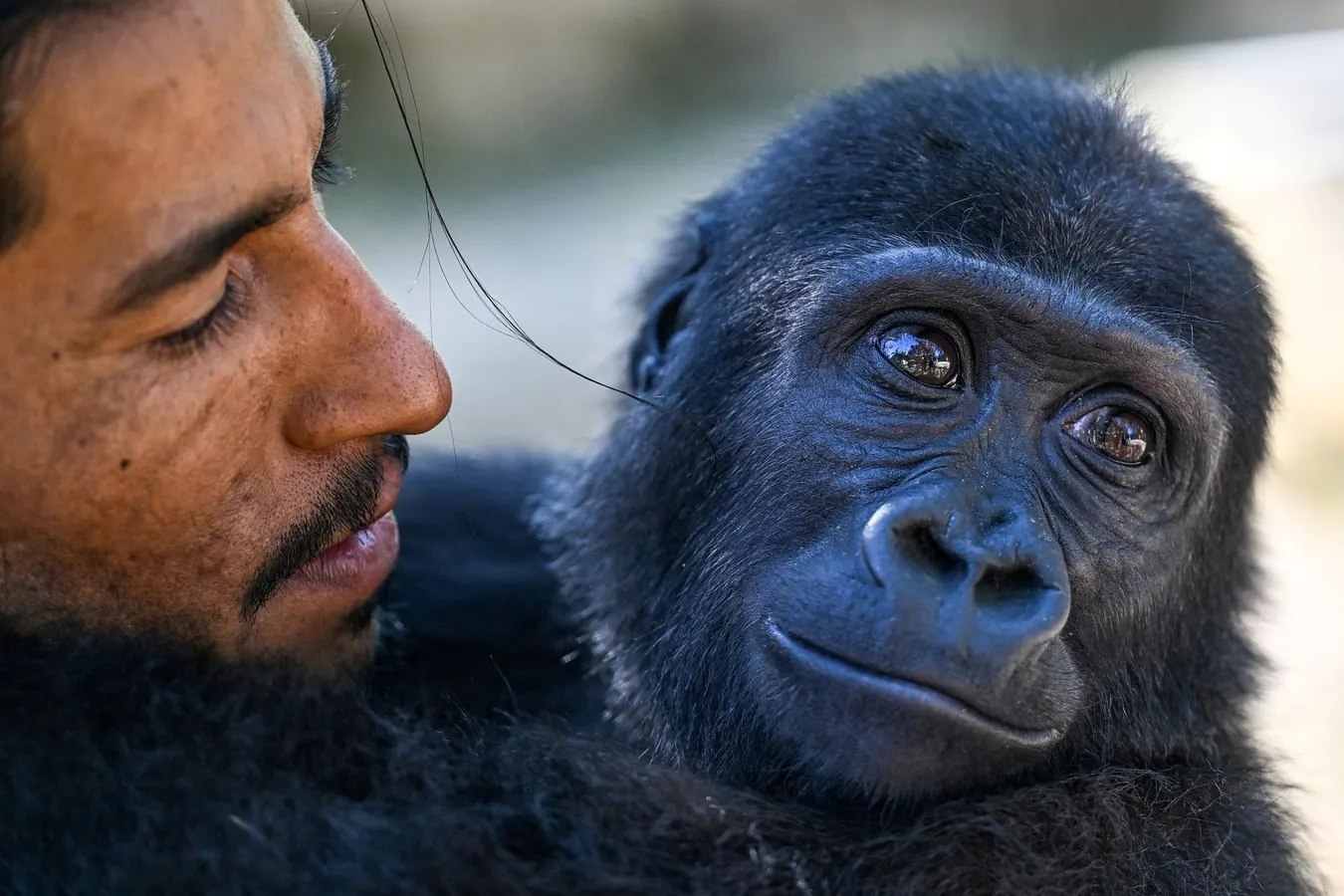
A baby Western lowland gorilla named Zeytin, holds onto the keeper’s neck at the Polenezkoy Zoo in Istanbul, on September 3, 2025.
Photo by Ozan KOSE / AFP
Key Facts
A University of Warwick study published Thursday found that humans and all four other living great ape species—chimpanzees, bonobos, gorillas and orangutans—produce laughter with the same evenly spaced rhythmic intervals between sounds.
The study analyzed 140 individual laughter sequences from orangutans, gorillas, bonobos, chimpanzees and humans aged six months to seven years, with data being captured during “controlled, playful tickling interactions in their home environments.”
Results show “great apes have been laughing in a recognizable way to modern humans for at least 15 million years.”
Results also found that while human laughter has become faster and more variable over evolutionary time, the underlying beat pattern in laughter is the same across all species studied.
Humans are the only of the studied species to have developed contextual control over laughter, establishing the ability to suppress, fake or modulate it depending on social circumstances, which researchers describe as a fundamental building block of speech.
The study was published in Nature’s Communications Biology.
What To Watch For
The University of Warwick study could be extended to gibbons and other primates that do not fall under the great ape category, according to a release, which noted the extension could further map the evolution of vocal control.
Key Background
Adriano Lameira, an associate professor at Warwick’s ApeTank research group, said laughter “provides a rare evolutionary window” into how vocal transformations happened over time. The study challenges a long-held view that human vocal control emerged abruptly, instead arguing the evolution of human speech dates back millions of years, even before the first humans existed.
Further Reading
Rhythm and timing in laughter reveal that human vocal plasticity falls on a hominid continuum (Nature.com)
















Leave a comment