


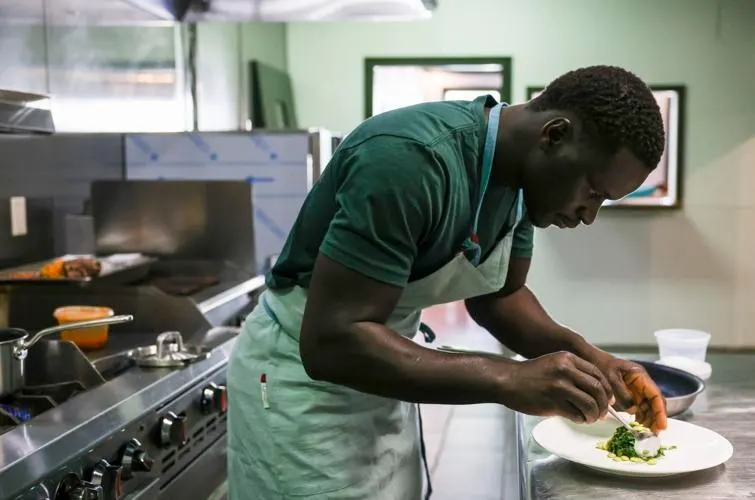
Chef Serigne Mbaye inside Dakar NOLA’s new home in New Orleans. The 2026 James Beard Award winner says Michelin still lacks the knowledge to define West African cooking.
Dakar NOLA
The first thing I noticed at Dakar NOLA’s new home was parked outside.
It was chef Serigne Mbaye’s car, finished in deep forest green. I learned later that green is his color. Once I knew, I started seeing it everywhere. The same shade runs through the dining room and out onto the patio. Inside, it settles beside dark wood and West African masks. The room began to feel like an extension of Mbaye himself.
New Orleans was hosting the 2026 Bocuse d’Or Americas selection during my visit, and Mbaye had duties connected to the competition. I was grateful he made time for our conversation. He walked into the restaurant wearing designer frames and looking completely at home in the larger dining room.
I began by complimenting his glasses.
“If you know, you know,” he said.
The glasses were one piece of a style Mbaye has shaped with help from his aunt, a tailor in Senegal. The two have worked together on clothing he has worn to award ceremonies, with Mbaye taking part in the design.
“Why should I wear a suit and tie?” he sarcastically asked.
For Mbaye, wearing Senegalese clothing on a national stage allows someone watching from West Africa to see part of themselves in the room. His clothes carry the same sense of place as his cooking. Senegal is present before he says a word.
The confidence behind those choices resurfaced when I asked about Michelin. Mbaye said he would not allow the guide to define West African cooking when he believes its inspectors still lack the knowledge to judge it fully. When I asked whether he felt ready for a star, he answered without hesitation.
“We’re ready,” he said. “I was born ready.”
Dakar recently moved from Magazine Street to 937 Leonidas Street. The new home gives Mbaye and co-owner Afua “Effie” Richardson more room for an idea that began with pop-ups.
It also gives them more people to welcome.
Hospitality begins at the sink
Before the Ataya arrives, Dakar asks guests to wash their hands.
A handmade cart is brought to the table. Mbaye said he helped design it with a potter and a woodworker. The ritual comes from the way guests are welcomed into a Senegalese home before a meal.
“We want you to know that you are home,” he said.
The gesture provides a physical introduction to teranga, the Senegalese culture of hospitality. A guest participates instead of listening to a server define the word.
“Fine dining doesn’t have to be a white tablecloth and a shiny table,” Mbaye said.
At Dakar, the hand-washing ceremony offers an alternative. It recognizes the guest’s arrival and gives the server an early opportunity to connect.
The restaurant currently lists its seven-course tasting menu at $175. Some dishes arrive family style, encouraging people to share food across the table.
The printed menu opens with a note from Mbaye.
“Each dish is a reflection of my heritage, crafted with intention and love,” it reads.
Then comes tea.
Ataya carries the welcome
Dakar’s current menu describes ataya as the Senegalese tea ceremony “evolved and in miniature.” Ginger and turmeric bring warmth. Mint leaves a cooler impression at the finish.
“Ataya gives the best introduction to Senegalese drinking culture,” Mbaye told me. “It is the best sign of hospitality. It is a beverage that is given to make people feel welcome in your home or in your community.”
Mbaye grew up watching adults drink ataya daily in Dakar. The traditional preparation begins with jasmine or gunpowder green tea. A street version called Ataya Wekk adds lemon.
“It gives kind of an Arnold Palmer flavor profile,” he said.
Mbaye has an easy way of making unfamiliar drinks more approachable. He compared bissap, Senegal’s sweet hibiscus drink, to American fruit punch. Bouye is thicker and tart, landing closer to a baobab smoothie. Café Touba is strong coffee scented with grains of paradise and warming spice.
Ataya comes first because it carries the welcome.
“Teranga is the culture of hospitality in Senegal,” Mbaye said. “Ataya is the perfect way to show people teranga and make them feel welcomed by you.”
From dishwasher to Dakar
Mbaye grew up around hospitality long before he understood it as a profession. His mother had operated a Senegalese restaurant in Harlem during the late 1980s. It closed before he was born, but the cooking continued at home.
“Our house became the extension of that restaurant,” he said. “I grew up in hospitality.”
Mbaye was born in Harlem, NY and moved to Senegal with his family when he was five. He returned to the United States nearly a decade later, carrying an African accent in the city where he was born.
People struggled to place him. He learned to accept both parts of himself.
“I’m African American. I’m also African,” he said.
His first restaurant job came at The Harrison in New York when he was around 18. He attempted a pastry stage and performed badly. The chef still saw enough potential to offer him work.
Mbaye eventually landed in the dish area, where his career took a memorable turn.
“I wasn’t so good at washing dishes,” he admitted. “They demoted me to porter.”
“How do you get demoted from washing dishes?” I jokingly asked.
The joke landed, but Mbaye’s answer turned serious. Many of the dishwashers working beside him had families depending on their wages. He came to understand the pressure they carried and began matching their effort.
He also noticed what happened whenever the chef entered the kitchen.
“Everyone fixed their posture,” he said. “I’m like, all this guy is doing is serving food. I want to do that someday.”
Why Dakar belongs in New Orleans
Mbaye could have opened Dakar in another city. I asked why this restaurant needed to be in New Orleans.
He sees pieces of the Caribbean when he looks at the city. Senegal reminds him of it too. Even parts of Europe bring New Orleans to mind.
“To me, New Orleans is the most unique city in America,” he said.
Food plays a part in that feeling. The people matter more.
Mbaye remembers moving from New York and being confused when strangers greeted him on the street.
Someone might look over and say, “Baby, how you doing?”
His first instinct was to wonder what they wanted. Over time, he began to understand the greeting as part of the city’s social language. The warmth felt familiar, even when the wording did not.
New Orleans also gave his cooking an audience comfortable with rice, seafood and sauce. Mbaye could place Senegalese memories beside Gulf ingredients without forcing the relationship.
The menu knows when to joke
Dakar Bread uses West African oil palm fruit pressed into the dough. Dibi pairs Gulf shrimp with oyster mushrooms under mustard sauce. The menu calls it Mbaye’s meatless homage to Dakar’s street-grilled meats. Seafood apparently receives some freedom with the definition.
Thon takes Gulf tuna and seasons it with Fulani suya spice. Aioli cools the heat before a wood-fired finish brings it back.
Akara turns black-eyed peas into a crisp fritter softened by onion and tomato.
Nambé continues with Gulf crab and cassava. Black-eyed peas return in a richer setting, surrounded by crab jus. The menu asks what might happen if a traditional New Year’s good-luck dish “won the lottery.”
It is one of those descriptions that reveals something about Mbaye. He takes the technique seriously. He does not insist on making every explanation solemn.
Many Americans, he believes, expect West African food to feel distant.
“To many, it feels very foreign,” he said. “Unbeknownst to them, it is more familiar than they would have ever imagined.”
Rice already has a long life in Southern kitchens. So does okra. Dakar changes the context around those ingredients and allows the guest to recognize the connection.
A rice snob makes his case
The clearest example during my meal was Wolof Jollof. Mbaye’s brick-red rice arrived warm, fluffy and deeply aromatic. Slow-cooked tomato gave it depth. A touch of citrus kept the grains lively.
Rof, a green herb-and-chile paste, brightened each spoonful. Habanero sauce brought a clean heat that built quickly enough to reward restraint.
Dakar’s menu describes the dish as Mbaye’s rendition of “the rice that conquered West Africa and the world.”
The line has some swagger. So does Mbaye. He believes rice offers a serious measure of a cook’s ability.
“To me, a cook that masters how to make perfect rice is a genius,” he said.
Mbaye trained in French kitchens where cooks learned mother sauces and French omelets. He respects those techniques. He questions why mastery of West African staples receives less institutional weight.
“Go into any three-star kitchen and say, ‘Make me a perfect jollof rice. Make me a perfect rice,’” he said. “They would struggle.”
I told him I had not expected him to be a rice snob.
“If I was on an island and the only food that I could eat every day was rice, I’m fine with that,” he said.
Then I asked which food opinion was most likely to get him in trouble online.
“Rice,” he answered.
Every culture believes its mothers and grandmothers make the best version, he explained. Mbaye shares that loyalty, although his confidence occasionally wanders into more dangerous territory.
“Some days I feel like I make it better than my mother,” he said.
I stopped him there before we both get in trouble with his mother.
Michelin gets a direct answer
Dakar won the James Beard Award for Best New Restaurant in 2024. Mbaye won Best Chef South this year in 2026.
North America’s 50 Best Restaurants moved Dakar from No. 6 to No. 4 in 2026. The organization also named it the Best Restaurant in South USA.
I reminded Mbaye of those accolades, gave him a smirk and side eye, and then asked about the award missing from the collection.
When was the Michelin star coming?
“I can’t allow Michelin to define the food that I’m trying to cook, because they don’t have enough knowledge about West African food,” he said. “Not yet.”
Mbaye believes Michelin and other established institutions need deeper expertise before judging the complexity of Senegalese cooking. Jollof rice and Soupa Kanja carry standards that may be difficult to recognize without cultural and technical familiarity.
His first answer was thoughtful and diplomatic. I wanted the shorter version.
“Do you feel ready for the Michelin star?” I asked again.
“Whether they come or don’t come, I’m ready,” he said. “I don’t think I’m waiting for them to put a stamp on it. We’ve been ready. I was born ready.”
The answer fit the man who had walked through the door in designer glasses and a restaurant painted in his favorite color. It also carried a warning for anyone tempted to reduce Dakar to its awards. Mbaye knows how quickly attention moves. He compared the restaurant industry to a sizzling plate. It arrives hot, but it can cool down just as quickly.
“People think they’re always going to be hot,” he said. “No, you ain’t.”
After winning the Beard Award, Mbaye returned to New Orleans and wanted a po’boy. He named Guy’s and Parkway as two of his usual stops.
The trophies may travel with him. His reset still involves bread, fried seafood and a New Orleans counter.
Sauces tell the drinks where to go
“Sauces are a major foundation of Senegalese cooking,” Mbaye said. “Our beverage program serves to use liquids in another form to elevate the experience of the sauces and flavors.”
The current menu’s Soupa Kanja makes the idea easy to understand. Okra thickens a soup built around Gulf shrimp and crab. Mbaye describes it as Senegal’s version of gumbo.
When I asked for a pairing that represented Dakar’s approach, he pointed to Brodie’s Love Pinot Noir Reserva 2020 with Soupa Kanja.
The wine’s ripe fruit can handle the soup’s depth, according to Mbaye, while its savory character works with the okra. Brodie’s Love was founded by Adilah Brodie and sources its wines from Chile.
The beverage team begins with the finished dish. They taste it and talk through the sauce, heat and texture. Sommelier Imani Pittman and the bartender begin building a pairing from those observations.
Pastry chef Shardé Cole may join when a drink reaches into her portion of the menu. Everyone eventually gathers again to taste the proposed pairing with the food.
Mbaye described the process without much ceremony. People stand around a dish, taste and speak honestly. If the pairing falls short, they keep working.
He also wants the glass to look worthy of the plate. The bar team wants guests to feast with their eyes before the first sip.
A daiquiri carries two memories
When I asked Mbaye which cocktail best connected Senegal with New Orleans, he chose The Dakar.
He described it as a daiquiri served over ice with hibiscus and Cheramie Aged Gold rum.
“Hibiscus beverages can be found throughout New Orleans and Senegal and the West African diaspora,” Mbaye said.
The daiquiri gives the drink a form New Orleans understands. Hibiscus carries the memory of bissap. Cheramie brings Louisiana rum into the glass. Mbaye says rum and gin work well with the tamarind or chile found in Senegalese cooking. The bartenders can explore, although the food establishes the limit. Dakar’s sauces already bring considerable flavor to the table.
Fonio reveals an access problem
Mbaye pointed to Brooklyn Brewery’s Fonio Rising Pale Ale as an example of a West African ingredient finding a place in American beer.
Fonio has been cultivated in West Africa for thousands of years. Brooklyn Brewery eventually moved Fonio Rising into its permanent lineup after an initial limited release. The beer gives American drinkers an approachable introduction to the grain. It also reveals how difficult it remains for Dakar to source alcoholic drinks made in Africa.
Mbaye sees more palm-wine beverages emerging from Ghana and Nigeria. Few have reached him through regular Louisiana distribution.
During Tales of the Cocktail, an activation from the Ajabu Cocktail and Spirits Festival allowed Dakar’s team to taste products bottled in Africa or produced elsewhere with African ingredients.
“It gives us the opportunity to learn more about African-branded spirits and also expand and expose our guests to this emerging market,” Mbaye said.
Teranga extends to the staff
Dakar’s prices place the restaurant firmly within fine dining. Mbaye also understands the labor behind each service. He described Dakar as a small, owner-operated restaurant without a large outside investor. Mbaye said the business offers health and dental insurance, contributes to a retirement plan and helps employees pursue educational opportunities.
He has also been working toward four-day schedules for members of the kitchen team.
Those choices come from his experience in restaurants. Mbaye remembered cutting his hand badly enough to require eight stitches. When he returned to collect his belongings, the chef asked who would finish his station. Mbaye wrapped the injury and continued cooking.
The memory now shapes how he wants to run his own kitchen. The National Restaurant Association reports that 42% of operators were not profitable in 2025. Benefits, education and shorter workweeks add pressure to an already difficult business model.
They also reveal how Mbaye interprets hospitality. Teranga cannot stop at the dining-room door if the people producing the experience are exhausted.
Senegalese aunties remain the final judges
Awards may impress diners. Mbaye reserves a different kind of anxiety for “Senegalese aunties.”
When I asked which audience was hardest to please, he chose them over judges and food writers.
A Senegalese auntie already knows how ceebujën should taste. Technique alone will not distract her from a weak version.
The answer complicates Mbaye’s role. He has spent years explaining Senegalese food to American diners. At home, some traditionalists may question why the food needs reinterpretation at all. Mbaye has lived between those reactions for much of his life. When he first moved to Senegal as a child, people considered him American. After returning to the United States, people treated him as African.
“I felt like an outsider in both places,” he said.
Cooking gave him a way to explain where he belonged.
What comes after Dakar
Mbaye recently became a father. After a long day, he said, hearing his infant son giggle gives him grace. Fatherhood has made the idea of legacy feel less abstract.
We were reaching the end of our conversation and I asked him, what was he on his way to now?
Mbaye did not mention Michelin. He spoke about creating opportunities for young West African chefs. His long-term goal is a culinary school in Africa centered on the continent’s traditions and techniques.
“We as Africans know African food, but the world doesn’t know what African food is,” he said.
He wants younger chefs to study recipes carried through their own families with the same seriousness that cooks bring to French or Italian culinary traditions.
Michelin had disappeared from the answer. Mbaye was thinking about who comes after him.
At Dakar, that education has already started.
Guests wash their hands. Ataya welcomes them. Then the rice arrives.














Leave a comment