


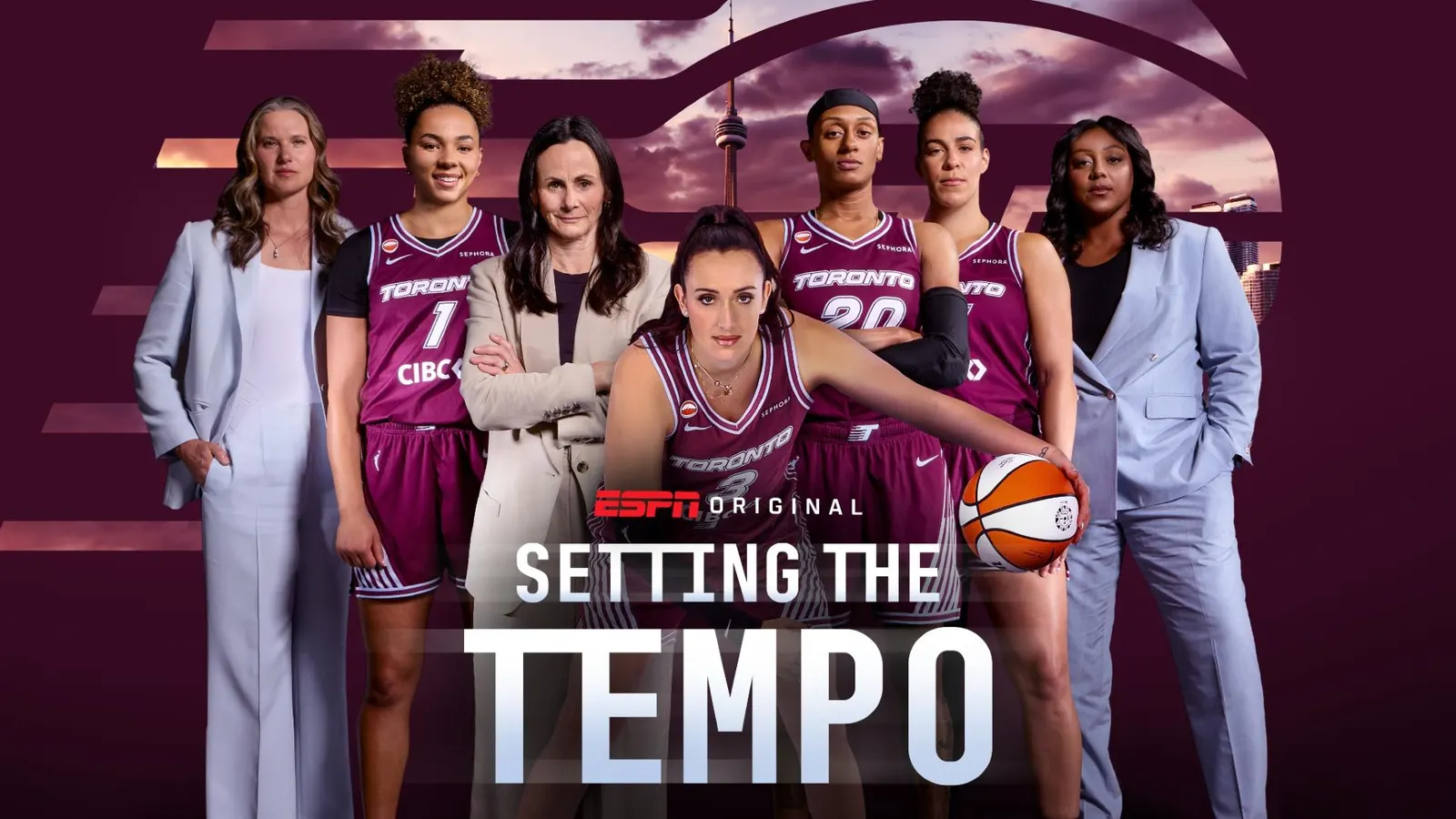

ESPN original, Setting the Tempo
ESPN
Women’s professional sport has decades of history but very little record of the work that built the industry. Setting the Tempo, a four-part ESPN Original Series premiering Sunday, September 20, set out to document one instance of that missing visibility as it follows the creation of the Toronto Tempo, the WNBA’s first Canadian franchise. The series follows Toronto Tempo team president Teresa Resch, head coach Sandy Brondello, and general manager Monica Wright Rogers as they evaluate talent, establish a culture, and build an organization under an incredibly compressed timeline. Teresa Resch and Emmy Award Winner Robin Roberts, who leads the productions company (Rock’n Robin Productions) behind the series, each shared their perspectives on the build, the decision to document it, and why increasing visibility across women’s sport continues to matter.
Resch, who previously worked with the Toronto Raptors, is one of the relatively few executives who can speak to the difference between operating within an established franchise and creating one. “The experience with the Tempo has been completely different than the experience with the Raptors in the sense of this is new,” Resch said. “Every decision we’re making, everything that we’re activating, is for the first time ever. It equates most with maybe the Raptors 30 years ago, or an expansion team in that space.”
What separates an expansion build from an established operation, in her experience, is that nothing arrives inherited. “The whole genesis of it, the fact that everything is an idea, is pretty unique, because that doesn’t really exist in anything established,” she said. The Tempo are also the league’s first Canada-based franchise. “Everything we’re experiencing with the Tempo is the first, and it’s also the first in Canada,” Resch said. “So, you add another layer of another country to it.”
MONTREAL, CANADA – JULY 10: A general view of the court during the first half between the Toronto Tempo and the Dallas Wings in the WNBA game at the Bell Centre on July 10, 2026 in Montreal, Quebec, Canada. NOTE TO USER: User expressly acknowledges and agrees that, by downloading and or using this photograph, User is consenting to the terms and conditions of the Getty Images License Agreement. (Photo by Minas Panagiotakis/Getty Images)
Getty Images
Importance of Documenting the Build
Women’s sport has historically been under-documented and much less visible than men’s sport. Women’s sport receives only 5-15% of all coverage across media spaces, and the moments that have been captured skew heavily toward competitive achievement and international mega events, with very little footage recording women leaders in the act of building an organization. As a result, a franchise launch is certainly among the least documented events in women’s sport.
Resch noted however that this pattern is beginning to change. “Women in sports, and specifically the WNBA, have some of the best stories in all of sports, they’ve just never been told. And I’m so excited to see that that is changing,” Resch said. “It’s so great to see them have the platform, and people investing in these stories and telling them.”
TORONTO. Teresa Resch, President, Tempo Basketball Club (r) introduces Monica Wright Rogers (l) as GM, Toronto Tempo. (R.J.Johnston/Toronto Star) R.J. Johnston/Toronto Star (R.J. Johnston/Toronto Star via Getty Images)
Toronto Star via Getty Images
The choice to document the Tempo originated in large part due to the volume of interest that followed the franchise announcement. “When we announced the team in May of 2024, I received an enormous amount of inbound from production companies interested in telling the story. So, I knew that there was something there.” Importantly, that initial burst of interest was not coming through existing relationships. “It wasn’t just one person that I knew. It was people cold calling, and I knew nothing about that space.” Rock’n Robin was ultimately the right fit for the project, what Resch described as “a true, authentic connection to telling the story in a way that was going to elevate the women that were part of it, the leaders, and be respectful to also the space and time that we were part of.”
For Robin Roberts, the appeal to documenting this build was due in large part to when their access began, as she noted, “There was something very special about getting the opportunity to capture a franchise before there was even a team on the floor. You rarely get that kind of access to the beginning of something.” Roberts describes finding that the Toronto group was an organization already thinking well past its roster decisions. “They weren’t simply launching a basketball team. They were thinking about culture, community, identity, and what this franchise could mean for an entire country.” Those are the projects Rock’n Robin looks for, she said, stories about people building something meaningful and creating opportunities that did not previously exist. “We knew very quickly this was something worthy of documenting,” Roberts said.
TORONTO. Ceremonial ball detail shot. Teresa Resch, President, Tempo Basketball Club introduces Monica Wright Rogers is introduced as GM, Toronto Tempo. (R.J.Johnston/Toronto Star) R.J. Johnston/Toronto Star (R.J. Johnston/Toronto Star via Getty Images)
Toronto Star via Getty Images
A Build Defined By Uncertainty
The conditions under which the organization operated were considerably more demanding than a typical expansion build. The previous collective bargaining agreement had expired in October 2025 and a new agreement was not signed until March 2026, roughly seven weeks before Toronto played its first game. All of this meant that GM Wright Rogers was evaluating talent and assembling a roster without knowing the salary cap she would ultimately be working under. Every expansion franchise before this one built its initial roster against a known number.
Resch identifies that period as the defining condition of the season, and she expects it to come through in the series. “The theme that also plays through it is uncertainty, that was such a huge part of our first season,” she said. “We didn’t even know the economic model that we’d be working under.” Timelines were also unsettled. “We planned and planned and planned around what had happened previously, but ultimately we didn’t know until the day before, week before, month before what was actually going to be certain.”
Resch also felt that the uncertainty mean leaning into a speciifc leadership strategy for the organization. “People can handle bad news, but what they have a hard time dealing with is uncertainty,” Resch noted. The response to this uncertainty was to narrow the organization’s attention to what they did know and what they could control.
Resch explained that there were several components the team could plan for. Once the schedule was released, for example, the team knew it would tip off May 8, the team also knew there would be an expansion draft, a college draft and free agency, even without confirmed windows, because all three had to occur before the season began. The team also knew it would hire a coach and a general manager, launch a name and logo, and introduce mascots. “So, we just really tried to stay laser focused on that and not be overwhelmed by those things that we didn’t know or didn’t have control over,” Resch said. “It’s easier said than done, but I think we did a pretty good job of both preparing and also actioning when we were able to.” Controlling the controllables became a key to the Tempo’s market success this season. On July 10, the Tempo drew 20,996 fans to Montreal’s Bell Centre, surpassing the WNBA regular season attendance record of 20,711 that Washington set in 2024.
TORONTO, ONTARIO – MAY 8: Head coach Sandy Brondello of the Toronto Tempo speaks to media prior to the game against the Washington Mystics at Coca-Cola Coliseum on May 8, 2026 in Toronto, Ontario, Canada. NOTE TO USER: User expressly acknowledges and agrees that, by downloading and or using this photograph, User is consenting to the terms and conditions of the Getty Images License Agreement.(Photo by Michael Chisholm/Getty Images)
Getty Images
Resch is now among the few people who have done a build like this one, for the first time, which positions her as a resource for the leaders who will build the franchises still to come. When asked what she would pass along, she described three components. The first is clarity about priorities. “For us, it was always about being Canada’s team,” she said. The second is that competitive standards can be established before competitive results arrive. Toronto was not expecting to win a championship as an expansion team, she noted, but that does not preclude putting championship habits, foundational pieces and operations in place from the beginning. The third is tolerance for error. “You have to have grace. You have to have empathy,” Resch said. “You’re going to learn the most from the things that don’t go well, so you have to make sure that you’re okay with those things happening.” The operating principle the organization settled on was to assume positive intent, particularly in a first year where decisions routinely made colleagues’ work harder without anyone intending it.
NEW YORK, NEW YORK – APRIL 13: Kiki Rice (L) of UCLA poses with WNBA Commissioner Cathy Engelbert (R) after being selected with the 6th pick in the first round by the Toronto Tempo during the 2026 WNBA Draft at The Shed on April 13, 2026 in New York City. NOTE TO USER: User expressly acknowledges and agrees that, by downloading and or using this photograph, User is consenting to the terms and conditions of the Getty Images License Agreement. (Photo by Angelina Katsanis/Getty Images)
Getty Images
Women Leaders Paving the Way Forward
League expansion is one of the few mechanisms that creates several senior leadership openings simultaneously in an industry where turnover is typically very slow. Previous vocational research in sport has documented the success of women at the highest levels, although organizations do not always diversify these hiring decisions. During this expansion however, Toronto placed women in its president, general manager, and head coach positions at the founding stage, challenging the more traditional approach to leadership attainment for women.
“When I got the role of president, I knew that as the GM I wanted someone with great league experience, someone who knew the WNBA well,” Resch said. “That happened to be a woman, because this league has been run and made up of women for the last 30 years.” Wright Rogers, who was entering her first general manager position, then applied a similar standard to the coaching search. “Being a first-time GM, [Rogers] wanted to hire someone who had won at this level,” Resch said. “And once again, the women have been leaders here and incredible winners. Sandy Brondello is one of the best coaches to have spent her entire career dedicated to this league.” The hiring results, in Resch’s framing, followed from those specific criteria. “When those things become your priority, you end up with women in leadership positions,” she said. “It hasn’t been the focus, but it’s been something that has definitely shaped how we lead and what this organization is built upon.”
ESPN network commentator Robin Roberts (right) speaks with Italian-born American basketball coach Geno Auriemma of the University of Connecticut before an exhibition game between Connecticut and the New York Liberty, Storrs, Connecticut, 1998. (photo by Bob Stowell/Getty Images)
Getty Images
Roberts, who has spent her career in rooms where there were few people who shared her experience, argues that the significance of those hires extends well beyond the three people who hold the jobs. “Visibility matters because you cannot underestimate the power of seeing someone and thinking, maybe that can be me,” Roberts said. “I know what it feels like to walk into a room and not see people who look like you or share your experience. And I also know what it means when you finally do. It changes your sense of what is possible.” The roles that matter, in her view, are not limited to the ones on the floor. “It’s important for representation to extend beyond the athletes we see competing. It matters in the front office, in ownership, in production, in media and in every place where decisions are being made. When young women can see themselves reflected across all of those roles, the possibilities become much bigger,” Robins noted.
BEVERLY HILLS, CA – OCTOBER 17: Robin Roberts arrives at the CoachArt Gala of Champions held at The Beverly Hilton Hotel on October 17, 2013 in Beverly Hills, California. (Photo by Michael Tran/FilmMagic)
FilmMagic
Robin Roberts served as ESPN’s studio host for WNBA coverage from 1996 through 2002, which placed her on air for the league’s first season, and she was inducted into the Women’s Basketball Hall of Fame in 2012. Resch was direct about what Robert’s involvement in the development of the series has meant. “It doesn’t happen without her,” Resch said. “She has come to the table and said, I want to give it a platform. I want to talk about it on GMA and want to be there for the launch.”
Roberts, who was on air for the league’s first season and has now documented one of its newest franchises, reads the current period as structural rather than cyclical. “What we’re seeing today is not a moment, it’s a movement with momentum,” she said. “There is a level of investment, attention and belief in women’s sports that we simply have not seen before.” What encourages her most is where that growth is occurring. “It’s ownership, leadership, media, business and fans all coming together. Watching Toronto build this franchise from the ground up made it very clear that women’s sports are not asking for a seat at the table anymore. They’re building the table.”
Setting the Tempo premiers September 20th. All four episodes will be available that day on the ESPN app and Disney+, and the linear debut will air consecutively beginning at 8:30 p.m. ET on ESPN. The series also airs from 5 to 7 p.m. ET on TSN and streams on Disney+ in Canada and select international markets.











Leave a comment