


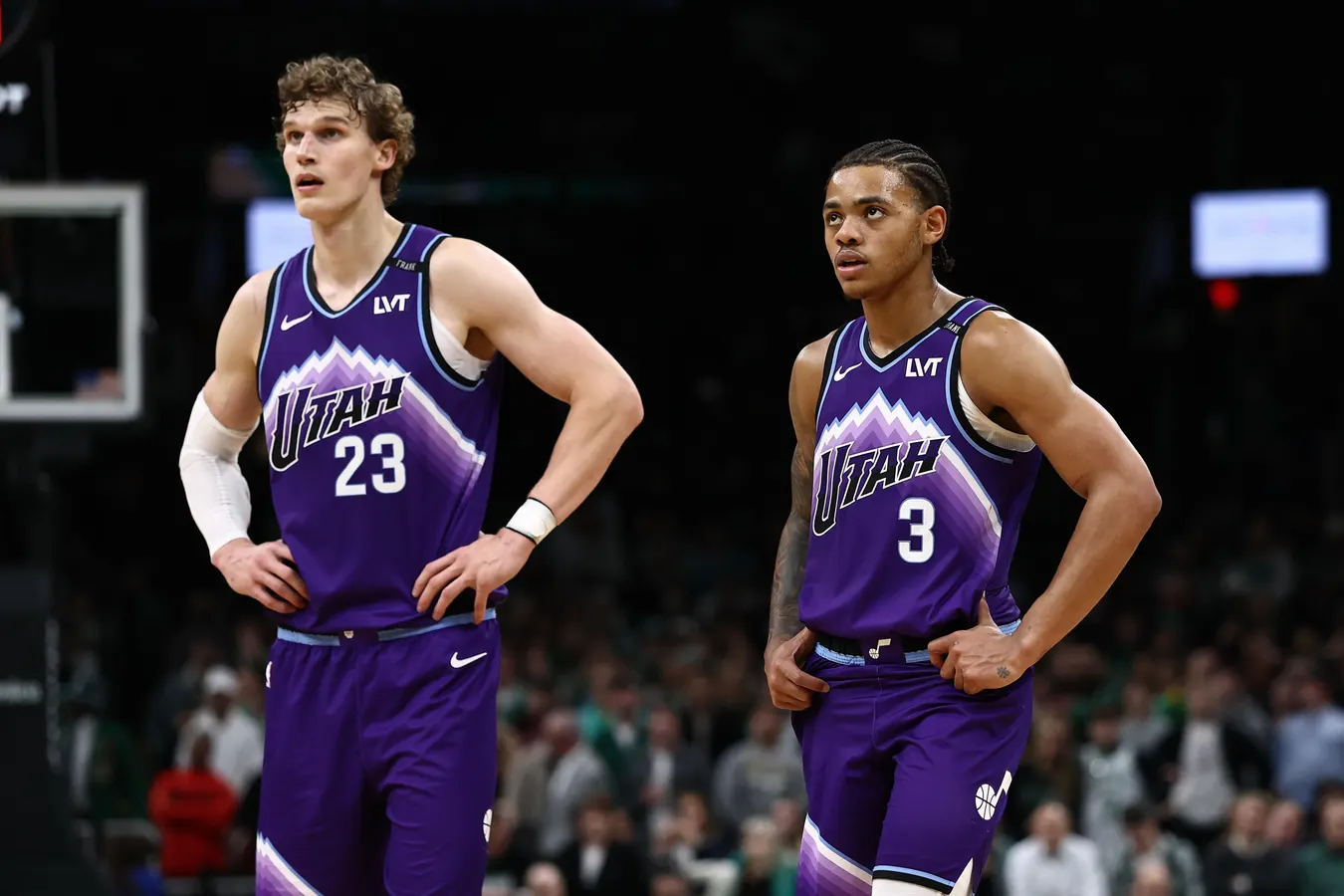

BOSTON, MA – NOVEMBER 3: Lauri Markkanen #23 of the Utah Jazz and Keyonte George #3 during the game against the Boston Celtics at TD Garden on November 3, 2025 in Boston, Massachusetts. NOTE TO USER: User expressly acknowledges and agrees that, by downloading and/or using this Photograph, user is consenting to the terms and conditions of the Getty Images License Agreement. (Photo By Winslow Townson/Getty Images)
Getty Images
After spending the past few seasons in rebuilding purgatory, the Utah Jazz are poised to get back into the NBA playoff mix in 2026-27.
The Jazz finished 22-60 this past season, but that record isn’t reflective of the talent on their roster. Starting center Walker Kessler lasted only five games before suffering a season-ending torn labrum, leading scorer Lauri Markkanen missed 40 games, and trade-deadline acquisition Jaren Jackson Jr. played three games in Utah before undergoing season-ending surgery to remove a growth in his knee.
Add those three to Keyonte George and 2025 No. 5 overall pick Ace Bailey, and that’s the foundation for an up-and-coming team in and of itself. Now add the No. 2 pick in this year’s draft—one of the most loaded in years—and the Jazz could quickly muscle their way into being the biggest threat to the San Antonio Spurs and Oklahoma City Thunder in the West.
That depends on a few key decisions breaking right for them, though. All three of them will happen this offseason.
The Jazz’s Draft-Night Debate
All year long, three prospects stood out among the rest as the best in this class. BYU forward AJ Dybantsa, Kansas guard Darryn Peterson and Duke forward Cameron Boozer figure to be the top three picks in some order. UNC forward Caleb Wilson is the only other prospect with even a semi-realistic chance of sneaking into the top three.
Dybantsa remains the heavy favorite for the Washington Wizards to select with the No. 1 overall pick, but it’s anyone’s guess where the Jazz will go at No. 2.
Positionally, Peterson would be a much cleaner fit than Boozer. The Jazz could use another guard alongside George, while they already have Markkanen and Jackson at power forward. If they re-sign Kessler in restricted free agency this offseason, they’ll have zero space to squeeze Boozer into the starting lineup unless they have another major trade planned.
With that said, teams can’t think about fit this high in the draft, even if they’re All-Star-caliber players whom they have to fit around. Best player available rules the day.
On that note…
“The Utah Jazz are ‘genuinely torn’ between selecting AJ Dybantsa, Cameron Boozer or Darryn Peterson one week away from the NBA draft,” Tony Jones of The Athletic reported Tuesday. He added that the Jazz were “drawn to Peterson’s ability to score at a high level” and they “love Boozer’s ability to pass, rebound and process the game at a high level.”
“That Boozer is firmly in the mix at No. 2 is a testament to how much the Jazz like him, being that he isn’t a clean positional fit,” he added. “The Jazz already have Jaren Jackson Jr. and Lauri Markkanen at his position, but Boozer is so talented that it may not matter for the Jazz. They may take him and worry about fit after.”
In some ways, it seems like the Jazz can’t go wrong at No. 2. All three of Dybantsa, Boozer and Peterson are among the best prospects who’ve reached the NBA over the past decade. There’s no such thing as a can’t-miss prospect in the NBA draft—just ask the Philadelphia 76ers about Markelle Fultz—but that trio is as close as one can reasonably get.
But whom the Jazz choose at No. 2 could hint at their longer-term vision for the roster, particularly when it comes to Kessler’s upcoming foray into restricted free agency.
The Jazz’s Big-Money Decisions
The Jazz have already offered Kessler a five-year deal worth roughly $140 million, but “a gulf remains” between the two sides in negotiations, according to ESPN’s Tim MacMahon. Sam Amick of The Athletic added that Kessler is “at odds with the team’s front office over the current handling of his restricted free agency.”
Kessler “was already known to be frustrated by Utah’s choice not to offer him an extension last summer,” according to Amick. “And now, with the Jazz choosing to leverage the realities of restricted free agency against him as a way to minimize his market, sources say he is strongly considering the prospect of a basketball future outside Utah.”
Kessler addressed those reports on his Instagram page, writing: “I’ve seen what’s being said, and I want it to be clear that I have always wanted to be here — I love this city, these fans, my teammates, my coaches — that’s real to me. You don’t grow roots where you don’t want to be 💜🏔️”
However, the Jazz aren’t likely to give much ground in negotiations, particularly since they’ll have the right to match any offer sheet that he signs with another team in free agency. Other teams can offer him no more than four years on his next contract, too.
The Jazz already have Markkanen and Jackson on near-max contracts that will eat up more than 55% of the salary cap combined for the next three years. Meanwhile, George is set to become extension-eligible this offseason fresh off a breakout campaign, which further complicates Utah’s long-term financial outlook.
George averaged a career-high 23.6 points and 6.1 assists per game this past season while shooting 45.6% overall and 37.1% from deep. He shot exactly 39.1% from the field in each of his first two seasons, so his efficiency skyrocketed during the 2025-26 campaign.
With Markkanen, Jackson, Bailey, the No. 2 pick and perhaps Kessler flanking him next year, defenses should be stretched even closer to their breaking point. George’s counting stats might go down since he’ll have to share more touches, but teams won’t be able to key in on him as much defensively. That should help him prove that last year’s shooting percentages were no fluke.
That could prove lucrative to George if he does. According to MacMahon, sources “expressed doubt” that the Jazz would sign George to an extension this offseason despite their “optimism that he will play a key role” in their future.
“While the Jazz are open to extension discussions, in order to be comfortable paying George at a number approaching the rookie extension maximum, Utah’s front office needs to see him build on his breakout campaign next season,” MacMahon added.
If the Jazz land a face-of-the-franchise-caliber prospect with the No. 2 pick—no matter whether it’s Dybantsa, Peterson or Boozer—that should only further accelerate their push back into the playoff mix. But if they’re unable to find common ground with Kessler and lose him in free agency, that would be a step back for them.
Bailey still has three more years on his rookie-scale deal, and whomever they take at No. 2 will have four full years on a below-market contract. However, the Jazz could still feel a financial squeeze beginning in 2027-28 with Markkanen and Jackson on near-max contracts and both Kessler and George on hefty new deals of their own.
If they’re able to leverage the well-below-max deal that Jalen Brunson signed with the New York Knicks in negotiations with Kessler and George, the Jazz might be able to keep this core together for a few years. Once Bailey and the No. 2 pick are up for new contracts, that’s when they’ll have to begin the process of subtracting.
But if they overpay Kessler and/or George this offseason or whiff on the No. 2 pick, their ceiling might go from the biggest looming threat to OKC and San Antonio to a solid playoff team without realistic championship aspirations.
Unless otherwise noted, all stats via NBA.com, PBPStats, Cleaning the Glass or Basketball Reference. All salary information via Spotrac and salary-cap information via RealGM. All odds via FanDuel Sportsbook.
Follow Bryan on Bluesky.












Leave a comment