


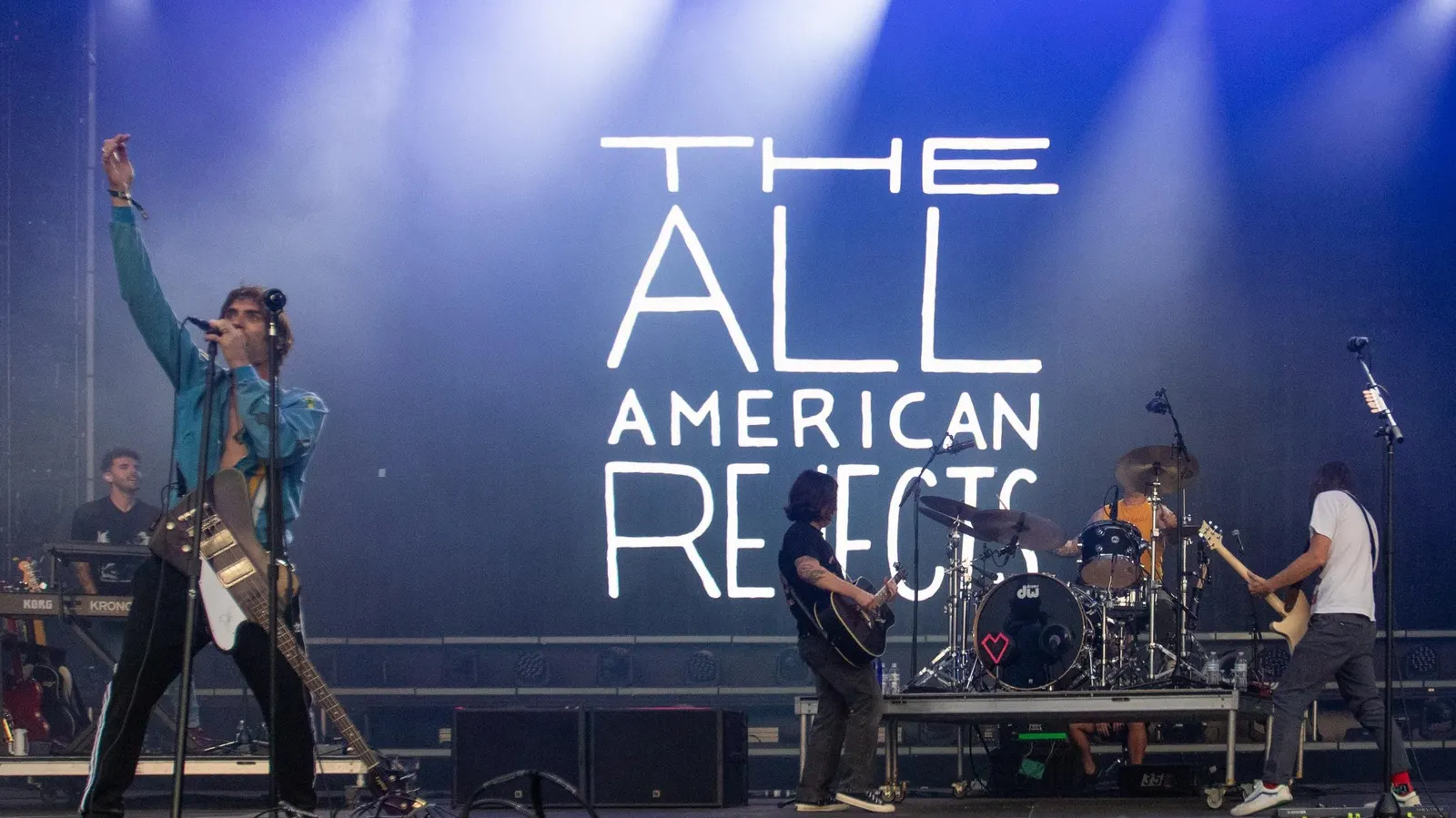

(Left to right) Tyson Ritter, Nick Wheeler, Chris Gaylor and Mike Kennerty of the All-American Rejects perform on stage on day one at Riot Fest. Friday, September 18, 2026 at Douglass Park in Chicago, Illinois
Photo by Ethan Chivari
Since forming in 1999, and releasing their self-titled debut studio album three years later, the All-American Rejects have moved in excess of 12 million albums globally, tallying three platinum records and a diamond certified single (“Gives You Hell”).
But since 2013, the group has been mostly on hiatus, releasing a new EP and a handful of singles since. But that changed in 2025 as the All-American Rejects hit the road for the “House Party Tour,” performing in non-traditional venues across the country in an effort to get closer to their fans in a more affordable manner while guiding their own trajectory as independent artists.
For frontman Tyson Ritter, that experience was paramount, leading to his formation of PlayHouse, a potential live music disruptor which helps connect artists with alternative venue spaces while cutting out middlemen like promoters and bookers. It’s an arrangement which helps artists develop realistic touring expectations with less risk. It also helps rein in ticket prices for fans while increasing artist profits.
Earlier this year the All-American Rejects returned with their fifth studio album Sandbox, their first in nearly 15 years, performing last weekend at Riot Fest in Chicago as part of a U.S. tour set to wrap up November 7 in Battle Creek, Michigan ahead of an Australian outing in December. The new album not only marks a highly anticipated return but stands as the first and only studio album they’ve released as independent artists.
I spoke with the All-American Rejects backstage at Riot Fest about lessons learned during the “House Party Tour,” the influence of it on PlayHouse, navigating art and commerce as independent artists, prioritizing the fan experience, creating Sandbox and the perspective gained from taking a break. A transcript of our conversation, lightly edited for length and clarity, follows below.
Nick Wheeler (left) and Tyson Ritter (right) perform on stage with the All-American Rejects on day one at Riot Fest. Friday, September 18, 2026 at Douglass Park in Chicago, IL
Photo by Ethan Chivari
Jim Ryan: What do you learn going on a tour like the “House Party Tour” after so much time had passed since the band toured regularly?
Mike Kennerty: There’s a lot of liability when you’re throwing a show yourself – or when thousands of people show up to a show you’re throwing yourself. But we got around that and figured that out. And it was just a lot of fun. I missed that face-to-face connection with the audience so close.
Nick Wheeler: We learned that people do still want to go to concerts and have an experience and see live music – despite what ticket sales to real shows say nowadays.
Ryan: And then you had what I imagine is the polar opposite experience, which was touring with the Jonas Brothers in much larger amphitheatres and arenas and working with the Savannah Bananas a bit. What was it like having the juxtaposition of those two vastly different experiences doing small, unconventional venues versus much larger ones?
Nick: It was a lot of whiplash.
Tyson Ritter: With all due respect to the Jonas Brothers, I think we learned on that tour that it’s kind of everything we want to avoid in the future. A general admission ticket is the way of a rock band. Once you start dividing people by wealth or class, you’re just creating like a giant fishbowl of what we’re going through in America right now: which is the people that want music the most are the furthest away from it. And the people that are spoiled by their dads or oil barons can pay for the f–ing house seats. So, f–k that experience.
(Left to right) Nick Wheeler, Tyson Ritter, Mike Kennerty and Chris Gaylor of the All-American Rejects pose backstage prior to a performance on day one at Riot Fest. Friday, September 18, 2026 at Douglass Park in Chicago, IL
Photo by Ethan Chivari
Ryan: Doing the house parties, and getting reacquainted with your audience like that, and then performing presumably in front of younger fans on something like a Jonas Brothers tour, do you see a bit of a multi-generational thing happening now when you look out at your audience these days?
Nick: It’s neat. It’s neat at those house parties seeing people revisiting what they used to do – what we used to do – and then also younger people doing it for the first time (because they never had that opportunity to begin with). So, it is kind of multigenerational. It’s pretty awesome.
Ryan: In terms of making Sandbox, I’ve read that it was recorded a bit more piecemeal, that you guys weren’t all necessarily in the same room together. What was it like recording in a new way like that this time around?
Tyson: It was a f–ing mess. And if I could go back and just put out two songs at the top of the “House Party Tour,” I would. That being said, it was nice to get one under the belt. And it’s ultimately set us up to be able to take our time with the next record. To really find something in this new chapter of this band’s career.
Nick: Yeah, I think we’ve been testing the waters a lot since we kind of stepped back in 2013, putting out an EP or a single here and there. I think it was time to say something that was at least 30 minutes long.
Mike Kennerty performs on stage with the All-American Rejects on day one at Riot Fest. Friday, September 18, 2026 at Douglass Park in Chicago, IL
Photo by Ethan Chivari
Ryan: No label – and no label budget – but a lot more creative control I would imagine this time around going it independent. What was the give and take there and how has that independent experience felt so far?
Tyson: It’s f–ing awful. Putting a record out yourself is f–ing impossibly hard in the 2026 landscape. Everybody is trying to find a way to make a better bicycle. And I just want to f–ing kick the bike over and walk.
I think the biggest take away is that everything that you need to do as a band, today, in 2026, has to be in person. That’s from concerts to selling your own s–t. Make it something tangible. The concert experience is tangible. The record experience is tangible. But the digital world is crushing artistry in every aspect – especially when it comes to monetizing art. If you want bands to survive in the next 10 years, you have to support them in all aspects as a fan. I take that upon myself for the music I love. And I hope that people realize if they want bands to make it they’re gonna have to f–ing show their support in all aspects.
Nick: I will say, making this album was one of the more pleasurable experiences. Not necessarily the actual recording of it – but just making it in general and everything that goes into that. There wasn’t a label A&R guy breathing down our neck or anything like that. There wasn’t too many cooks in the kitchen, you know? And it was probably as pure an album as we’ve released since the first album. Because nobody cared about us then either!
Nick Wheeler (left) and Mike Kennerty (right) perform on stage with the All-American Rejects on day one at Riot Fest. Friday, September 18, 2026 at Douglass Park in Chicago, IL
Photo by Ethan Chivari
Ryan: I know “Easy Come, Easy Go” had kind of been around for a bit. But was there a moment working on the new album where you really felt like it was coming together, that you were really onto something?
Tyson: No. This is like a quilt. A quilt of f–ing four years. We scavenged “Easy Come, Easy go” from a session I did with a guy who ended up producing most of this record with us. And I remember sending that s–t to Nick like five years ago. He was like, “I don’t think it’s for the band.”
Nick: I don’t remember that! (Laughing)
Tyson: It’s taken a long time to wind up this long tale of being off. I feel like we’re just now activated. So, this was kind of the cobbled experience of the last 10 years.
Ryan: Obviously, pushing this thing forward you guys are not merely relying upon nostalgia. There is some, sure. But there’s also new music. Plus, you’ve found new ways to really make the live experience unique. How important is it to you guys to continually find new ways to do that and not just rely solely on nostalgia?
Nick: I think it’s everything. Because before there was new music, and before there was a drive to create it, just showing up to play the same songs that we’ve been playing for a long time kind of got a little old. I still like playing those songs. But, man, now that we get to plug a couple of new ones in there, it kind of brings everything else back to life along with it. At least for me.
(Left to right) Nick Wheeler, Mike Kennerty and Chris Gaylor perform on stage with the All-American Rejects on day one at Riot Fest. Friday, September 18, 2026 at Douglass Park in Chicago, IL
Photo by Ethan Chivari
Ryan: Tyson, you dreamt up the PlayHouse idea following the “House Party” tour. It seems like the idea grew out of that. What’s it been like for you helping your fellow artists find these creative new ways to stage the live experience today affordably?
Tyson: Making PlayHouse out of the sort of genesis of what we distilled out of the house parties has been the greatest experience of my life. Because not only do we get to sort of create a platform where artists can pregame their tour to be certain that they can keep their lights on before they even leave their house, we also deconstruct the way that the gatekeepers have kept this model. DistroKid has given every artist who wants to make and distribute their own music on a digital platform accessibility. There’s no access for the live experience. And PlayHouse is filling that void for thousands of artists that will always, otherwise, be at the whim of some gatekeeper, whether it’s a booker or promoter. That’s gone now.
So, we’re de-risking everything about live touring for artists. I mean, this is gonna be revolutionary. And, I think, three years from now we’re going to be standing on something that’s the way. And agencies are going to be shaking in their f–ing boots because it exists.
Ryan: Well, taking a break – stepping away from this and coming back to a wholly different music industry landscape. What kind of perspective does that give you moving forward?
Tyson: I feel like we’re the band standing on the beach in a retirement village. Everything now is just icing. That we still get to do it? That we still have a drive to do it? And that the All-American Rejects have the means to be able to continue to do it is what I hope for every artist out there.








Leave a comment