


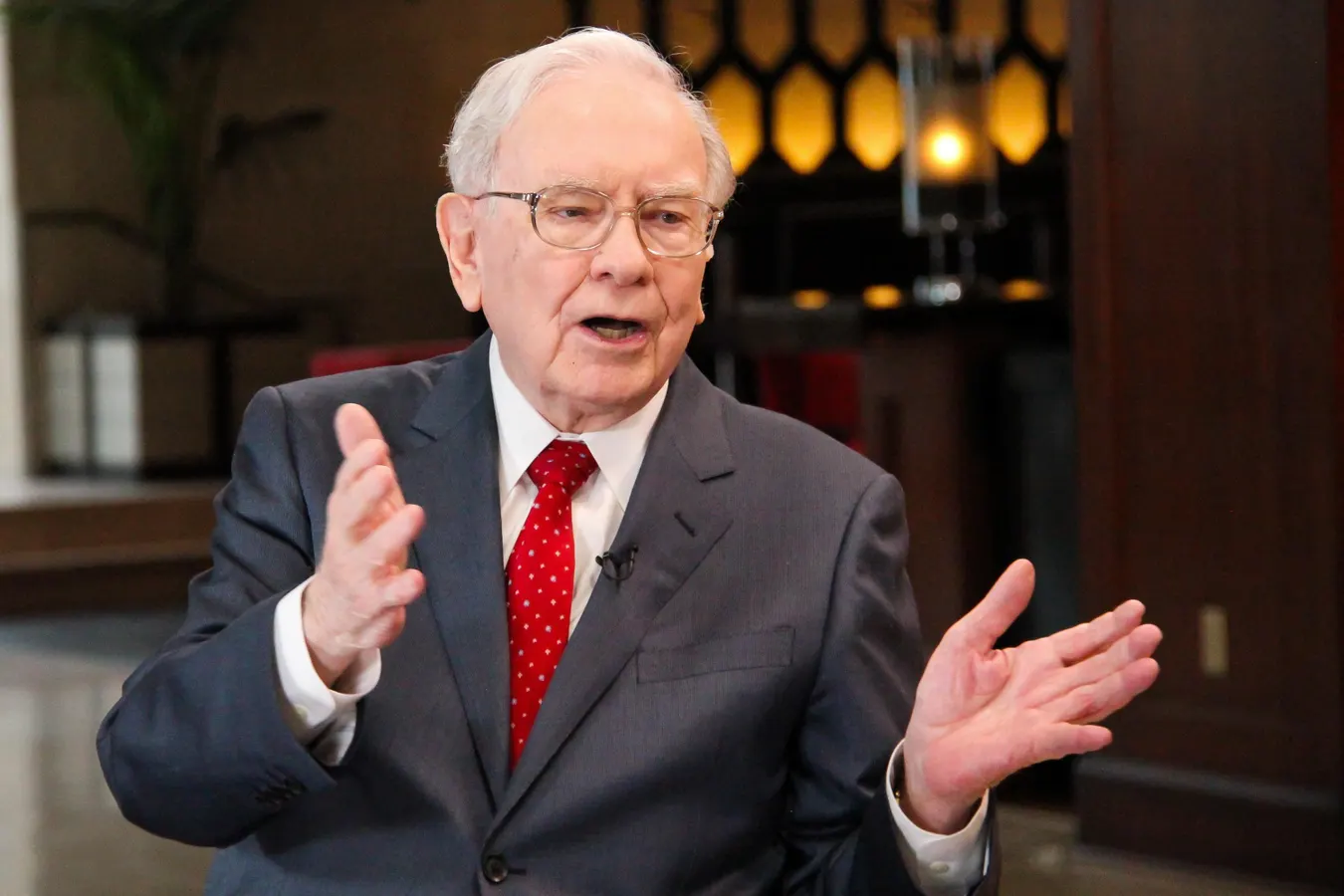

SQUAWK BOX — Pictured: Warren Buffett, chairman and CEO of Berkshire Hathaway, and consistently ranked among the world’s wealthiest people, in an interview with Squawk Box on February 29, 2016 — (Photo by: Lacy O’Toole/CNBC/NBCU Photo Bank/NBCUniversal via Getty Images)
NBCU Photo Bank/NBCUniversal via Getty Images
Retail investors are bracing for a wave of blockbuster IPOs — from SpaceX to OpenAI to Anthropic — with private‑market valuations stretching toward a trillion dollars. But Warren Buffett would tell them the same thing he’s said for decades: the moment of peak excitement is usually the worst time to buy.
In a 2019 CNBC interview, as the Uber IPO dominated headlines, Buffett summed up Berkshire Hathaway’s limited history with new listings: “In 54 years, I don’t think Berkshire has ever bought a new issue.” He explained why he avoids them: “The idea of saying the best place in the world I could put my money is something where all the selling incentives are there, commissions are higher, the animal spirits are rising… just doesn’t make any sense.”
Buffett’s point wasn’t that every IPO is a bad investment. His concern was that IPOs tend to arrive when enthusiasm is at its highest and valuation discipline at its lowest — a dynamic that feels especially relevant today.
The legendary investor has made only a few notable exceptions to his IPO philosophy. The first was in 1955, when he bought 100 shares ahead of the Ford IPO and made a quick $500 profit. The second was Berkshire’s uncharacteristic participation in Snowflake’s 2020 IPO — a position widely attributed to lieutenants Todd Combs and Ted Weschler and fully exited by 2024 with modest outcomes.
Even these rare exceptions reinforce Buffett’s broader point: investment outcomes depend less on the hype surrounding a new listing and more on the price paid for the shares.
Buffett has also said investors often buy into an IPO because of the hype and because they want to catch up with others getting rich, and that’s not a sound basis for an investment.
Why FOMO Still Drives IPO Buying
The legend was talking about FOMO — the fear of missing out — which is particularly relevant today as retail investors speculate about upcoming IPOs from highly valued private companies such as SpaceX, OpenAI and Anthropic, with current valuations pushing staggering levels like a trillion dollars.
History offers examples of several high-profile tech IPOs that launched with tremendous fanfare only to face narrative fatigue and reality checks later, leading to underperformance in the public markets.
Take Snowflake (NYSE: SNOW), which debuted in 2020 as the largest software IPO at the time.
Snowflake’s IPO By The Numbers
Snowflake (September 2020 IPO)
- IPO price: $120
- First-day close: roughly $254
- Peak market capitalization: more than $120 billion
- Market capitalization in October 2025: roughly $79 billion
- Market capitalization as of June 5, 2026: $82.6 billion
What Happened To Snowflake
While hype drives valuations up, public markets eventually demand clear, sustained performance, not just vision.
- SNOW’s steep valuation multiples came under pressure as revenue growth decelerated.
- Growth rate dropped from 106% in fiscal 2022, to 69% in 2023, to 36% in fiscal 2024 and to 29% for 2025 and recent fiscal 2026.
- Lack of GAAP profitability and high stock-based compensation were among other concerns.
- To top it off, interest rates began rising in 2022, and investors lost the willingness to pay premium multiples.
Yet the most important lesson from Snowflake may not be about growth rates or profitability or macro tightening. It may be about the entry price.
Virtually no retail investor had the opportunity to buy Snowflake shares at the IPO price of $120. Shares were allocated almost entirely to institutional investors and select high-net-worth clients of the underwriting banks and select anchor investors, including Warren Buffett’s Berkshire Hathaway and Salesforce Ventures, which bought in via private placements.
When trading actually commenced on the public market, rampant demand caused the stock to open at $245 per share, touch an intraday high of $319 and close at $253.93. The intraday low was $231.11.
For many retail investors, the actual entry point was closer to $245 than $120.
Assuming a retail investor bought shares at $231.11, Snowflake’s intraday low on its IPO day, and held them through June 5, 2026, they would have gained roughly 3% based on the stock’s closing price of $238.26.
How The Index Fund Comparison Changes The Story
Now consider the alternative.
The S&P 500 index fund VOO closed at an adjusted price of $286.46 on Sept. 16, 2020, the day Snowflake debuted. An investor who bought VOO on that date and continued holding it through June 5, 2026, would have earned a gain of roughly 137%, with the fund closing at $678.
In this case, the boring index fund outperformed the more exciting IPO, largely because investors were able to buy VOO at a far more reasonable valuation.
The comparison is not meant to suggest that Snowflake is a weak company. In fact, the stock has recovered substantially from its lows, and its one-year return of roughly 15% is impressive. The company is expected to deliver revenue growth of 30% this fiscal year.
What Retail Investors Should Remember Before The Next Mega‑IPO
For retail investors evaluating future blockbuster IPOs, a few lessons stand out:
- Much of the anticipated growth may already be priced in before the company reaches public markets.
- Existing investors and underwriters have strong incentives to maximize valuation, not necessarily long-term returns for new buyers.
- Highly valued private companies often face uncertain timelines to sustained profitability.
- Missing the IPO does not mean missing the opportunity. Stocks rarely move in a straight line, and often offer better entry points later.
Please note that I am not a registered investment advisor and readers should do their own due diligence before investing in this or any other stock. I am not responsible for the investment decisions made by individuals after reading this article. Readers are asked not to rely on the opinions and analysis expressed in the article and encouraged to do their own research before investing.















Leave a comment