


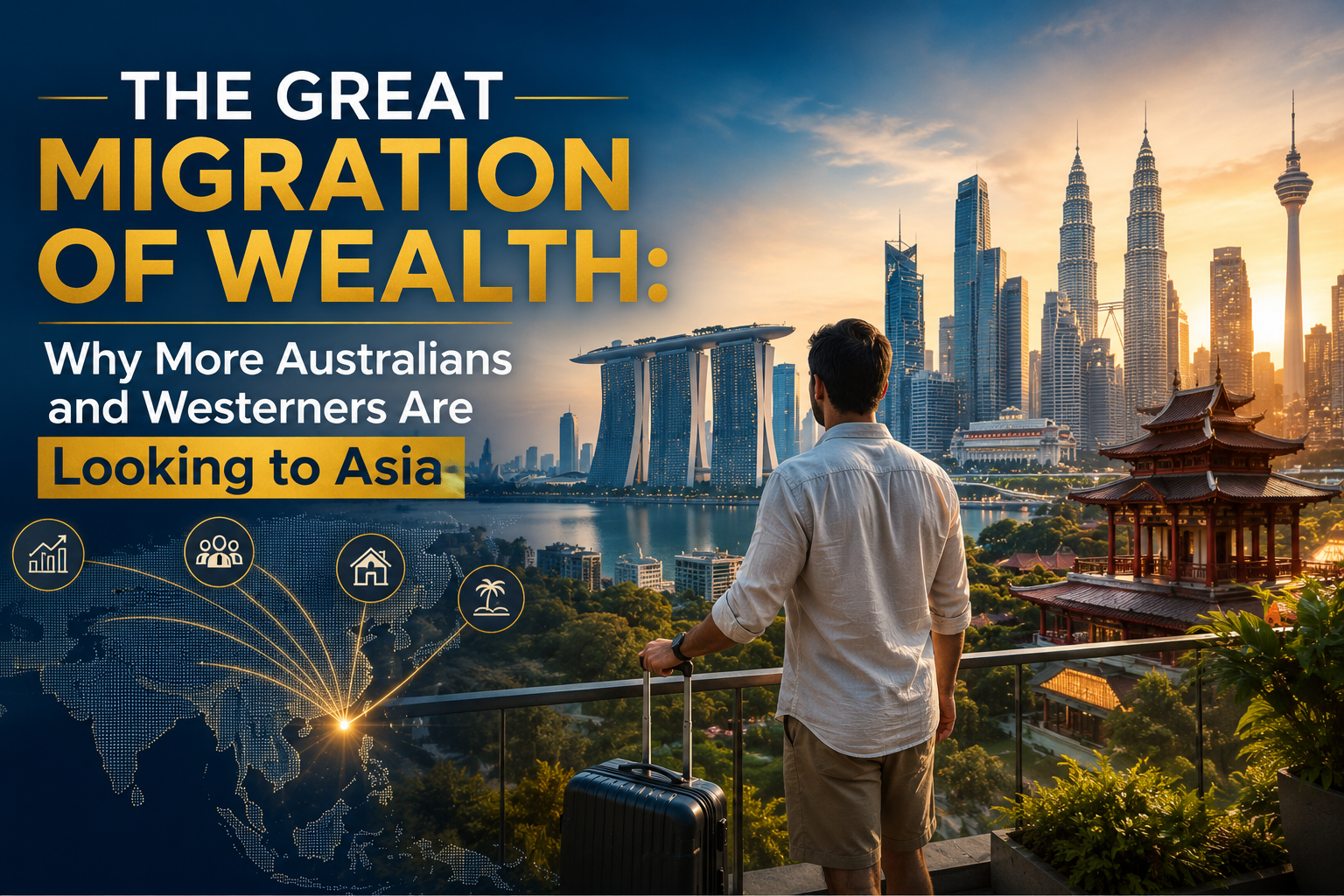
The Great Migration of Wealth: Why More Australians and Westerners Are Looking to Asia
By Jamie McIntyre
There are moments in history when economic, demographic and technological trends converge to reshape the way people live, work and invest.
I believe we are living through one of those moments now.
For decades, Australia represented the dream. It was one of the world’s most prosperous nations, offering affordable housing, a high standard of living and opportunities that attracted people from around the globe.
Today, Australia remains a remarkable country, but it has also become one of the most expensive places in the developed world to buy a home, raise a family and retire comfortably.
As a result, increasing numbers of Australians, along with Europeans, North Americans and others from higher-cost Western economies, are beginning to look beyond their own borders.
Many are discovering that the future they want may lie in Asia.
A Trend I’ve Been Watching for Years
Over more than 25 years of studying investment cycles and global wealth trends, I’ve always believed that the biggest profits are made by recognising major shifts before they become obvious.
During previous decades, I publicly encouraged investors to buy Australian real estate while many markets were still affordable.
I also publicly shared my bullish view on Bitcoin when it traded at around US$75, long before it became widely accepted, and later publicly stated that investors should consider taking profits when Bitcoin approached US$110,000.
Looking back, I believe members of my investor community have collectively created wealth well in excess of US$10 billion through Australian property, Bitcoin, precious metals and other investments by applying many of the long-term investment principles I have taught.
Past performance does not guarantee future outcomes, but I believe history demonstrates the importance of identifying structural trends early.
Today, I believe another major trend is unfolding.
Australia’s Affordability Challenge
Australia has experienced one of the strongest property booms in the developed world.
While this has benefited existing homeowners, it has also created serious affordability challenges.
Many younger Australians now struggle to save a deposit.
Those who purchase often face mortgages extending over several decades.
Those unable to buy compete in rental markets where dozens, and sometimes hundreds, of applicants compete for a single home.
At the same time, Australians continue facing higher costs across almost every aspect of life.
Housing.
Energy.
Insurance.
Food.
Healthcare.
Education.
Childcare.
Taxes and government charges.
For many families, the dream of financial freedom feels further away than ever.
The Digital Revolution Has Changed Everything
The world has changed dramatically.
Millions of people no longer need to work from a traditional office.
Entrepreneurs operate online.
Professionals work remotely.
Businesses sell globally.
Investment portfolios can be managed from almost anywhere.
Location has become a lifestyle choice rather than simply a workplace requirement.
That single change is transforming migration patterns around the world.
Why Bali?
Australians have enjoyed a love affair with Bali for generations.
For decades it has been Australia’s favourite international holiday destination.
People understand the culture.
They enjoy the tropical climate.
They appreciate the friendliness of the Balinese people.
Direct flights make travel relatively convenient.
Following the pandemic, Bali experienced a powerful resurgence in tourism while also becoming one of the world’s fastest-growing international lifestyle destinations.
Australians have been joined by Europeans, Americans, Russians and many other nationalities choosing to spend extended periods, establish businesses or relocate permanently.
Bali is evolving from a tourism destination into an international residential and entrepreneurial hub.
Lombok: The Next Chapter
Neighbouring Lombok is increasingly attracting attention as infrastructure expands and tourism grows.
Many investors see Lombok as offering the opportunity to participate in an earlier stage of development while benefiting from improving accessibility and increasing international awareness.
With significant land availability and major tourism investment, Lombok is becoming an increasingly attractive destination for long-term investors.
Lifestyle Meets Investment
Many Australians are no longer making a choice between Australia or Asia.
They are choosing both.
Maintaining assets in Australia while diversifying internationally has become an increasingly common strategy.
Many retirees now spend part of the year overseas.
Others establish businesses that allow them to live more flexibly.
Some purchase holiday homes that also generate rental income.
International diversification has become as much about lifestyle as investment returns.
A Different Development Philosophy
Recognising these long-term trends, LUX Property Group has developed a business model aimed at making international property ownership more accessible.
Rather than waiting until projects are completed before selling at full retail prices, the company has focused on offering wholesale pricing during construction on selected developments.
It has also introduced initiatives including interest-free developer finance on selected projects, turnkey delivery, professional property management, furnished properties, builder warranties and resort-style facilities designed to simplify overseas ownership.
The philosophy is straightforward.
If buyers commit early and wait for construction, they should share in the value created during the development process.
Looking Beyond Individual Properties
LUX Property Group’s vision extends beyond individual villas.
Its projects include integrated lifestyle communities incorporating hotels, restaurants, wellness facilities, recreation, retail precincts and larger master-planned developments.
Among its most ambitious projects is the proposed Nesara Bay City in Lombok, envisioned as a mixed-use coastal community designed to serve residents, investors and visitors alike.
The Next Decade
No one can predict the future with certainty.
However, demographic trends, technology, affordability pressures and changing work patterns are reshaping global migration.
Australia will undoubtedly remain one of the world’s great countries.
But for an increasing number of Australians, building wealth and enjoying a higher quality of life may involve looking beyond Australia’s shores.
I believe what we are witnessing today is not a temporary phenomenon.
It is the early stages of a long-term shift in capital, talent and lifestyle toward Asia.
The steady trickle of Australians and other Westerners relocating assets, businesses or themselves into destinations such as Bali and Lombok may, over the next decade, become something far larger.
History often rewards those who recognise major trends before they become obvious.
This may prove to be one of them.
⸻
Disclaimer: This article expresses the author’s opinions and observations. References to past investment commentary are provided for context and do not constitute a guarantee of future investment performance. Property and financial investments involve risk, and readers should seek independent professional advice before making investment decisions.





Leave a comment