


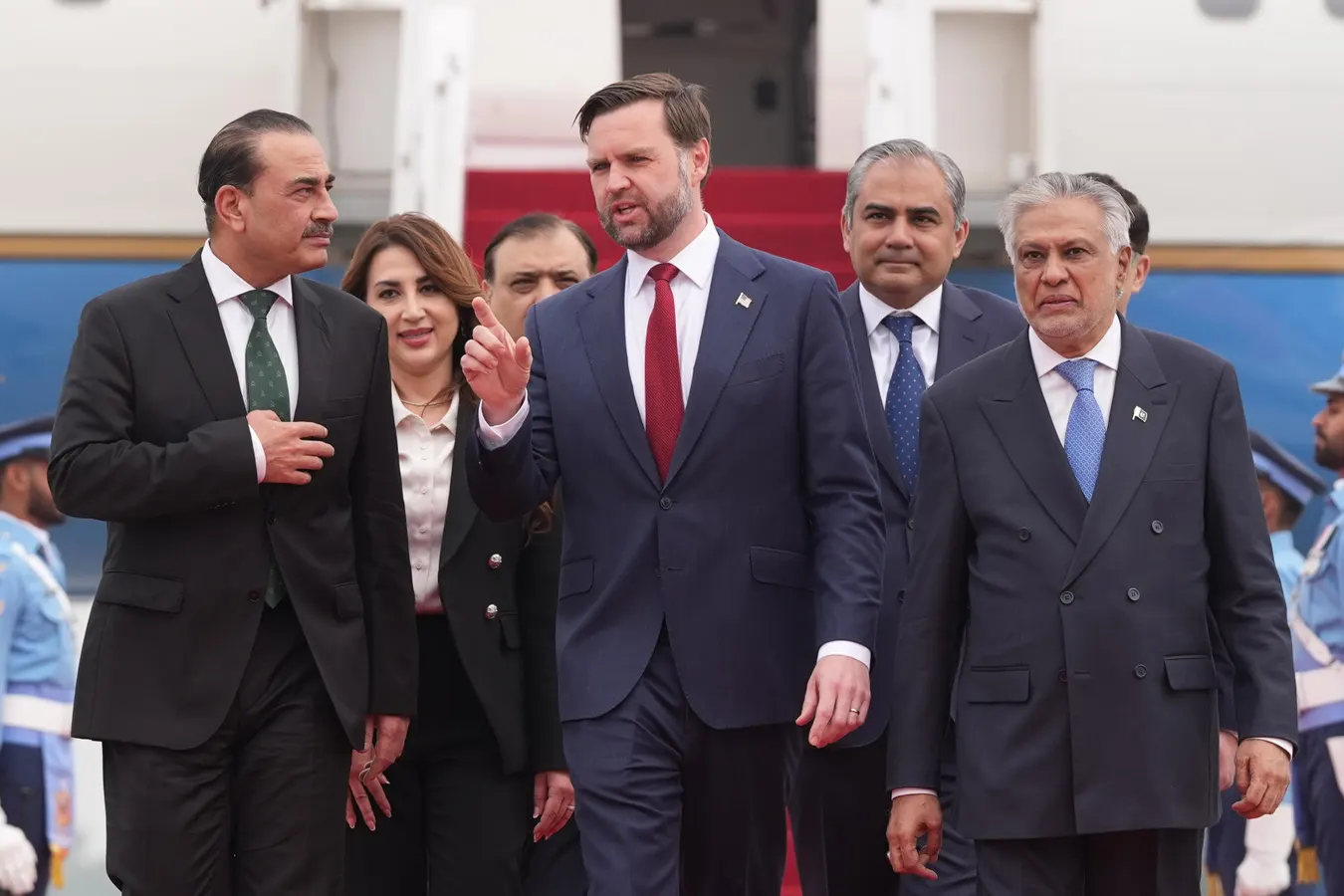

ISLAMABAD, PAKISTAN – APRIL 11: U.S. Vice President JD Vance (C) walks with Pakistan’s Chief of Defence Forces and Chief of Army Staff Field Marshall Asim Munir (L), and Pakistani Deputy Prime Minister and Foreign Minister Mohammad Ishaq Dar after arriving for talks with Iranian officials on April 11, 2026 at Islamabad, Pakistan.
Getty Images
The announcement that Washington and Tehran have agreed to end hostilities and restore commercial access to the Strait of Hormuz has had a massive impact on markets. Crude futures dropped sharply.
To some, for a brief, euphoric moment, it looked like one of the Middle East’s most dangerous escalatory cycles had finally halted. But seasoned observers of the region, particularly Iranian foreign policy experts, know better than to call this peace. It is more precisely an incomplete pause or armistice. The 14-point Memorandum of Understanding signed by President Trump in Versailles on Wednesday leaves many issues unresolved.
The deal already raises serious questions about the credibility of the United States not only as a guarantor of freedom of navigation in the global commons, but also as a global power that can make its red lines stick. As recently as March 6, Trump was calling for “unconditional surrender,” full ballistic missile disarmament, and an end to the Iranian regime’s support and proliferation of armed proxies throughout the region. He seems to have achieved none of these goals.
The global implications of the Iranian MOU are dire. U.S. deterrent power in the Taiwan Strait, in the South China Sea, and on the Korean Peninsula suffered a historic blow. Fortunately, Russia is bogged down in Ukraine enough that it appears not to be in a position to present a major threat in Europe. For now.
Some observers have compared this Gulf war with the ill-fated adventure of the declining British Empire and the French Republic at Suez in 1956, which heralded their terminal geo-strategic demise. At least, the then-superpowers, the USSR and the U.S., were aligned against London and Paris. There is very little Washington can show today as a strategic geopolitical achievement.
Iranian foreign ministry spokesman Esmail Baqaei responds to reporters on his country’s foreign policy agenda and regional developments during the weekly press conference held at the Ministry of Foreign Affairs in the capital Tehran, on February 10, 2026.
AFP via Getty Images
What the Deal Does
If the MOU sticks, the Strait of Hormuz, through which roughly one-third of the world’s traded oil passes, will once again open. This means that the tankers and cargo ships trapped in the Persian Gulf since March be able to exit, although shipping giants predict that the ships won’t actually pass through the Strait for some time. Insurance rates will reflect whether navigation in the Strait becomes safe.
Gulf States that had rushed to plan pipeline corridors to Red Sea ports, a costly, years-long infrastructure gamble driven by desperation, may now reassess those projects. From a financial standpoint, leaning back into the hydrocarbon infrastructure in the Strait of Hormuz is a rational and, in part, unavoidable, step. However, now that Iran has played its trump card, future projects will price in a political risk premium. Expect more pipelines going from the Gulf States to traverse Arabia to the Red Sea and Mediterranean, albeit Iranian ballistic missiles can target oil terminals there, just as they hit Kuwait, UAE, Qatar, and Saudi Arabia. Only reinstated deterrence will work in the future.
The war has also driven a surge in investment in non-Gulf hydrocarbon assets, especially in the Atlantic and Pacific basins, including Africa and Latin America. Expect increases in project financing in Angola, Equatorial Guinea, and Nigeria, as well as Argentina, Brazil, Guyana, and Venezuela. Eurasia will continue to be an investment magnet, in particular Kazakhstan for oil, and Turkmenistan for gas. Russia will attract renewed attention if and when the war in Ukraine ends, and Western sanctions are removed.
Non-hydrocarbon energy sources, such as solar, wind, and nuclear will also attract increased capital flows, especially as renewable sources of energy become increasingly competitive.
Whether the deal slows the momentum of these trends or merely redirects them remains to be seen. Energy transitions rarely reverse simply because a single chokepoint reopens. Furthermore, capital flowing into energy markets will now be devoted to rebuilding damaged oil and gas infrastructure in the Middle East, not just expanding the energy market overall.
TEHRAN, IRAN – JANUARY 10: Iranian Basij militia members display their drones during military manoeuvres on January 10, 2025 in Tehran, Iran. Drones are some of Iran’s most important military tools.
Getty Images
What the Deal Doesn’t Do
The list of unresolved issues is sobering.
Iran’s nuclear program remains where it was. Tehran has accumulated uranium enriched to 60% in the Bushehr reactor, levels not necessary for civilian power generation, and sufficient for the production of at least nine nuclear weapons. This alarms Western and Israeli intelligence agencies, and nothing in the current framework beyond Iran’s say-so meaningfully constrains its path to a weapons-grade threshold. The IAEA’s inspections authority, already contested by Tehran before the war, is now the subject of bitter negotiations that may drag on for months. Iran has historically treated verification as a matter of sovereignty. That may get worse, as the IRGC has taken the leading role in the Shia theocracy.
Sanctions relief and release of the frozen Iranian assets of approximately $12 billion to $24 billion indirectly, are perhaps the most combustible near-term issues. Around the world, up to $120 billion in Iranian funds are frozen by sanctions.
The Trump Administration dangled the carrot of a $300 billion Reconstruction Fund to be committed to by the Gulf States. Most of these funds would nominally be directed toward rebuilding bombed-out refineries, ports, and airports. However, a look at the actual contributions versus commitments for Gaza reconstruction raises questions about the much bigger endeavor promised by the U.S.
Tehran is demanding immediate and substantial economic relief as a prerequisite for sustained compliance. Washington, facing domestic political constraints and healthy skepticism, including in Congress, is offering phased relief tied to verified behavioral changes. The gap between those two positions is wide. Conflicting statements from both capitals in the hours and days following the announcement have done little to clarify where the actual red lines are and are a troubling sign for a deal that depends on mutual confidence.
Then there is Lebanon.
Hezbollah’s (and Iran’s) conflict with Israel continues unabated, and, despite the promise of a ceasefire, the situation is being addressed within the US-Iran ceasefire framework without consulting Israel, with implementation remaining deeply contested. Trump repeatedly expressed displeasure with Israeli Prime Minister Benjamin Netanyahu while studiously failing to mention that Hezbollah has continued to attack Israeli troops and remains a heavily armed militia outside the control of the Lebanese government.
Iran has funded, armed, trained and inspired the group for four decades. The title of Hezbollah’s leader is officially the “representative of the (Islamic Republic’s) Supreme Leader in Lebanon”. Any lasting normalization of Iranian-American relations will eventually require reckoning with what Tehran is willing, or able, to ask of its Lebanese proxy, and how America can support and guarantee the security of its closest ally: Israel.
What Comes Next
The near-term test for this deal will be the IAEA inspection question. If Tehran accepts robust, intrusive monitoring with short-notice access provisions, it will signal genuine intent. If the negotiations stall, as they have before, the ceasefire framework will begin to look like what skeptics already fear: a tactical maneuver that relieves Iranian economic pressure without constraining its strategic ambitions.
The deeper test will be Hezbollah. As long as the Iranian-backed terrorist organization refuses to lay down its arms despite the explicit desire of both the Lebanese Christian and Sunni Muslim communities and continues active military operations against Israel in Lebanon on behalf of Iran, the United States will face pressure from key regional allies, including Israel and the UAE. Even Israel’s antagonist Turkey is not happy with Hezbollah’s running roughshod over Lebanon. Ankara would like to use its ally Syria to disarm the Iranian proxy and open another front against Israel.
A deal that opens the Strait of Hormuz is worth having, but at what cost? The Middle East has a long history of agreements that have failed to solve anything. Just look at the numerous deals and UN Security Council Resolutions that promised Hezbollah’s disarmament. The current ceasefire deserves cautious optimism in the near term. In the longer term, there are storm clouds on the horizon.














Leave a comment