


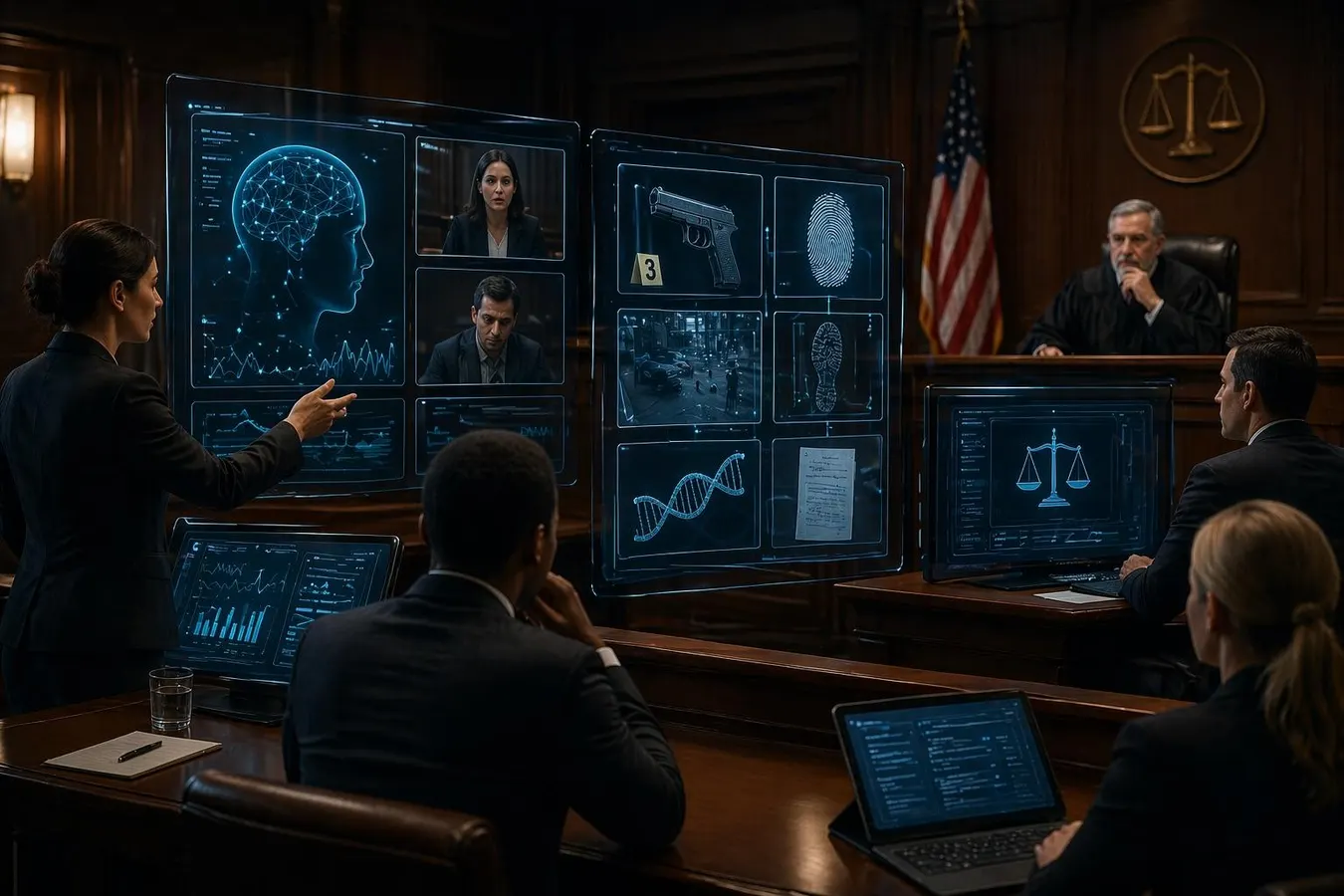

Artificial intelligence has moved from the back office to the witness stand, becoming the foundation for expert testimony and forensic evidence in criminal trials.
AI
Artificial intelligence (AI) is no longer just a tool for legal research. It is now also the foundation for expert testimony and forensic evidence in federal criminal trials, with significant implications for white-collar practitioners. AI-generated evidence, however, presents concerns of analytical errors, bias, and lack of interpretability, raising serious reliability questions. When such evidence accompanies expert testimony, Federal Rule of Evidence 702 and the Daubert v. Merrell Dow Pharmaceuticals, Inc. standard apply, requiring trial courts to act as gatekeepers to ensure that expert testimony rests on reliable methodology under a preponderance of the evidence standard. The application of such evidentiary rules to AI has had mixed results. Some courts have excluded AI-generated evidence when experts fail to verify outputs or explain methodology, as in In re Celsius Network LLC.Other courts have admitted such evidence when its proponents laid an adequate foundation, as in United States v. Sterlingov. Recognizing that AI-generated evidence also may enter the record without expert testimony, potentially escaping Rule 702’s heightened reliability requirements, the U.S. Judicial Conference’s Advisory Committee has proposed Federal Rule of Evidence 707 (“Machine-Generated Evidence”), set for a vote on May 7, 2026, which would extend Rule 702’s reliability requirements to AI-generated evidence offered without an expert. AI-generated evidence in a criminal case also presents issues under Crawford v. Washington, which emphasized the standard for admission of hearsay statements under the Confrontation Clause to require the opportunity for confrontation when a statement is “testimonial,” or created primarily for use in criminal proceedings. Confrontation challenges to AI-generated evidence pose questions of whether a machine can be a witness against a criminal defendant, and if so, how does one “confront” a machine? As evidentiary rules take shape in response to AI, they will define how practitioners can harness or challenge AI’s power in white-collar cases.
The Gatekeeper’s Dilemma: Applying the Federal Rules of Evidence to AI
Courts tasked with assessing the authenticity and reliability of evidence are grappling with applying existing evidentiary rules to AI-based evidence that parties seek to enter into the record, such as algorithmic analyses identifying patterns in financial transactions and stock trading, blockchain tracing reports detecting cryptocurrency movements, machine-learning models flagging anomalies in billing data, and AI-authored valuation reports synthesizing complex datasets. Most AI-generated evidence enters the courtroom through expert testimony subject to Federal Rule of Evidence 702, as interpreted by the Supreme Court in Daubert, which requires trial courts to act as “gatekeepers” to admit only expert witness testimony that is based on sufficient facts or data, is the product of reliable principles and methods, and reflects a reliable application of those principles to the facts of the case. In other words, Rule 702 is designed to ensure that expert testimony, including AI-generated conclusions or outputs introduced by experts, rests on a sound scientific or technical foundation.
On the other hand, AI-generated evidence also may be admitted directly or through a lay witness under Federal Rule of Evidence 902(13), which provides a self-authentication mechanism for certified records generated by an electronic process or system. This pathway allows AI-generated evidence to be introduced based primarily on a certification regarding the system’s general accuracy, without subjecting the underlying AI methodology to the more demanding scrutiny that Rule 702 applies to expert testimony. For now, this means that certain AI-generated evidence may evade Rule 702’s reliability requirements, raising questions about whether the current evidentiary framework adequately addresses the unique challenges posed by artificial intelligence.
In August 2025, the Advisory Committee on Evidence Rules proposed a new evidentiary rule in response to concerns that machine-based inferences and the reliability of that process are akin to reliability concerns about expert witnesses, and that parties may admit AI-generated opinions in lieu of expert testimony. Proposed Rule 707 provides that “[w]hen machine-generated evidence is offered without an expert witness and would be subject to Rule 702 if testified to by a witness, the court may admit the evidence only if it satisfies the requirements of Rule 702(a)-(d).” The proposal clarifies that the requirements would not apply to “the output of simple scientific instruments,” such as the results of a mercury-based thermometer or an electronic scale, which do not present the same reliability concerns as inferences and predictions produced by a machine or AI system. The proposal has received mixed feedback, with some commenters seeking more clarification as to what “machine-generated evidence” encompasses and others raising concerns that this approach encourages individuals to admit AI-generated evidence in lieu of expert testimony.
Recent cases applying reliability requirements to machine-generated evidence accompanying expert testimony offer a preview of the evidentiary battles that will define white-collar litigation in the years ahead, especially if the new Rule is adopted. In the context of probabilistic genotyping software used for forensic DNA identification, appellate courts, such as the Third Circuit in United States v. Anderson and the Sixth Circuit in United States v. Gissantaner, have applied the Daubert factors, which include whether the expert’s method or technique (1) “can be (and has been) tested;” (2) has been “subjected to peer review and publication;” (3) has a “known or potential” error rate; and (4) has attracted widespread acceptance within a relevant scientific community. Courts have found probabilistic genotyping software reliable where output could be tested against other probabilistic genotyping programs, error rates could be calculated, and past admissibility in cases had been shown.
Opening the “Black Box”: Courts Confront AI Evidence Under Daubert
AI evidence presents challenges when courts evaluate whether expert testimony is reliable enough to be admitted in accordance with Daubert. One core issue is algorithmic opacity, often called the “black box” problem, which makes it difficult to test or explain how an AI system reaches its conclusions. Another concern under Daubert is that an AI system trained in one context may not produce reliable results when applied in a different setting, which makes error rates difficult to establish. AI methodologies also may not be able to undergo peer-reviewed validation since the systems evolve rapidly. These challenges have led courts to exclude AI-related evidence introduced by experts, but not in every case. The following cases illustrate how courts have navigated evidentiary challenges that will define white-collar litigation in the years ahead.
The decision in In re Celsius Network LLC, 655 B.R. 301 (Bankr. S.D.N.Y. 2023), offers a cautionary tale for white-collar practitioners seeking to admit AI-generated evidence accompanying expert testimony. In a bankruptcy proceeding, Chapter 11 debtors that operated a cryptocurrency lending platform and a committee of unsecured creditors moved to exclude a valuation report written by artificial intelligence at the instruction of opposing counsel’s valuation expert regarding the value of a utility token native to debtor’s platform. The report was generated within 72 hours, whereas a human-authored report would have taken over 1,000 hours to complete. The court, however, found the report was not the product of reliable methods because it did not contain citations to facts or data underlying the expert’s methods or opinions, and the expert did not review the underlying source material. The court excluded the expert’s report, but allowed the expert to still testify because he demonstrated sufficient knowledge on the topic.
By contrast, in United States v. Sterlingov, 719 F. Supp. 3d 65 (D.D.C. 2024), a case involving charges of money laundering and money transmission without a license, the court found the government had demonstrated by a preponderance of the evidence that blockchain tracing analysis generated by a proprietary computer software program relied upon by the government’s expert satisfied Daubert. Importantly for AI-evidence, the court concluded that a lack of a compiled “error rate” for the software did not diminish its reliability and denied the motion to exclude the analysis as evidence. In the end, the court was persuaded that the blockchain analysis was not “junk science,” and denied the motion to exclude the testimony and evidence based on the analysis. Sterlingov suggests that computer-processed evidence may survive Daubert when proponents lay an adequate foundation, even if not every Daubert factor is met.
When AI “Hallucinates”: Expert Credibility on the Line
Apart from challenges to the reliability of the underlying evidence, a developing doctrine concerns when an expert who relies on problematic AI outputs can still pass Rule 702 standards. In Kohls v. Ellison, No. 24-cv-3754 (D. Minn. Jan. 10, 2025), the court excluded expert testimony where the expert’s AI dependence impaired his judgment. The expert, a credentialed expert on the dangers of AI and misinformation, relied on AI to draft his declaration, and, ironically, he failed to discern that the AI system generated references to academic articles that did not exist and formulated incorrect citations. The court recognized that AI has “the potential to revolutionize legal practice for the better,” but excluded the expert’s testimony since his failure to verify the content of his declaration “shatter[ed] his credibility.”
The court in Ferlito v. Harbor Freight Tools USA, Inc., No. 20-cv-5615 (E.D.N.Y. Apr. 23, 2025), reached a different conclusion, finding little risk that an expert’s use of ChatGPT impaired his judgment regarding proper methods for securing a maul’s head to its handle. The key distinctions from Kohls were that the expert’s methodology and conclusions did not depend on the AI-generated content and no indication existed that the AI had produced any fabricated information. Rather, the expert used ChatGPT to confirm his initial findings, which the court found acceptable. Ferlito and Kohls suggest that courts are accepting of experts who treat AI as a research assistant, but experts must be able to independently verify the AI-generated content and explain how AI affected their methodology or conclusions.
The Road Ahead: Proponents and Challengers of AI Evidence
For practitioners on both sides of AI evidence disputes, the developing case law offers practical guidance. Proponents seeking to admit AI-generated evidence or expert testimony that relies on AI should anticipate Daubert challenges and build the evidentiary record accordingly. An AI system’s methodology should be documented thoroughly, and a known error rate should be established through validation studies applicable to the particular intended use. Practitioners also should retain experts who can explain the AI system’s operation in terms accessible to the court and jury and insist that the expert verify all AI-generated content and disclose all AI use. Document preservation is important at every step, from data input to final output.
Challengers of AI-generated or assisted evidence in criminal cases may raise Confrontation Clause arguments pursuant to Crawford, such as that AI-generated evidence is “testimonial” and admission requires defendants to have the opportunity for confrontation. Although lower courts have generally held that machine-generated evidence does not trigger the Confrontation Clause, AI may be distinguishable based on how the system is programmed and trained. If AI evidence is found to be testimonial, one issue previewed by the Court’s application of Crawford in Melendez-Diaz v. Massachusetts, a case concerning a forensic drug test, is who should be confronted when the machine accuser is the product of a team of programmers.
Aside from confrontation arguments, challengers of AI evidence in any case can contest the evidence’s reliability. Challengers of reliability should demand discovery of algorithmic details, training data, and validation studies, and retain experts capable of evaluating AI methodologies and identifying deficiencies. The Evidence Rules Committee’s scheduled May 7 vote on Rule 707 may provide clearer guidance on what reliability standard applies. Regardless, however, practitioners may utilize the Daubert framework to harness or challenge AI evidence. The Daubert factors most vulnerable in AI contexts include testability, known error rates, peer review, and governing standards. When challenging AI-assisted expert testimony, probe whether the expert independently verified AI outputs and whether the expert can explain how AI was used. If AI-generated evidence is admitted, challengers also may try to convince the jury that they should not trust AI evidence and should not rely upon it under these same principles.
As AI becomes more prevalent in investigations, compliance monitoring, and experts’ research, evidentiary battles are expected to become routine. Prosecutors will be required to defend AI outputs flagging suspicious transactions in court and experts relying on AI-research will face scrutiny. Practitioners who understand the Daubert framework and who prepare accordingly will be able to harness the power and efficiency of AI to make the algorithm work to their client’s advantage.














Leave a comment