


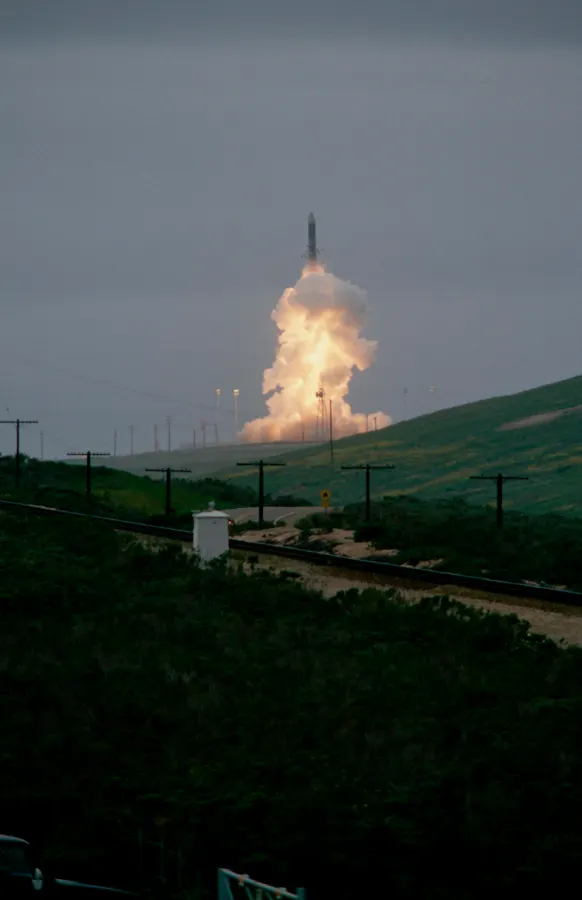

Distant view of an MX intercontinental ballistic missile as it rises from its silo during a test launch. This is the 11th test of the four-stage rocket, meant to modernize America’s nuclear weapons delivery arsenal. (Photo by Roger Ressmeyer/Corbis/VCG via Getty Images)
Corbis/VCG via Getty Images
Senior Pentagon officials have confirmed a proposed shift in U.S. nuclear policy that would put the use of tactical (short-range) nuclear weapons firmly on the table in a regional war with Russia or China.
Undersecretary of Defense for Policy Elbridge Colby suggested that the change is being considered because the president needs “more rational nuclear options” in such a scenario.
But the proposed approach is far from rational. It will make a nuclear exchange more likely, not less. And it will accelerate an already troubling growth in the reliance on nuclear threats as a centerpiece of U.S. national security policy.
Contrary to the logic of the proponents of making the use of tactical nuclear weapons a live option in a future conflict of Russia or China, there is no way to contain or limit a nuclear conflict once the bombs start falling. The idea that the use of tactical nuclear weapons will be met with a similar rather than greater action by a nuclear-armed adversary is a risk not worth taking.
Being attacked with tactical nuclear weapons is not an option that an adversary will just shrug off without retaliation, and likely with escalation. Once a nuclear attack and counterattack have occurred there is no guarantee that they won’t spark an all out nuclear conflict.
So, far from filling some sort of “deterrence gap,” contemplating the use of tactical nuclear weapons will only increase the risk of the very outcome they are meant to head off — a devastating nuclear exchange.
The new Pentagon guidance is part of a larger embrace of nuclear weapons as a guarantor of U.S. security. Over the next decade the Pentagon will spend nearly $1 trillion on nuclear weapons.
The nuclear spending plan includes building a new intercontinental ballistic missile, the Sentinel, which has already suffered massive cost overruns. More importantly, former Secretary of Defense William Perry has called ICBM’s “some of the most dangerous weapons we have” because a president would have only a matter of minutes to decide whether to launch them on warning of an attack, increasing the risk of an accidental nuclear exchange prompted by a false alarm. We would be safer if ICBMs were eliminated from the U.S. arsenal altogether.
Instead of building more nuclear weapons and crafting more reasons to use them, the Pentagon should seek to reduce the U.S. arsenal of nuclear weapons to the level needed for minimum deterrence, somewhere between 300 and 900 strategic warheads. Washington should consider further cuts if Russia and China can be brought along.
In addition, rather than cooking up more scenarios that involve “winning” a nuclear war, U.S. policy should be aimed at preventing a nuclear exchange. That’s far safer than expanding the arsenal or increasing the number of scenarios in which nuclear weapons may be used.
Even at the height of the Cold War confrontation between the U.S. and the Soviet Union, there were efforts to improve communications between the two rivals and to set at least some guardrails on the development and potential use of nuclear weapons. But now that New START, the last U.S.-Russia nuclear arms control agreement, has been allowed to lapse, both Washington and Moscow are flying blind in assessing each other’s intentions and capabilities in the nuclear sphere. This is an unacceptably risky situation that should be remedied by renewed talks on nuclear policies and postures aimed at reducing the prospect of nuclear use in any future conflict.
Few leaders of either party have discussed the revival of serious nuclear talks with Russia, an idea that used to have strong bipartisan support. In the remaining months between now and the midterm elections, and as the 2028 presidential election begins, candidates should be asked if they have a plan to reduce the risk of a potentially world-destroying nuclear conflict.
Other important issues, from the war on Iran to the tariff wars, have grabbed far more attention in policy circles and among the broader public, but we ignore discussing the future of U.S. nuclear posture, policies and spending at our peril.
A smaller nuclear arsenal with fewer scenarios in which it might be used would not only make America safer, it would free up tens, or likely hundreds of billions of dollars over the next decade, funds that could be used to address other urgent national needs.
We need a shift in nuclear policy, but increasing the prospect of using tactical nuclear weapons should not be part of it.
















Leave a comment