


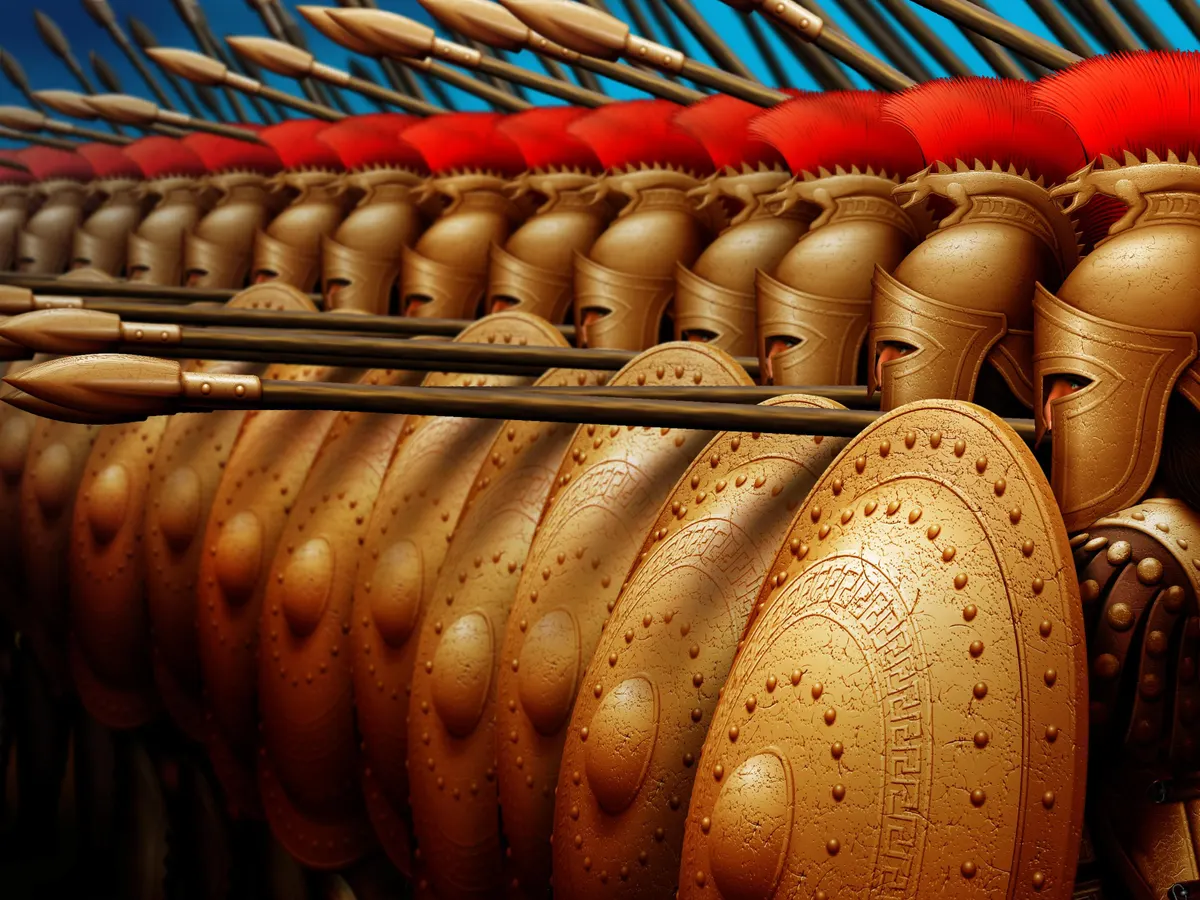

The Phalanx was composed of men who moved and fought as one cohesive unit, creating an impenetrable wall of interlocking shields.
getty
During my decades-long campaign in the high-stakes world of energy trading and utility operations, I’ve seen two very different types of “battlefields.” The first is the one I entered as a young leader—a Darwinian, “survival of the fittest” environment where individuals competed fiercely for personal gain, and information was not shared broadly. There was perceived value in being the one who controlled the information, like in “Game of Thrones.” The second is the one I’ve spent my executive career building: a Macedonian Phalanx.
Building the Phalanx
The Phalanx was an original and brilliant battlefield maneuver of Alexander the Great. This revolutionary military formation was, at its heart, a profound leadership philosophy of unified action. The Phalanx was composed of men who moved and fought as one cohesive unit, creating an impenetrable wall of interlocking shields. The core lesson of this formation is that the Phalanx is only as strong as its weakest link. If one soldier breaks rank or drops their shield, a hole is created that the enemy can exploit, compromising the entire unit.
When I rose to leadership, I made it my mission to transition our culture away from that “Game of Thrones” mentality toward this “warrior elite” model. Here is how we build that unbreakable wall:
1. Eliminating the “Peacocks”
On the energy trade floors of yesteryear, performance metrics often caused colleagues to hoard information with the goal of gaining an edge over the internal competition. To build a phalanx, you must shift from individual performance metrics to team-based objectives. By removing internal competition, you allow your team members to focus their energy externally—on competing with other companies rather than with the person in the next cubicle. I’ve used the phalanx analogy with my teams for years. “Shields locked, moving as one” became our mantra. We drill the idea that there can be “no holes” in our organization, because a single weakness compromises us all.
2. Fighting Internally to Win Externally
A unified front doesn’t mean a lack of disagreement. In fact, within the phalanx, we encourage robust, even fierce, debates. We do all our “fighting” internally during the preparation phase so that every perspective is heard and every weakness is identified. However, once we face the external world—whether it’s a negotiation, a regulatory investigation, or a catastrophic storm—we present one wall. To the outside world, we are a single, disciplined force to be reckoned with.
3. Hiring for the “Unteachable”
You cannot build a “warrior elite” on technical skill alone. When I assemble my inner circle, I look for traits that cannot be taught: integrity and humility. I define humility as “knowing what you don’t know” and being willing to grow from there. A team member with integrity and humility will hold their shield for the person next to them, even when the pressure is astronomical, because they value the collective mission over personal glory.
4. The Test of the Storm
The true power of this unified action was revealed during Winter Storm Uri. When the Texas power grid was struggling, we didn’t have a team of individuals looking out for their own careers. We had a phalanx. Because we had years of pre-existing trust and a shared “we win together” philosophy, my team didn’t need to be micromanaged.
In those dark hours, we thought like a single organism dedicated to a noble purpose: protecting the lives of millions of Texans. People gave up their personal lives, worked twenty-hour days, and operated with a “muscle memory” of loyalty that only a cohesive unit can possess.
The Phalanx is Your Legacy
Building this kind of culture isn’t a quick fix. It takes time and intention to build it and requires choosing to believe in your people for who they can become, investing in them for the long haul, and refusing to treat them as disposable assets.
The legacy of a leader isn’t measured by their individual achievements, but by the strength of the phalanx they leave behind. When you foster an environment where every member knows they are part of an unbreakable wall, you create a team that doesn’t just survive the chaos—it conquers it.















Leave a comment