


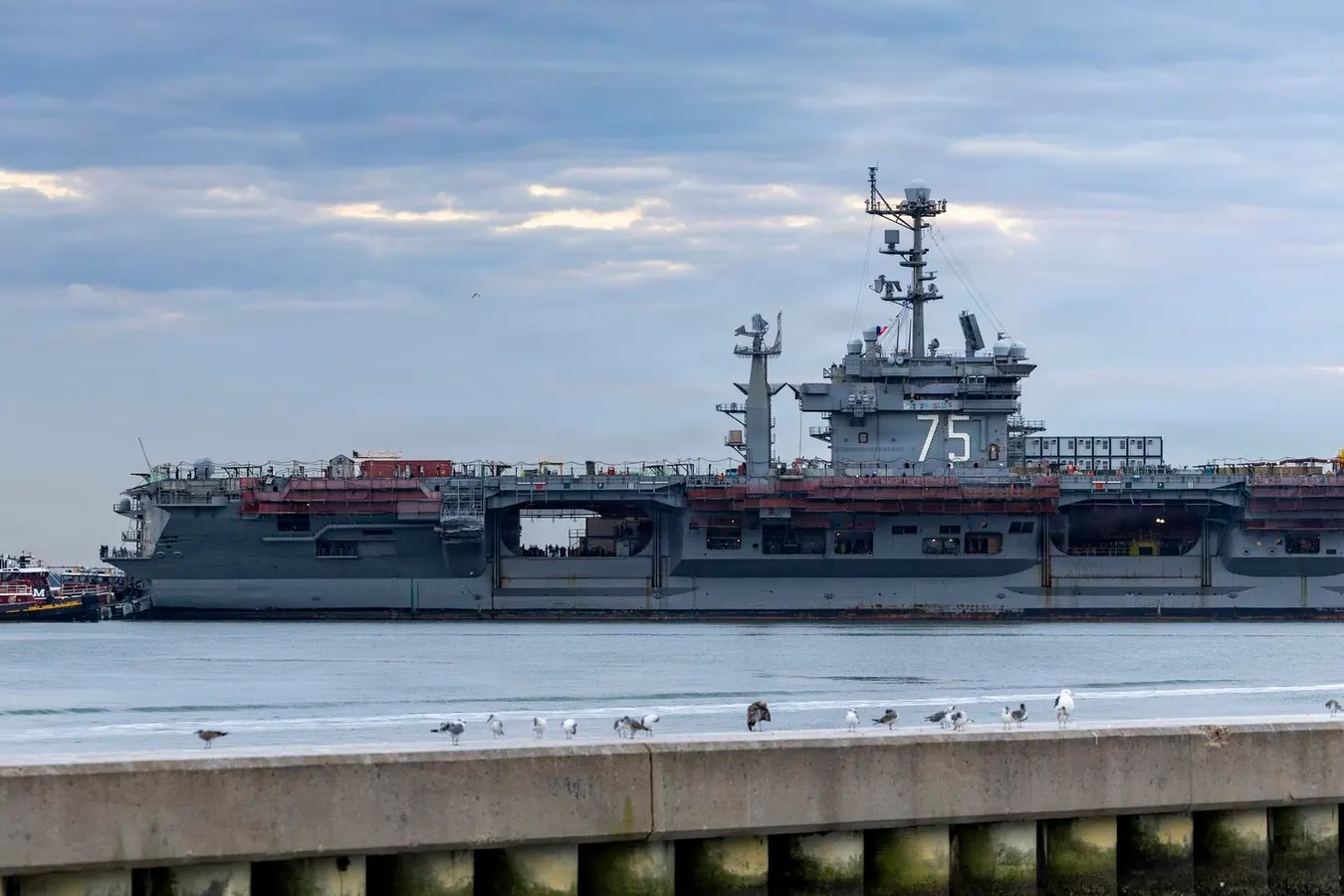

260930-N-KH255-4628 NORFOLK, Va. (Sept. 30, 2026) The Nimitz-class aircraft carrier USS Harry S. Truman (CVN 75) transits the Elizabeth River while departing Naval Station Norfolk for Newport News Shipbuilding to begin the shipyard phase of its Refueling and Complex Overhaul (RCOH).
(U.S. Navy photo by Mass Communication Specialist Seaman Apprentice Stryker Cole)
American consumers may be spending more to fuel up at the pump, but taxpayers will also be on the hook for the refueling of the United States Navy’s eighth Nimitz-class nuclear-powered aircraft carrier, the USS Harry S. Truman (CVN-75). This week, the service announced that a $5.1 billion Fixed Ceiling Incentive contract was issued to Huntington Ingalls Industries’ Newport News Shipbuilding for the warship’s Refueling and Complex Overhaul.
The massive, multi-year, mid-life maintenance process will include the refueling of the aircraft carrier’s two nuclear reactors, as well as the modernization and upgrade to the vessel to ensure it remains operational for another 25 years. The word “complex” can’t be overstated, as it will require the carrier to be taken partially apart and then put back together.
The process handles about 35% of all maintenance and modernization for the ship’s entire lifespan, as it includes upgrading propulsion equipment, electronic and combat support systems, living infrastructure, and working on thousands of ship components and tanks.
The process is expected to take at least three to four years, but has increased with the two most carriers that have undergone the RCOH.
CVN-75 arrived at NNS on Wednesday, and will begin the refueling process after years of planning.
“We’ve taken a proactive approach, from ordering long lead-time materials to conducting thousands of inspections and preliminary work, to ensure the RCOH of USS Harry S. Truman is successful,” said Bryan Caccavale, NNS vice president of program management in a company statement. “This extensive engineering and construction project to ready the ship to rejoin the fleet is a team effort, across shipbuilders, suppliers and our Navy partners, and we are honored to do our part.”
First RCOH Under PAE Maritime
CVN-75 will be the eighth Nimitz-class supercarrier to undergo the RCOH, and it will also be the first to undertake the process since the standup of the Portfolio Acquisition Executive Maritime, the centralized U.S. Department of the Navy organization with single, cradle-to-grave accountability for delivering surface ships, aircraft carriers, and maritime combat capabilities. It was established in March of this year as part of the defense acquisition modernization directives.
The goal of the office is to reduce bureaucracy, accelerate capability delivery, enhance fleet readiness, and manage the industrial base.
It uses a Fixed Ceiling Incentive structure that was designed to share risk, which incentivizes improved shipbuilder performance to achieve required delivery dates.
“This award is the latest example of how we are leveraging innovative contracting approaches to drive improved outcomes,” said Rear Admiral Casey Moton, Acting PAE Maritime, in a U.S. Navy statement. “Our program management and contracting teams have worked side by side to arrive at a contract that incentivizes schedule performance, addresses key lessons learned, shares risk appropriately so that we can re-deliver Truman to the Fleet on budget and on schedule.”
Additional Work Required
In addition to the normal RCOH maintenance, NNS will repair the exterior cosmetic damage from CVN-75’s February 2025 collision with the 53,000-ton Panamanian-flagged cargo ship Besiktas-M near the Suez Canal.
The impact with the merchant vessel Besiktas-M damaged a sponson on the starboard side near one of the aircraft elevators and tore through the exterior bulkheads of two storage rooms and a maintenance space.
The work was deferred to cope with wider shipyard backlogs.
During the RCOH, NNS will also perform hull and freeboard blast and paint, repairs to its propellers, sea chests, shafts, and rudders.
Lessons Learned From Past RCOHs
The U.S. Navy will want to avoid past delays during the RCOH maintenance period with the USS George Washington (CVN-73). It began its refueling on August 4, 2017, and the process stretched to 2,117 days, roughly five years and nine months, or almost as much time as it took to build the carrier, and about two years longer than expected for an RCOH. Some of the delays were due to the Covid-19 pandemic and national lockdown, which stopped work entirely for a period, followed by supply chain issues, and competing requirements for resources.
For much of the crew, it was a horrible experience.
The sailors either lived aboard the aircraft carrier during the overhaul, which was an active construction project, or were housed on barges and had to deal with two-hour daily commutes. Many were subjected to deafening noise, poor ventilation and strained support systems.
Tragically, nine sailors died by suicide during the RCOH, including three in a single week in April 2022.
That prompted the U.S. Navy to issue sweeping recommendations to improve housing, parking, and mental health resources across depot maintenance availabilities. In addition, the U.S. Navy will have contractors handling more of the work, freeing up the sailors to pursue advanced technical training, to enroll in academic programs, or even to switch to career-enhancing billets while CVN-75 is sidelined.
There will still be many sailors who will remain with the USS Harry S. Truman during its RCOH. Although some could end up performing non-rate-specific duties, many will be there to help modernize the ship and literally obtain experience of how the systems are installed and integrated.
CVN-75 was originally delivered to the U.S. Navy in 1998, and the USS Harry S. Truman is now scheduled to complete the RCOH in November 2031. When redelivered to the fleet, it will be “the most technologically advanced Nimitz-class aircraft carrier,” the U.S. Navy suggested.
The USS Harry S. Truman began its formal RCOH Smart Start period in November 2025, preparing the ship and crew for the multi-year maintenance and modernization effort.
The important and expensive part will be meeting the timeline.
















Leave a comment