


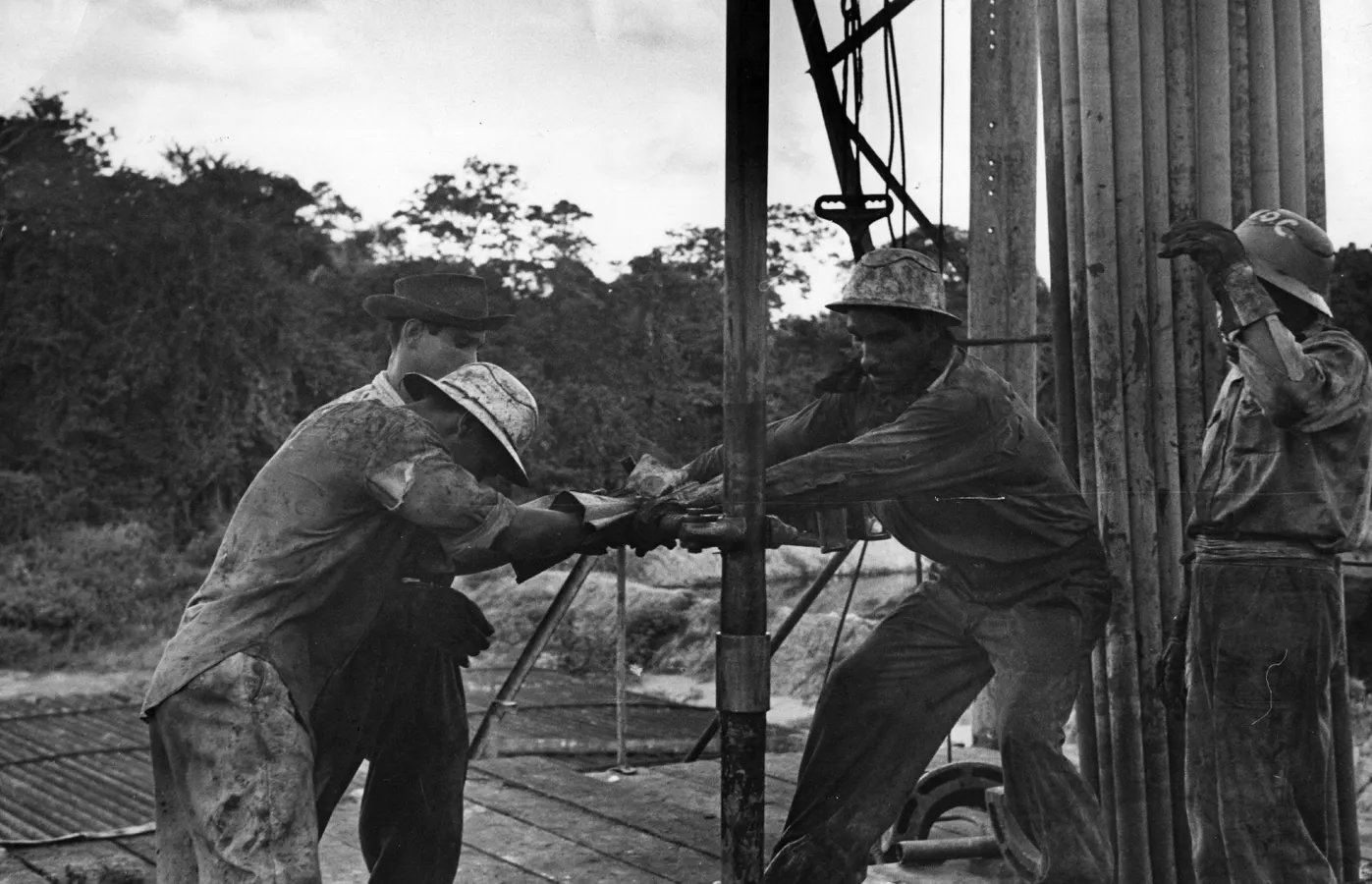

Oil drillers at work in Venezuela. Original Publication: Picture Post – 5036 – Poor Little Rich Country – pub. 1950 (Photo by Harry Deverson/Getty Images)
Getty Images
Although few details have been forthcoming, the Trump Administration’s announcement that the U.S would take partial control of 65 billion barrels of oil reserves in Venezuela has left many to scratch their heads. It appears that the intent is to create a private company, majority owned by the U.S., to develop seventeen oil fields in that country. Leaving aside some of the more vague comments, the U.S. will not ‘take’ the oil nor is it clear exactly who will develop (or redevelop) the fields.
Various caveats are warranted, especially for causal observers. Most important, while the deal nominally represents more oil reserves than the U.S. possesses, because most if not all involves extra-heavy oil, the size of the reserves does not mean that they could produce more than the U.S.’s 14 million barrels a day (mb/d). Extra-heavy oil is generally produced at a much lower rate than conventional fields, where typically eight to twelve percent of reserves are produced in a year. Contrast that with Canada, where oil sands are produced at a rate below one percent a year.
The acting president of Venezuela has suggested an initial target is 1.5 mb/d, which is reasonable, What we know about new US-Venezuela oil deal | AP News since applying Canadian production rates to the Venezuelan deal would suggest a production rate of about 2 mb/d, not earth-shaking but significant. It would triple existing Venezuelan production but still leave it below the glory days before Hugo Chavez devastated the industry through mismanagement and the mass firing of the national oil company’s employees.
While there is a lot of oil that can be accessed cheaply through maintenance and reworking of existing wells, recall that the original deal Chevron signed in 1995 to add 35 thousand barrels a day of capacity at the Boscan heavy oil field called for expenditures of $2 billion over 20 to 30 years. Chevron, Maraven sign heavy oil agreement | Oil & Gas Journal Adjusted for inflation, that would be about $4 billion but probably only half or $2 billion would have been upfront investment. Still, a rough calculation implies that reaching 2 mb/d of production would cost over $100 billion. That sounds like a lot but more likely it would be spent over a decade or more by numerous companies.
One hope is that the deal would mean guarantees from the U.S. government for investors in this oil, since apparently the intent is to allow the private sector to put up the capital and undertake the operations. To date, only Chevron of the oil majors has been committed to the country’s oil sector, despite the U.S.’s arrest of Nicolas Maduro and his replacement by Delcy Rodriguez, who put a new petroleum law in place to attract private and foreign companies.
Unfortunately, the level of political risk may not have decreased significantly. It might be that the deal will provide much needed oil revenue for the current regime, making them disinclined to interfere with any deals signed. At the same time, there is no guaranteed that the current regime will stay in place, nor that any Caracas government will honor any agreements made now, especially after the Trump Administration leaves office.
Indeed, history is replete with governments reneging on oil deals, especially those that would seem to have been signed under duress. The Iranians agreed to a deal with the Soviet Union after World War II, under which the Russians removed their troops but received a deal to create a joint Soviet-Iranian oil company. (Sound familiar?) After the troops left, the deal was never consummated. A future Venezuelan government could similarly step back from the deal, claiming that political/military pressure was used to generate the agreement.
And many of the 1970s nationalization of most major oil companies holdings in oil exporting nations were partly due to the sense that the original concession agreements were unfair. In particular, contracts signed in the first half of the century were done with governments that had little or no expertise and were dependent on foreigners for capital and technology, implying to later opponents that the contracts were poorly designed and unfavorable to the government.
Further, the extremely long-term nature of those, such as British Petroleum’s 99 year concession in Iran, was cited as evidence that they were unreasonable. At present, there are conflicting reports about the length of the new Venezuelan deal, with the White House suggesting it is for 100 years What we know about new US-Venezuela oil deal | AP News and Venezuela’s acting president describing it as a 25 year deal. Venezuela’s interim president says US energy deal will last 25 years | Reuters
Similarly, reports that the U.S. would pay ‘cost’ for its 55% of the oil produced are troubling. Without a doubt, opponents of the deal will seize on that as evidence of its being exploitative and will demand renegotiation on that basis. A production sharing contract that allows the operators to receive a percentage of oil to cover their costs and then splits the remaining ‘profit’ oil between the operator and the government would be much less prone to political criticism.
And a signed contract under an existing petroleum law does not guarantee that political risk is eliminated. Enron signed a deal to develop a massive power project in India, arguing that the political risk was low because the country had a well-established rule of law. But the deal stirred up massive opposition and a new government forced a renegotiation of the project’s terms. Enron’s demise happened shortly thereafter. (M.I.T. economists addressed this as long as four decades ago. Oil Exploration in the Developing Countries: Poor Geology or Poor Contracts? – BLITZER – 1985 – Natural Resources Forum – Wiley Online Library)
Although the President believes that the U.S. will control the oil production, that overstates the reality of the industry. While oil fields’ operators might decide investment and production plans, the government remains sovereign and has ultimate authority, as Hugo Chavez showed when he unilaterally renegotiated pre-existing contracts signed under his predecessor. Those contracts included clauses calling for international arbitration, which seemed to reduce or remove the risk of unilateral government action. To date, two decades later, Exxon and ConocoPhillips continue to seek compensation for their losses.
Obviously, major operations in Venezuela under this agreement will come after Trump leaves office in 2029 and his successor might have not interest in enforcing the deal against contrary actions by whatever government is in place in Caracas then, which makes the meaning of ‘control’ of the oil fields the crucial question. If the Venezuelan government demands that the operator cut production because of OPEC quotas, or demands a new pricing agreement, will the U.S. military intervene? Almost certainly not.
The best case scenario for the industry—and Venezuela—is that the deal allows for various production-sharing agreements, similar to those common around the world, investments result in increased production and a reasonable return to the operators. (Again, an excessive profit would almost certainly result in forced contract renegotiation.)
The worst outcome would be if a new government in Venezuela, after investments have been made and production increases, either unilaterally alters contract terms or nationalizes the holdings, imposing losses on the investors and, in all probability, initiating a new round of declines as resulted when Chavez did the same.
The oil industry has many risk-takers and there will certainly be more investment forthcoming. Small companies without diversified holdings will be most at risk, whereas larger companies would invest as part of their diversified portfolios. Hopefully, the Venezuelan government will have learned from its past mismanagement of the industry, especially the politicization of its management.
For the U.S. Administration, one classic lesson should be followed. Just as good fences make good neighbors, good contracts make good partners.













Leave a comment