


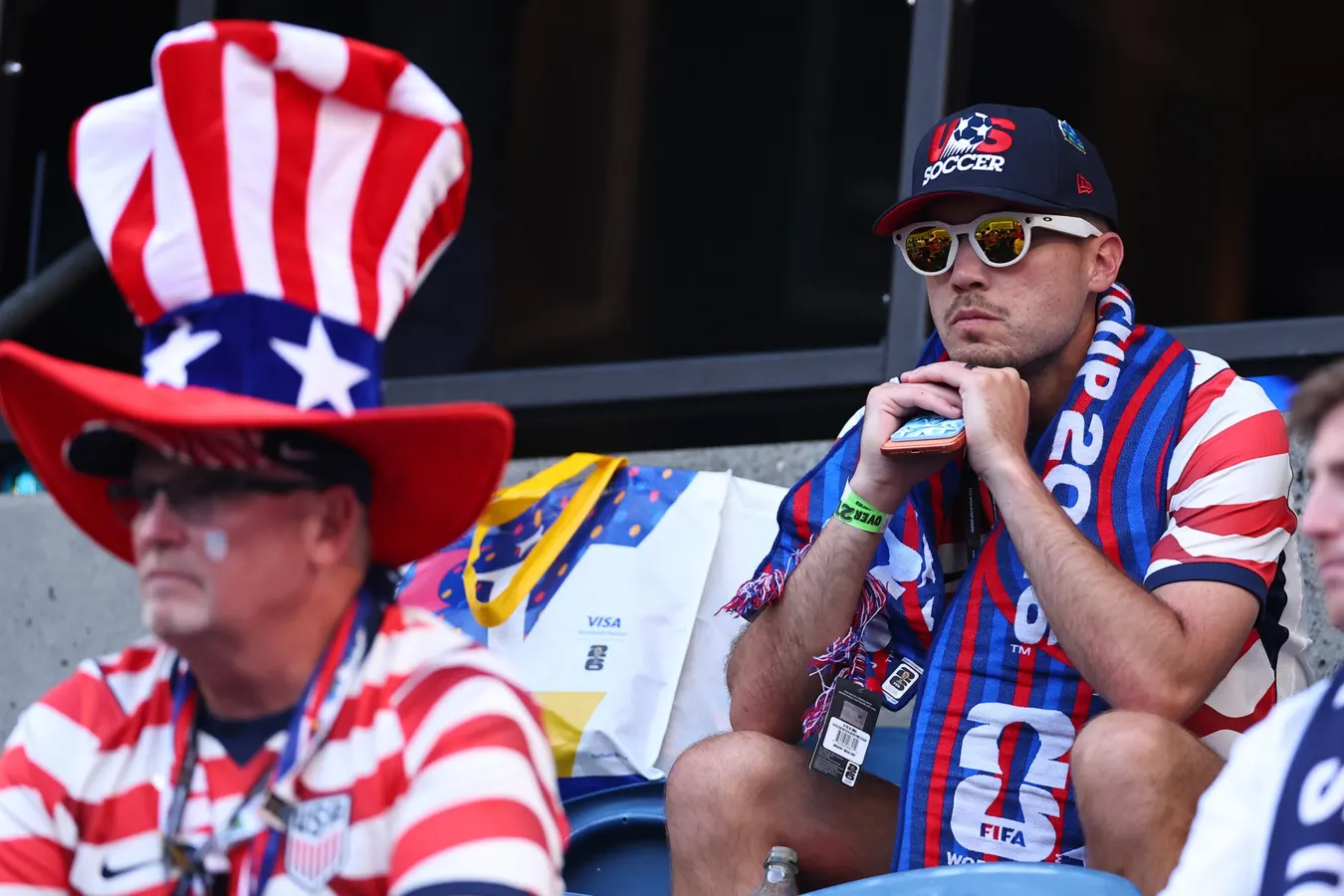

SEATTLE, WASHINGTON – JULY 6: A dejected fan of USA after being knocked out during the FIFA World Cup 2026 Round Of 16 match between USA and Belgium at Seattle Stadium on July 6, 2026 in Seattle, United States. (Photo by Robbie Jay Barratt – AMA/Getty Images)
Getty Images
Andres Cantor was born in Buenos Aires in the early 1960s and grew up rooting for the World Cup-winning sides of Mario Kempes and later Diego Maradona.
After moving to the United States and attending the University of Southern California, he went into broadcasting and eventually became the authoritative voice of Spanish-language soccer broadcasting in the United States, first for Univision and later Telemundo.
He was on the call for the United States’ 1994 World Cup upset of Colombia and Landon Donovan’s famous 2010 goal against Algeria. And he was on the call on Sunday night, when the United States gave its worst World Cup performance that anyone can remember in a 4-1 defeat to a talented but beatable Belgium side before a stadium packed with U.S. fans in Seattle.
Not long after, he took to X (formerly Twitter) to give his thoughts on the performance. The first word he used to describe it? Disgraceful. It was an acknowledgement not of the outcome of elimination, but the quality of the effort.
It is vitally important for the future of U.S. soccer that voices like Cantor, who know both U.S. soccer and the world game intimately, are amplified during the autopsy process. Because there are too many other, less-informed pundits recycling old analyses about the gap between the United States and the rest of the world in talent development and sporting access.
Sure, those remain issues. They are also well-understood by pretty much everyone in the higher levels of U.S. soccer development by now. And the gaps are empirically far narrower than they once were. Player development in this country has come enormously far, with nearly all MLS clubs (and a few lower-tier pro soccer teams as well) operating free academies for elite talent and a direct pathway to the first-team for those good enough. Getting to that level is the harder part, and certainly does come with financial obstacles. But it’s more accessible certainly than a generation ago.
Primarily, this wasn’t about that. Instead, this loss and its humiliating nature in particular was fundamentally a failure of U.S. soccer’s self-congratulatory, inflationary and overly capitalistic culture. And until that is corrected, the on-field results will continue to be less than the sum of the parts.
A Talent Gap, But Not A Chasm
Yes, there was still a talent gap between the United States and Belgium, particularly in key areas of the back line and goalkeeping. But these were modest margins relative to the chasm that separated the USMNT and eventual world champions Brazil in their 1994 meeting at the same stage, or even the 2014 team that was eliminated by a better version of Belgium than this one.
According to Transfermarkt, arguably the world’s authority on the global player marketplace, the United States had the 10th-most-valuable squad of the teams in the round of 16, and Belgium the eighth. The gap of roughly $7.1 million per player might be somewhat deflated by the advanced age of some of Belgium’s elite talents, since it’s a figure that correlates to future production as much as present. Even so, U.S. fans were well within their right to expect that the advantage of home field could turn this into a true pick’em at the very least, in the team sport where the home edge usually matters more than any other.
World Cup Squad Value Per Player
Belgium: $24.0 million
United States: $16.9 million
Source: Transfermarkt
Instead, this was simply an awful performance, the worst margin of defeat the U.S. suffered in a knockout stage match since a 1930 semifinal loss to Argentina, played in front of likely the largest TV audience ever to watch this team.
Standing on its own, you could call it an aberration. Taken in the greater context of other similar failures to meet the moment by the nation’s club teams, as well as the national team’s similar failures at similar stages of other competitions, there has to be a more systemic culprit.
The best place to start is a sporting culture that exaggerates accomplishments and rewards capitalistic success before the sporting variety.
Not So Golden Generation
At the USMNT level, this has started with modest improvement that was real, combined with the inflation of this team’s abilities based on their club employers. The infiltration of Americans into the UEFA Champions League, widely considered the world’s top club competition, is certainly worth celebrating. And it’s almost stunning how much more seasoned this current crop of players are at that level. Seven of the top 10 most-experienced UCL performers who play for the U.S. are on the current squad. Two more are still active professionals who were unselected by manager Mauricio Pochettino.
Top 10 USMNT Players In UEFA Champions League minutes
2026 United States squad: 7
1994-2002 squad: 0
Source: StatMuse
But that represents global trends as well as U.S. growth. The player market is simply more interconnected than ever. Every single team at this World Cup rostered at least one player with UCL experience. The United States did not field a single player at a World Cup who had played in the competition until 2006, after DaMarcus Beasley made his debut in the 2004-05 edition. And that the time, that wasn’t particularly unusual for teams outside of Europe.
There is more talent relative to global opposition in the American squad than in most previous tournaments, particularly in terms of depth. But it’s not as drastic a gain as is often painted when coloring expectations.
More Money, More Problems
At the club level, it is the flawed belief in trickle-down economics that appears to guide most of Major League Soccer’s big decisions.
From salary rules that allow teams to spend big, but only on a fraction of their roster, to a comically forgiving playoff format, every aspect of the league’s competitive structure is designed to maximize revenue – from player endorsements to ticket sales to TV inventory – rather than maximize competitive spectacle or stakes. Where owners have universally invested beyond their club means is in real estate – stadiums, academy facilities, etc. – that increase overall franchise values.
Even academy investment only really took off once MLS ownership realized it could be a revenue generator, with the sale of even one Alphonso Davies or Ricardo Pepi capable of fully funding academy operations for several years.
To be clear, not all clubs operate with a revenue-first mentality. But those prioritizing only competitive results over building teams via commercial starpower are hamstrung.
The league continues to boast about its growing franchise valuations (including those from Forbes) and rising attendance figures as signs of progress. They are. But that only makes the competitive failures look worse, with MLS sides repeatedly losing spectacularly when pitted against Liga MX foes in the late stages of Concacaf competition.
Concacaf Champions Cup winners since 2002
Liga MX (Mexico): 22
Liga FPD (Costa Rica): 2
MLS (USA/Canada): 1
The gap in squad values between leagues at this point is minimal. But Mexican teams are free to spend their money more sensibly across their roster spots. Even Lionel Messi’s Inter Miami squad, which has led MLS payroll charts for multiple seasons, struggles to fill supporting-cast roles.
Add in what can only be described as a repeated pattern of wilting under a spotlight with intensity they otherwise rarely experience, and you get what you got in 2024 and 2025: Two MLS teams looking absolutely outclassed by Mexican opposition and being outscored 8-0 over two finals, when their play the rest of the way suggested they were very much capable of keeping things interesting. The matches — admittedly played in much less friendly environments than Monday – were almost carbon copies of the Americans’ loss to Belgium.
Leagues Cup And Pro/Rel
It’s worth noting that those two results came in the second and third years of the Leagues Cup, another joint competition between MLS and Liga MX, staged solely in the United States for – you guessed it – revenue reasons.
In that tournament, designed to appeal almost exclusively to U.S.-based Liga MX fans, U.S. teams have excelled, winning all three editions. CF Monterrey in 2023 is the only Mexican team to reach a semifinal.
(Thankfully, tournament organizers have adjusted by agreeing to stage four of the competition’s 62 matches on Mexico soil in 2026. That should do it.)
You could even apply this anti-competitive dynamic to league membership.
Cities have had to make increasingly robust financial efforts to join MLS, and the league has expanded from its original 10-team format to the 30-team behemoth it is today. But unlike other soccer leagues around the world, once expansion MLS franchises are set up, their place in the league is virtually guaranteed. Those exiting have done so for financial reasons, not because their play merited it. (Though Chivas USA was pretty awful on the field as well).
Promotion/relegation zealots often argue for an open league system in bad faith and without acknowledging the uniquely U.S. issues that would need to be solved. But the lack of competitive consequences for floundering clubs does very little to muffle those pushing for pro/rel.
Why Might FIFA Bend To Trump?
The last aspect of Monday’s loss is the extraordinary circumstances of FIFA’s decision – possibly under political pressure – to provisionally reverse Folarin Balogun’s red-card suspension and allow the striker to play.
Cantor clearly references this as a possible explanation for the stunningly inept display Monday night from the USMNT. And it’s impossible to know just exactly how it affected this U.S. squad, or Belgium for that matter.
But even that can be ascribed to similar themes. While the initial decision to show Balogun red was controversial, the reversal was far more irregular, and suggested motives not based on competitive integrity.
If FIFA did show deference to President Donald Trump in reversing the decision, as some suspect, it was doing so as an organization that has benefited enormously financially by staging its marquee event in the United States. After all, this tournament has broken records both for overall attendance and ticket prices. The U.S. government certainly could’ve intervened if it had concerns about how prices might impact tourism and U.S. consumers, or allegations that FIFA had deceived customers. It didn’t.
Until all this changes and the decision-makers in U.S. soccer shift priorities to put competitive aspirations on equal footing to commerce and reputation, we’re going to see more teams at the club and international level failing in the biggest moments. Because prioritizing competitive rigor is exactly what creates more high-leverage competition, and you only truly earn poise in high-leverage competition by going through it.
The 11 U.S. players who took the field in Seattle may have experienced similarly intense experiences at the club level. But together, a primetime, round-of-16 clash against a capable and experienced opponent before an unprecedentedly tuned-in U.S. public audience was clearly foreign to them. And they played like it.
Who knows if such a chance will ever come around again.














Leave a comment