


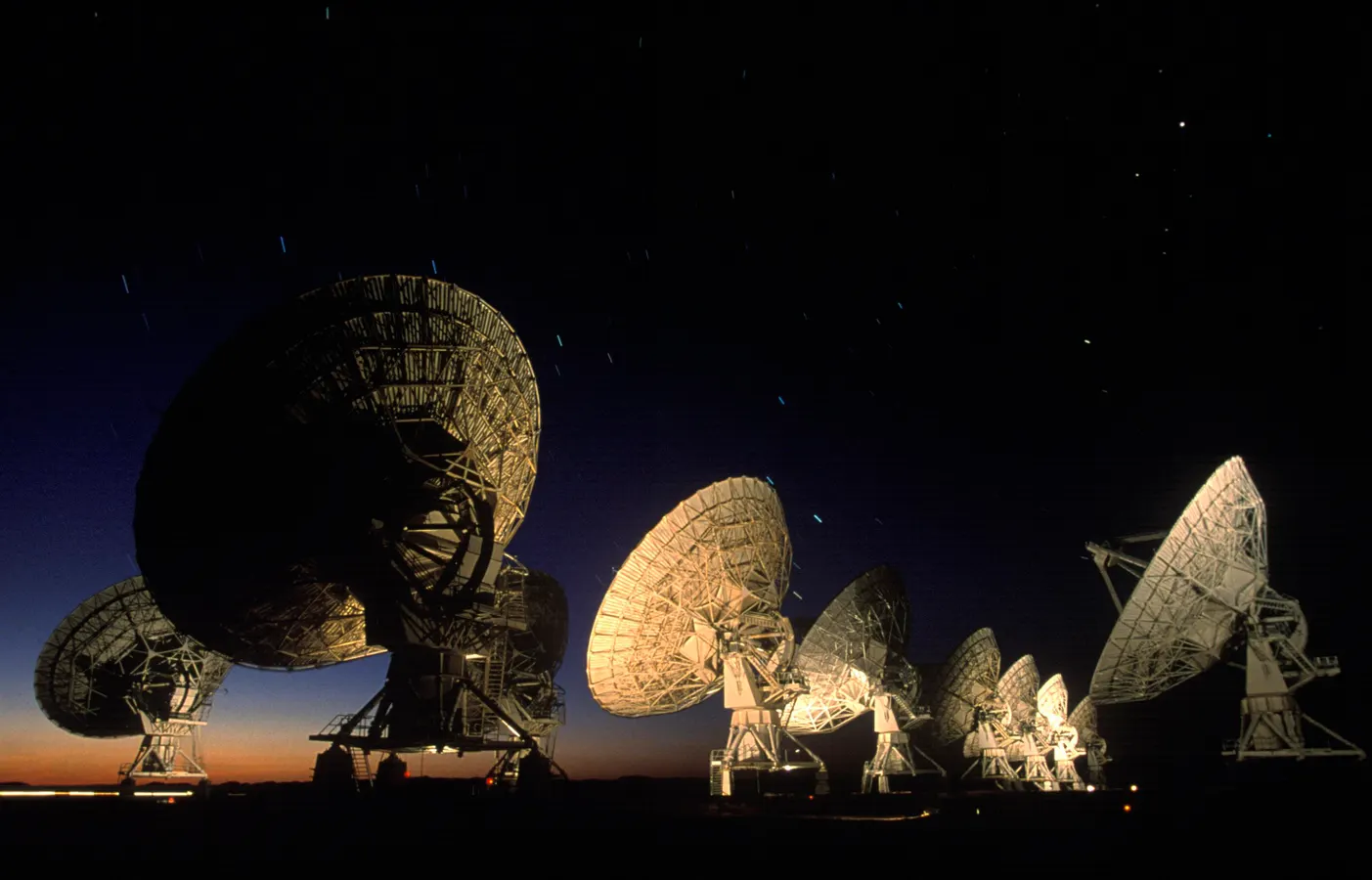

SOCORRO, NM – 1999: These twenty-seven moveable antennas, known as the Very Large Array (VLA), take in radio signals, some extremely faint, from throughout the cosmos, 1999 near Socorro, New Mexico. The VLA is a radio telescope built by the National Science Foundation that came on line in 1980. This facility has enabled scientists to garner detailed images of natural cosmic phenomena, such as new stars being born, galactic collisions, our own solar system and even the suspected black hole at the core of the Milky Way. The questions man has tried to answer by looking to the heavens with such powerful telescopic tools are at the very center of his search for meaning in his individual life as well as meaning in general. It is hoped that the study of the universe, or “cosmology,” including how stars, galaxies, black holes, etc. are formed and how they evolve, with more and more complex telescopes driven by more and more complex computers, will answer these questions. But it seems that as each more powerful observatory comes online, yet more probing questions arise. Will we ever uncover the secret of the true nature of the universe and thus the reason for existence in general and our existence in particular? (Photo by Joe McNally/Getty Images)
Getty Images
On Friday, April 24, 2026, the White House fired all 24 members of the National Science Board. According to the National Science Foundation website, the board’s next scheduled meeting is May 5.
Most people outside the research enterprise have never heard of the NSB, so it’s worth saying what it is. The National Science Foundation Act of 1950 created NSF with two heads: a director and a board. Jointly they set the strategic direction of an agency that now distributes roughly $9 billion annually in federal research funding, approve its budget submissions, and authorize new major programs. The board’s members are nominated for their distinguished records in science, engineering, education, and public affairs, drawn from industry and universities, and confirmed to staggered six-year terms so that scientific research priorities are set by the long arc of scientific progress rather than the election cycle. The statute requires that members be chosen “solely on the basis of established records of distinguished service.”
That last phrase is the one I keep returning to.
circa 1940: American scientist, inventor and administrator Vannevar Bush (1890 – 1974), whose ‘differential analyser’ was a forerunner of the computer. He served as director of the Office of Scientific Research and Development throughout World War II and authored an influential report that led to the founding of the National Science Foundation. (Photo by MPI/Getty Images)
Getty Images
American scientific preeminence is often discussed as if it were a product of talent or funding. It is really a product of institutions, the unglamorous architecture of boards, charters, terms of service, peer review and statutory independence that the postwar generation built deliberately. The structure traces to Vannevar Bush’s 1945 report Science, the Endless Frontier, which argued that federal science required governance insulated from political pressure and stability of support beyond any single budget cycle. The five-year fight to translate Bush’s vision into law turned largely on questions of independence and accountability, and the staggered six-year terms were part of the resulting compromise. Six-year terms exist for a reason. Staggered appointments exist for a reason. “Solely on the basis of distinguished service” is in the founding statute for a reason.
The board’s function has been contested before, but always on the existing terms. As recently as 2022, scholars were debating how to modernize the board’s role, proposing to reduce its management duties and make NSF look more like other federal agencies. But other federal agencies are precisely the ones most exposed to political control. Their leaders serve at the pleasure of the president. Their priorities shift with each administration. The whole reason NSF’s structure is unusual is that the postwar designers did not want science funding to work that way. Even the would-be reformers recognized this: they proposed keeping the board’s staggered terms and statutory independence intact.
These structures depend on a shared understanding, across administrations and across parties, that some institutions are worth preserving even when they constrain you. When that understanding lapses, the structures themselves do not survive long.
On May 5, the National Science Board is scheduled to meet. There is no agenda, and at the moment, no board. That absence is the thing worth attending to, beyond the news of any particular firing. The question is not who sits on the board. The question is whether the kind of board the 1950 Act envisioned still exists in practice, and what American science looks like if it does not.















Leave a comment