


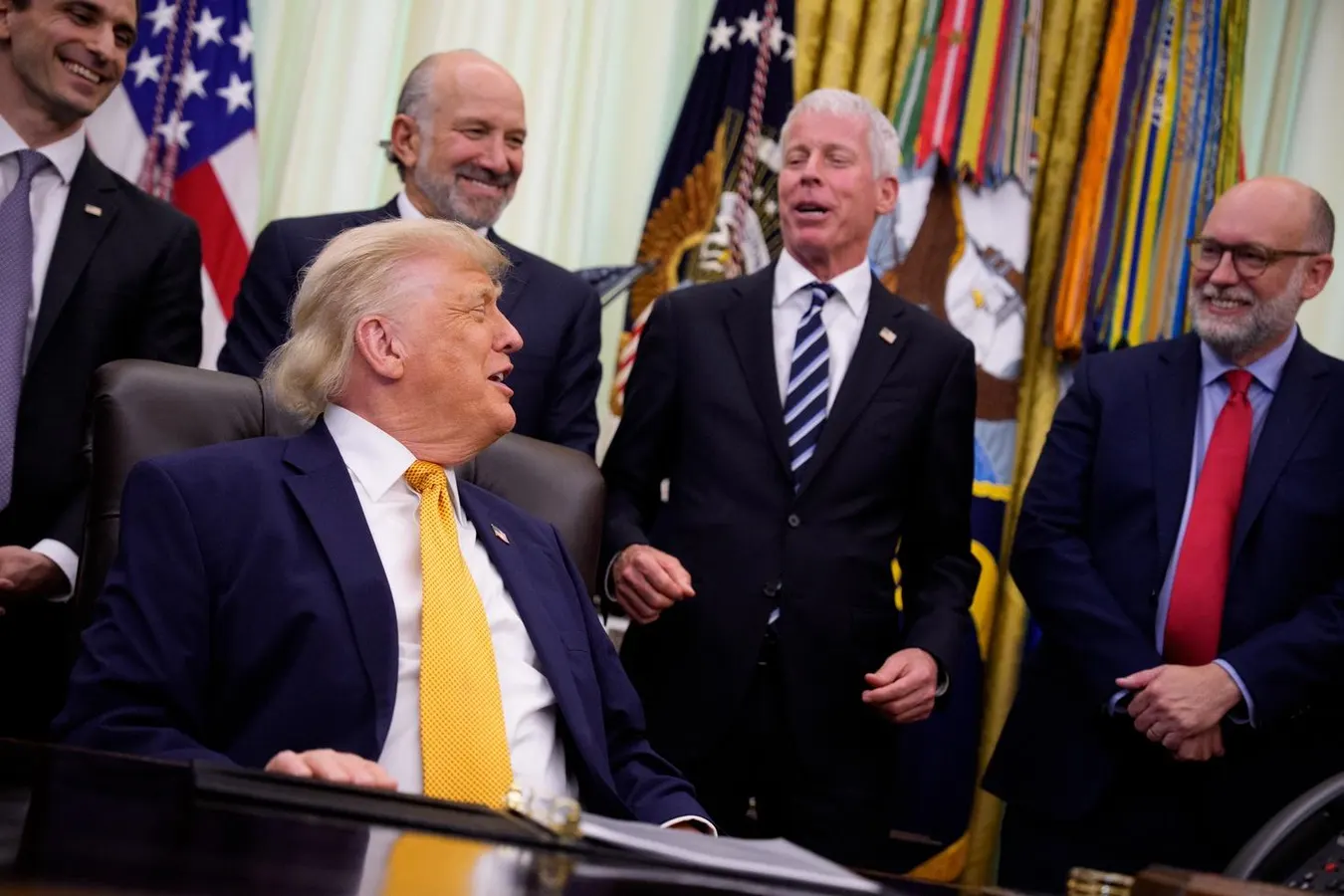

U.S. President Donald Trump (2nd-L), has reportedly directed White House Office of Management and Budget Director Russell Vought (R) to draft an executive order that would establish a board of political appointees to decide who gets what National Institutes of Health grants. (Photo by Andrew Harnik/Getty Images)
Getty Images
U.S. President Donald Trump is reportedly taking yet another step to establish more political control over National Institutes of Health grant funding—you know the money that’s supposed to go to scientists researching ways to better prevent, treat and control different diseases. On Friday, Trump apparently told White House Office of Management and Budget director Russell Vought to draft an executive order that would create a board that would determine which grants the NIH would fund, according to Sophia Cai and Tim Röhn reporting for POLITICO.
The Board Would Reportedly Determine What NIH Grants Will Be Funded
Would such a board be comprised of independent experts in medicine and health, who could serve as the voices of science and patients without fear of reprisal? How about no. Instead, such a board would consist of political appointees of Trump such as Vought and NIH director Jay Bhattacharya, MD, PhD, who ultimately could have a lot of incentive to do whatever Trump wants—assuming that they want to keep their jobs.
For an NIH grant to be awarded, this political board would reportedly have to unanimously approve of it. That means a single dissent could sink a grant like a fruitcake in a tank of water. This would basically give the U.S. President and his political appointees unprecedented control over the now $48 billion in funds that Congress has allocated to the NIH for the 2027 fiscal year.
This Yet Another Step For The Trump Administration To Gain More Control Over NIH And Other Federal Funding
Getting more control over the $1 trillion in federal funds that goes out each year to people and organizations around the U.S. each year seems to be a priority for Trump. After all, he and his administration have taken multiple steps to do so since taking office in January 2025. All of these steps have progressively reduced the role that scientists and other non-Trump appointee experts both inside and outside the federal government play in deciding who gets what grants and contracts.
I’ve covered these different steps in Forbes over the past year and a half. One example has been eliminating measures such as funding paylines that allow grant applicants to see whether their proposals should get funded based on external scientific peer reviews. Another has been blocking applicants’ and NIH program officers’ access to external scientific peer review scores, which is a bit like keeping everyone from seeing the judges’ scores in a figure skating competition. And, OMG, there’s the new OMB rule that if implemented would give Trump political appointees unprecedented power to award, cut or terminate different grants and contracts.
More Control Over NIH Funding Would Give Trump More Power
If you believe in the “Golden Rule”—that is, whoever has the gold rules—you can see how such unprecedented control over federal funding would give Trump and his political appointees unprecedented power as a result. They could for example withhold grant and contract funding to any individual, organization or institution until it bends to whatever the Trump administration demands. If you think that this is an unchartered possibility, look at something that sort of rhymes with unchartered—namely Harvard.
Yes, Harvard the university and not the group of islands located in northwestern Greenland. Trump has been trying to gain more control over the former Harvard since the middle of 2025. His administration tried to block the $2.6 billion in grant funding that had already been awarded to Harvard University and its faculty in order to force Harvard to comply, as I have detailed in Forbes. A lawsuit eventually helped Harvard trump Trump’s demands as a federal judge in Boston forced the federal government to restore that grant funding to the university. But according to the POLITICO article, Trump remains intent on finding other ways to slash Harvard’s federal funding.
Harvard hasn’t been the only university that the Trump administration has used the federal funding hammer on since early 2025. Some universities like Columbia University, the University of Pennsylvania, Brown University, Cornell University, Northwestern University and the University of Virginia yielded fairly quickly to various Trump administration demands and reached settlements. Others like the University of California, Princeton University and MIT have fought back in different ways. Nevertheless, what’s happened in 2025 and 2026 so far could be just the “Infinity War” preview to the overall “Endgame.”
Political Control Over NIH Funding Could End Up Hurting Patients And Basically Everyone
Meanwhile, the people most likely to eventually get hammered by NIH funding being used as a political hammer are patients. And assuming that you are a human and not a ficus plant, you will eventually become a patient some day. The NIH has long had a grant making process that tried to keep decisions separate from politics and whoever happened to be in the U.S. President’s office at the time. The process relied heavily on external scientific peer review to make funding decisions and attempted to keep funding decisions reasonably transparent.
The grants-making process before 2025 was certainly far from perfect and had as many flaws as the Sharknado movies. But the overall intent of the process’s structure was rather Samwise Gamgee or Luna Lovegood pure—to keep patient interests and science at the forefront above politics. The moves by the Trump administration threaten to do the exact opposite—bringing significantly more politics, opacity and bureaucracy into the grants-making process.
As news from the POLITICO article spread over the weekend, science and patient advocates began offering concerned responses. For example, Jenna Norton, PhD, a program director at the National Institute of Diabetes and Digestive and Kidney Diseases posted the following on LinkedIn urging the scientific community to contact members of Congress since such a political board could essentially circumvent Congressional authority:
From LinkedIn
From LinkedIn
And Research!America, a non-profit medical and health research advocacy alliance, issued a statement opposing the formation of political review committee. This statement included the following quote from its president and CEO Russ Paulsen: “Adding more bureaucrats would slow medical progress to a grinding halt. American patients and their families waiting for the next lifesaving treatment or medical breakthrough should not have to wait even longer.”
I have reached out the contacts in different relevant offices and agencies of the federal government and will provide update accordingly. We’ll have to see what details emerge in the coming weeks as this latest alleged step was taken without any accompanying formal announcement or Truth Social post. Sometimes, though, the quietest moves can have the loudest impact in the long run.















Leave a comment