



Two New Books Outline The New Q3
20-first
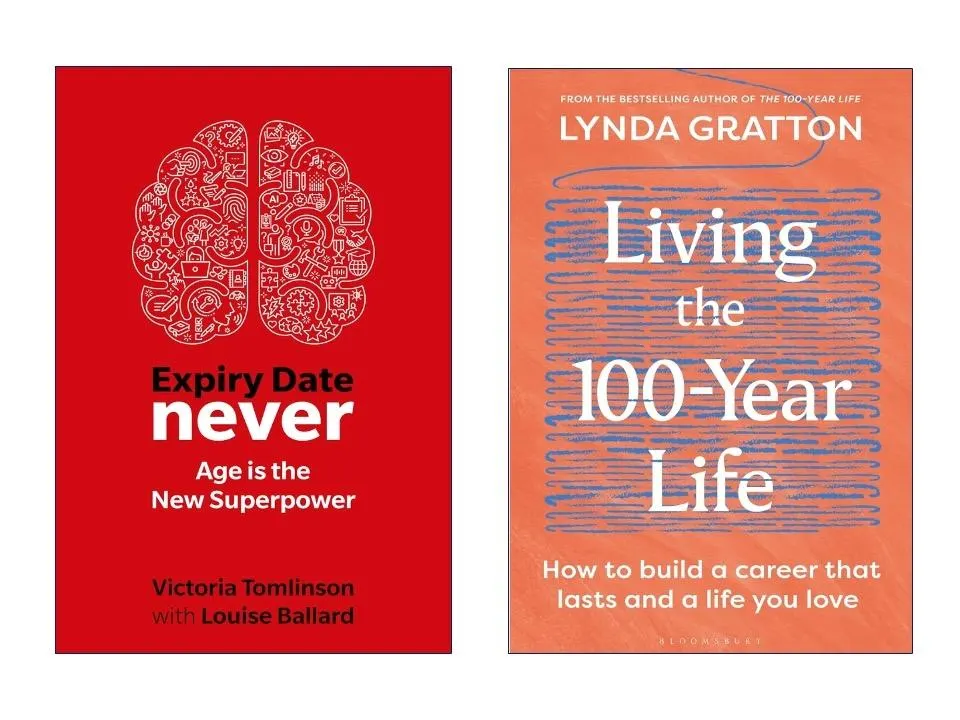
Two books launching this month expose a growing mismatch in the later stages of a career. People are increasingly ready to work, contribute and adapt for longer. The organisations employing them are proving rather less adaptable. The question is no longer simply whether people can or must work longer, but whether our employment systems are capable of keeping up with them.
Lynda Gratton’s Living the 100-Year Life is the practical follow-up to the longevity conversation she helped launch a decade ago with Andrew Scott in The 100-Year Life. Victoria Tomlinson and Louise Ballard’s Expiry Date Never: Age is the New Superpower comes at the same transformation from a rather more impatient direction. Its target is what the authors call “obsolete workplace design”: recruitment systems, job structures and retirement assumptions that continue to filter out experienced people even as employers complain of skills shortages.
I’ve recently had conversations with both authors on my 4-Quarter Lives podcast. What struck me was not simply where their arguments converge, but where they don’t. Read side by side, the books illuminate the two halves of a problem we have spent too long treating as one: how individuals adapt to longer working lives, and whether the systems around them are prepared to adapt too.
From Career Ladder To Life Weaving
Gratton has spent decades studying the future of work. Her new book is less interested in predicting that future than in helping individuals navigate it. If The 100-Year Life gave us the demographic wake-up call, Living the 100-Year Life asks what we actually do about it.
Her answer is agency. The familiar three-stage life — education, employment, retirement — gives way to something much less linear. She uses the metaphor of weaving: across a longer life, we strengthen different threads — mastery, cooperation, knowing, amplification, nurturing, friendship, intimacy, calm and adventure — while continually making choices about which need attention. The career ladder becomes only one possible strand in a much larger life.
The shift matters because Gratton is emphatic that longer lives don’t necessarily mean stepping away from work. When I asked her about what happens in the decades I describe as Q3, she pushed back on that interpretation. “I don’t think we step away from work,” she told me. “I think the type of work we do changes.”
That distinction is important. Gratton’s approach deliberately loosens the connection between chronological age and life stage. Mine has increasingly convinced me that there is something distinctive happening in the roughly 25 years from 50 to 75 — what I call Q3 — that is useful to recognise and name. We may draw the map differently, but we are looking at much of the same territory.
For many people, accumulated mastery begins to meet a greater appetite for autonomy. Status may matter less; impact may matter more. Some want to accelerate, some decelerate, and quite a few want to do both at once in different parts of their lives. A portfolio here, a board role there, teaching alongside consulting, entrepreneurship after corporate life, or simply the same work reconfigured around different priorities.
Gratton also puts transitions at the heart of this longer working life. As she told me, “A long working life… has quite a lot of transitions in it.” Those transitions require choices, she argues, and choices require time to think and reflect. That is a significant challenge for people emerging from the intensely productive decades of Q2, when reflection has often been crowded out by work, children, responsibility and achievement.
The opportunity isn’t simply to keep going. It is to become better at changing shape.
When Adaptable People Meet Inflexible Systems
If Gratton puts much of the agency into the hands of individuals, Tomlinson and Ballard turn the lens around. Expiry Date Never speaks to a generation that is already rethinking work, learning new skills, building portfolios, starting businesses and looking for different ways to remain productively engaged. Its central complaint is that the systems around them haven’t kept pace.
Tomlinson came to the issue through working with senior professionals who had left long careers assuming that another interesting role would naturally follow. Often, it didn’t. People who had spent their careers succeeding suddenly interpreted their inability to get hired as personal failure.
As Tomlinson told me on the podcast, the first thing people need to understand is: “It’s not you… it’s endemic, it’s systemic.”
The book documents recruitment practices that screen out experienced candidates, development investment that declines with age, rigid full-time roles, assumptions about ambition and retirement, and employers simultaneously reporting skills shortages while overlooking people with decades of experience. Tomlinson and Ballard call for a new contract between employers and experienced workers, stronger action on age discrimination and a cultural shift that treats longevity as an asset rather than a liability.
They are not arguing for older workers instead of younger ones. Quite the reverse. The opportunity is in combining experience and fresh perspectives across generations.
AI makes that argument considerably more interesting. Much of the discussion about AI and ageing has focused on whether older workers have the digital skills to keep up. Tomlinson turns the question around. If AI increasingly supplies speed, information and routine analysis, some of the human capabilities that become more valuable are precisely those that take time to accumulate: judgement, context, pattern recognition and the confidence to recognise when something simply doesn’t look right.
That doesn’t exempt experienced workers from learning. They will have to adapt to AI as rapidly as everyone else. But organisations casually discarding experience just as AI transforms knowledge work may be making a rather expensive category error.
Tomlinson’s advice to individuals is practical. “Imagine yourself working at the age of 70. And enjoying it,” she suggested at the end of our conversation. Then work backwards. What would that work look like? What would give it purpose? What connections, skills and experiments do you need to start building now?
Her work with professional services firms suggests that the best transitions begin not a year before retirement but perhaps five or even ten years earlier. Too many people plan what they are going to stop without building what they are going to start.
Designing The Q3 Career
Put these two books together and a different picture of the later career begins to emerge. Gratton asks how individuals can develop the agency and resilience to navigate longer, less predictable working lives. Tomlinson and Ballard ask why employers are making that navigation so unnecessarily difficult.
This is where the idea of a Q3 career becomes useful. It allows us to separate continuing contribution from continuing ascent.
The first half of many careers has been built around accumulation: expertise, responsibility, earnings and status. Q3 can use those assets differently. Some people will continue climbing. Others will become entrepreneurs, advisers, teachers, investors or non-executives. Some will want four days rather than five, nine months rather than twelve, or intense periods of work interspersed with other priorities. Increasingly, careers may become mosaics that take several minutes to explain rather than job titles that take several words.
Employers need to catch up with that complexity. Start with four pieces of career architecture: recruitment, learning, progression and exit. At what age do people quietly disappear from candidate lists? Who still receives serious development investment after 50? Does progression mean only upwards, or can an experienced employee move sideways, reduce management responsibilities, mentor, teach or build something new without being interpreted as having lost ambition? And why, after decades of increasing longevity, do so many retirement systems still turn careers into cliffs?
The goal isn’t to persuade everybody to work until 75. Nor is it to bolt another 20 years onto the old corporate career. It is to create more ways for people to contribute for as long as they want and are able.
That matters economically as well as individually. Organisations confronting demographic contraction, skills shortages and rapid technological change can ill afford to waste accumulated human capital because their talent systems were designed for 20th-century lives. Gratton offers individuals tools for constructing longer, more flexible lives. Tomlinson and Ballard demand that employers and policymakers do their share of the adaptation. We will need both.
There are signs that institutions are beginning to notice. London Business School, where Gratton has spent some four decades studying work and organisations, is launching a major, well-funded Centre for Longevity this month. I’ll be at the launch and will report on the question that follows naturally from these two books: are the business schools educating tomorrow’s leaders adapting fast enough to the longevity revolution themselves?
People are already redesigning the second half of their careers. The question is whether their employers will redesign fast enough to keep them.
















Leave a comment