


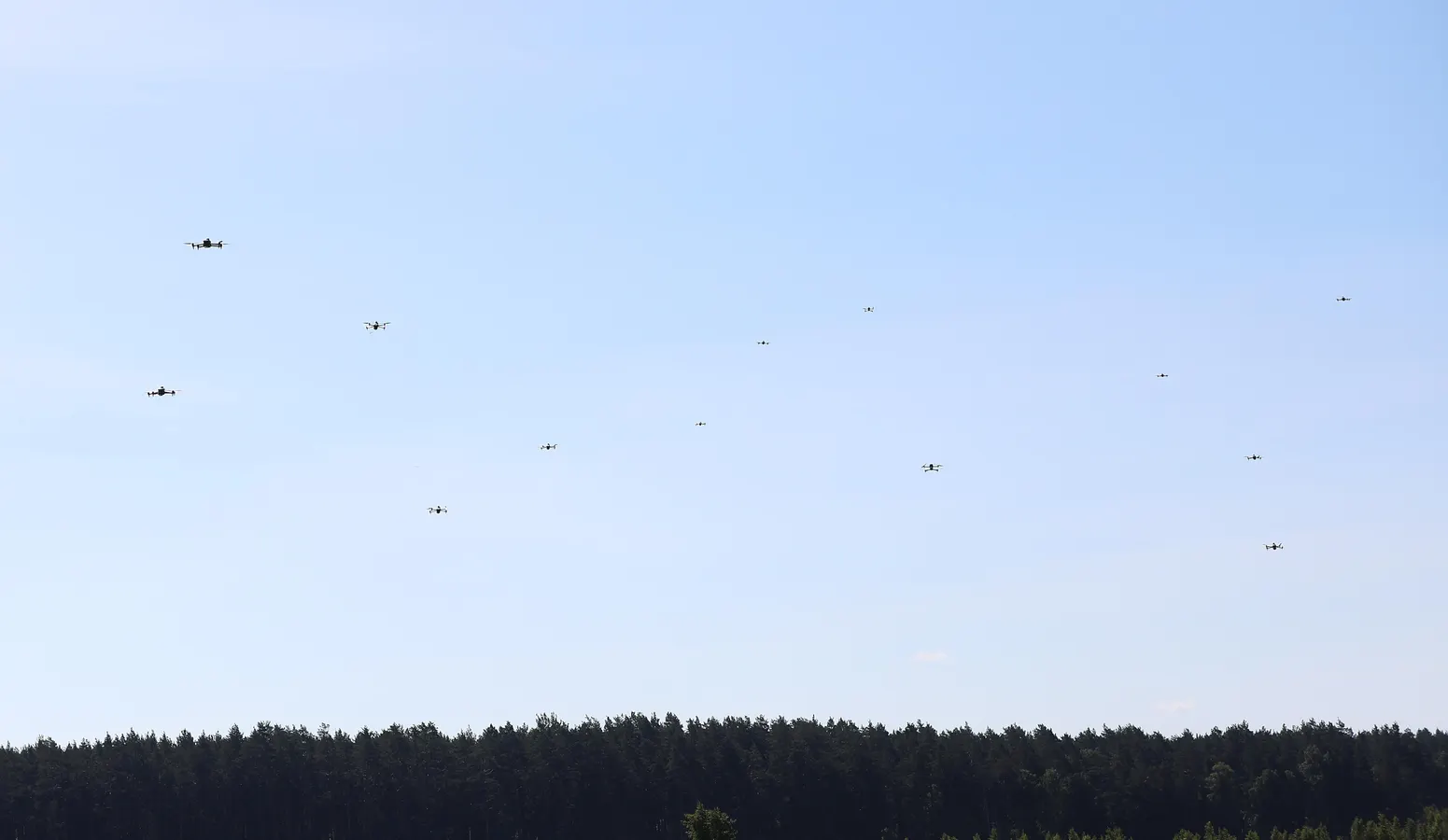

A swarm of drones flies in Europe during a NATO exercise. (Photo by Alius Koroliovas/Getty Images)
Getty Images
The U.S. Army recently conducted a groundbreaking exercise testing large swarms of unmanned aircraft systems against attack helicopters and ground sensors to gauge whether small drones could overwhelm current Army defenses.
The XVIII Airborne Corps hosted the Scarlet Dragon 26-3 exercise at Fort Bragg, North Carolina earlier this month.
‘No One Sensor To Rule Them All’
Drones synchronize before launching in coordinated swarms of 25 to 100 tactical formations to stress sensors, software and air defense crews, creating battlefield-like pressure. (U.S. Army photo by Sgt. Noe Cork)
U.S. Army
It marks the first time the Army has launched separate large drone swarms to attack en masse at once during a single exercise.
The Army did not release details of any weak points exposed during the exercise, but participants emphasized in a statement that the tests proved that a diverse array of drone-detecting sensors are needed to stop threats before they strike.
“What we’ve found is that there’s no one sensor to rule them all,” U.S. Army Col. Rob Kenny, chief of fires for the XVIII Airborne Corps, said in a statement. “It takes an integrated, layered approach.”
Drone Motherships
An AH-64 Apache helicopter flies past a Sentinel radar during the Scarlet Dragon exercise. The radar fed the shared air picture used for early warning while Apaches provided conventional aircraft profiles for the network to track. (U.S. Army photo by Sgt. Noe Cork)
U.S. Army
The tests saw AH-64 Apache helicopters of the 82nd Airborne Brigade pair with Sentinel radar sensors to scan the landscape and create a picture of the surrounding airspace on a shared network.
Drone swarms swooped down from different directions and in different numbers ranging from 25 to 100 at once.
Some attacking drones were launched in a “mothership” demonstration. This saw a large unmanned aircraft system packed with small drones drop and launch them in midair.
The Army used the drone mothership to test the capabilities of its artificial intelligence and sensors to distinguish between the incoming mothership drone from so-called “daughter” systems and prioritize which ones to target for defeat.
Stealth Drones Just Above Ground Level
F11 Core drones fly in formation to test Army defenses during the Scarlet Dragon exercise. (U.S. Army photo by Sgt. Noe Cork)
U.S. Army
To make the test more challenging, swarms of smaller F11 Core drones sought to penetrate Army defenses hovering close above ground level.
The service also tested the attack potential of other unmanned aircraft systems during the test, including a catapult-launched fixed-wing drone and a Light-Sport NI84SR aircraft. The Light-Sport aircraft that can be piloted or used as an unmanned system and can carry heavy payloads of up to 800 pounds.
The move to push the Army’s defensive limits comes as drone swarm tactics are increasingly becoming the new norm in combat. An August exercise proved that a single U.S. soldier can now control up to 21 drones on the battlefield at once.
This new iteration of Scarlet Dragon is part of a larger military shift to swarming tactics. It demonstrates the changing character of war as one dominated by machines automatically seeking targets while software, rather than bullets, forms the first line of defense.















Leave a comment