


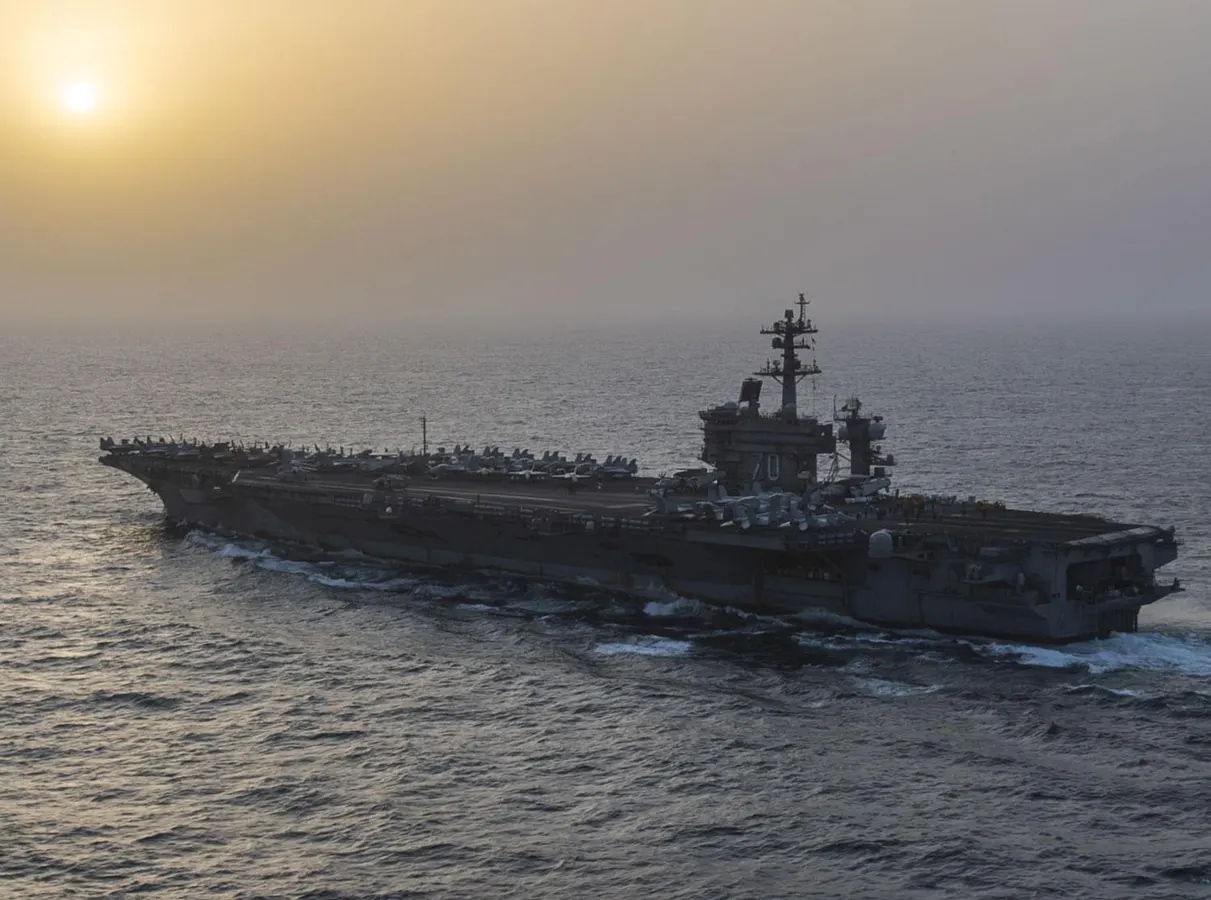

The Nimitz-class aircraft carrier USS Carl Vinson (CVN 70) operates in the U.S. Central Command area of responsibility.
(Official U.S. Navy photo)
The San Diego-based nuclear-powered aircraft carrier USS Carl Vinson (CVN-70) was awarded the United States Navy’s Battle Effectiveness Award for the warship’s 2024-2025 deployment, the service confirmed.
“The Battle ‘E’ Award recognizes U.S. Navy commands that display superior performance during operations, inspections, certifications, assessments and training events in a competitive cycle, assessing their proficiency and overall effectiveness in all phases of operations,” the United States Navy explained.
The Battle Effectiveness Award remains one of the U.S. Navy’s most prestigious honors, awarded annually to ships, aviation squadrons, shore installations and specialized units that demonstrate the highest levels of sustained battle readiness, as well as day-to-day superiority and mission performance. Unlike individual medals, the Battle “E” is earned by the entire command.
Supporting Operation Rough Rider
The third Nimitz-class supercarrier departed from Naval Air Station North Island, San Diego, Calif., in November 2024 and conducted operations in the U.S. 3rd, 5th, and 7th Fleet areas of operations in 2025, operating primarily in the Indo-Pacific and Arabian Sea.
In addition, during the nine-month-long deployment, CVN-70 was also dispatched to the South China Sea, Sea of Japan and East China Sea before being diverted in March 2025 to the Middle East to support United States Central Command combat operations against the Iranian-backed Houthi rebels during Operation Rough Rider.
The Carl Vinson Carrier Strike Group completed more than 10,000 sorties and 23,000 flight hours, carried out 45 replenishments-at-sea and sailed over 275,000 nautical miles combined, the U.S. Navy stated.
The USS Carl Vinson and her carrier strike group concluded the deployment last August, stopping in Hawaii in late July before returning to San Diego on August 14, 2025.
“The Carl Vinson team displayed unrelenting perseverance and superior performance as they successfully carried out sustained operations at sea throughout 2025,” said Capt. Joshua Wenker, commanding officer of the USS Carl Vinson. “Our Sailors worked together to successfully execute a wide range of missions while operating in the Western Pacific and the Middle East, once again setting the standard for courage and steadfastness. I could not be more proud of my team, and their achievements continue to add to the storied history and legacy that has made this ship America’s Favorite Carrier!”
In addition to the Battle “E,” the USS Carl Vinson earned awards for Carrier Maintenance and Environment Protection and Energy Conservation, which the U.S. Navy confirmed for the warship’s dedication to “comprehensive maintenance capabilities and coordinated logistics as a core component to keeping the fleet ready to fight.”
CVN-70: A Highly Decorated Flattop
The USS Carl Vinson has earned a total of 10 Battle “E” Awards, with the first in 1990 and the most recent before this year being for its 2024 deployment.
The nuclear-powered flattop has also earned two Navy Unit Commendations and five Meritorious Unit Commendations. CVN-70 has been recognized three times, including in 2025, for being the top-performing ship in the U.S. Pacific Fleet, for which she was awarded the Marjorie Sterrett Battleship Fund Award.
Other past commendations include the National Defense Service Medal, the Armed Forces Expeditionary Medal, the Global War on Terrorism Expeditionary Medal, a total of 15 Sea Service Deployment Ribbons, and four Vice Admiral James H. Flatley Memorial Safety Awards.
Named For “The Swamp Fox”
The USS Carl Vinson is one of the three Nimitz-class supercarriers not named for a former United States president, apart from the USS Nimitz (CVN-68), named to honor the U.S. Navy’s highest-ranking admiral of World War II, and the USS John C. Stennis (CVN-74), which was named for the Mississippi senator.
Rep. Carl Vinson (D-Ga.), one of the most powerful and colorful figures in Congress, announced on 1964 that he would not run for re-election, after serving one month more than 50 years in Congress/
Bettmann Archive
However, where CVN-74 has remained a controversial choice, in part due to the fact that the lawmaker had little connection to the U.S. Navy, CVN-70 was named for the late Rep. Carl Vinson (D-Georgia), who represented his state in the House of Representatives for 51 years. More importantly, he earned the nickname “The Swamp Fox” and “The Admiral” due to his support of U.S. naval affairs.
Rep. Vinson served as chairman of the House Naval Affairs Committee in 1931, where he played a pivotal role in guiding the U.S. Navy through the Second World War and the early Cold War. Rep. Vinson was a strong supporter of the “Two Ocean Navy Act,” which dramatically increased the naval budget by 70%.
The United States Navy’s supercarrier to bear Rep. Vinson’s name was launched in 1980, and she officially entered service in 1983. As with other nuclear-powered carriers in her class, CVN-70 can carry more than 65 fixed and rotary-wing aircraft, while she can travel more than 5,000 nautical miles in less than seven days in support of national tasking.
USS Carl Vinson was also the first U.S. Navy aircraft carrier to operate with the Lockheed Martin F-35C Lightning II, when it conducted out tests with the fifth-generation multirole stealth fighter during the Rim of the Pacific 2018 exercise.
Carrier Air Wing 2 (CVW-2) was embarked on the USS Carl Vinson during the 2024-2025 deployment, with it composed of nine squadrons flying the F-35C Lightning II, F/A-18E/F Super Hornets, EA-18G Growler, E-2D Advanced Hawkeye, CMV-22 Osprey and MH-60R/S Sea Hawks.











Leave a comment