


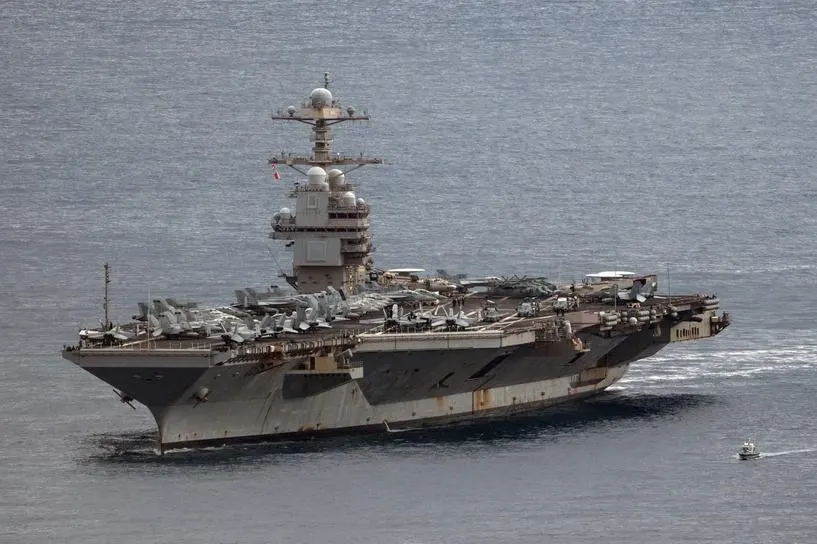

The United Stated Navy aircraft carrier USS Gerald R. Ford arrives in Souda Bay, Greece on March 23, 2026 for repairs following a fire that reportedly broke out in a laundry room on the aircraft carrier, injuring sailors and causing significant damage. The vessel has also had issues with its toilet system. Since departing Norfolk, Virginia on June 24 last year, the Ford has been deployed to the Mediterranean, Caribbean, and most recently the Red Sea as part of U.S. operations against Iran. (Photo by Carl Court/Getty Images)
Getty Images
Three years of continuous combat operations, coupled with recent extended deployments of vessels at sea, are severely straining both the U.S. Navy’s fleet and ship repair workers, according to industry experts.
The Navy has long languished under the persistent demand for new ships amid vessel shortages and lags in shipbuilding. Now, existing vessels are being pushed to their limits to keep functioning properly while repair workers feel anxieties about potential job cuts as ships remain at sea continuously.
According to a recent report by the U.S. Naval Institute, the Navy is sustaining over a dozen guided missile destroyers plus aircraft carriers to support operations in the Middle East, with two Arleigh-Burke class destroyers, the USS Spruance and USS McFaul, deployed for 10 months.
The Impact Of Extended Deployments On Repairs
U.S. sailors do maintenance work on an F/A-18 fighter plane in the hangar bay of Nimitz-class aircraft carrier USS George Washington in August 2026 while supporting operations in the Middle East. (U.S. Navy photo)
U.S. Navy
Extended deployments are causing ships to skip required maintenance periods, putting severe strains on the vessels and creating uncertainties for ship repair workers in the United States.
“There’s less work because some of these ships would have been in and awarded contracts for continuous maintenance,” said retired Rear Adm. John Polowczyk, president of the Virginia Ship Repair Association, in an interview.
The USS Santa Barbara, a littoral combat ship freshly commissioned in 2023, was sent to Singapore for vital repairs to avert “immediate, critical threat of mechanical failure,” of all four engines which were “operating well beyond their maximum recommended operational thresholds,” according to a report last month by The Washington Sun.
The USS Gerald Ford, the world’s largest aircraft carrier, suffered a fire and plumbing problems during a 326-day deployment that ended in May.
Repairs for aircraft carriers are typically scheduled well in advance. When ships are constantly delayed in returning for maintenance, repair workers in the U.S. are left without work to perform, impacting their livelihoods and straining industry.
“We’re frozen,” said Polowczyk. “My members are extremely worried that funding issues and the continued pace of operations will impact the Navy’s ability to award the next round of coming awards sometime in fiscal year 27.”
Unprecedented Operational Demands
A U.S. sailor performs maintenance on a bomb ejector rack aboard Nimitz-class aircraft carrier USS George H.W. Bush on September 23, 2026 while deployed to the U.S. 5th Fleet area to support operations in the Middle East. (U.S. Navy photo)
U.S. Navy
While it’s not unheard of for the Navy and repair workers to shoulder extra burdens due to extended deployments, the current demands on the fleet are unprecedented.
“We go through ‘boom-bust’ cycles of maintenance with extra-long deployments,” said Dr. Steven Wills, a navalist for the Center for Maritime Strategy at the Navy League of the United States, in an interview. “Some of this happened after Desert Shield and Desert Storm, where we deployed a significant amount of the fleet for a longer period—but not as long as this.”
Ships are complex environments, blending components and systems that require detailed routine maintenance. Some repairs cannot be performed by crews onboard. Combat conditions can also prevent crews from performing repairs.
While it’s temporarily possible to patch routine problems up and keep sailing, excess wear and tear will take an inevitable toll that only gets worse. The longer a ship stays at sea without sufficient repair and assistance from land crews, the grimmer conditions on board become.
Why Ships Require Continuous Care
The U.S. Navy aircraft carrier USS Abraham Lincoln, with marine organisms visible growing on it, is shown stationed in Thailand for rest and maintenance in September 2026 after over nine consecutive months of combat deployment without a port call, carrying over 5,000 personnel. (Photo by © TNP/Arnun Chonmahatrakool/Thai News Pix/LightRocket via Getty Images)
Thai News Pix/LightRocket via Getty Images
Without regular maintenance, a vessel succumbs to a slow but inevitable state of decay, from the inside and outside.
“You really have degradation in capability,” explained Wills. “When you really start pressing these ships, some of the subsystems really take more effort to keep online.”
Anything from air conditioning systems to kitchen equipment in the galley is in constant use and gets worn down. Marine life grows on the bottoms of the ships—not only coating them in green slime but making them heavier, introducing drag that reduces speed and wastes fuel economy.
Older aircraft carriers sometimes suffer from leaky catapult systems, Wills said. It’s imperative to maintain carrier systems in working order to ensure aircraft can launch from and land on them effectively.
“This has totally screwed up aircraft carrier maintenance because we’ve now delayed multiple aircraft carriers out of their usual cycles,” Wills said.
“A lot of aircraft carrier maintenance is very carefully planned. Now we’ve had Gerald Ford, Abraham Lincoln, Harry Truman, all be delayed and have extended deployments. The Theodore Roosevelt just deployed and she may have an extended deployment, too. All of this snowballs downstream.”
Minor problems on a ship, if left unaddressed over a long period, can potentially become hazardous.
“You get to a point where people start signing waivers for things, and that’s potentially dangerous,” said Wills.
How Delays Impact Repair Workers
Fluctuations in demand for ship repair work caused by continuously deferred maintenance are creating worries for U.S. ship repair workers. (Photo by: Jeffrey Greenberg/Universal Images Group via Getty Images)
Universal Images Group via Getty Images
At home, ship repair workers keep waiting for ships to return—and to earn their livelihoods.
Polowczyk sees no difficulties with recruiting and retaining a viable ship repair workforce. The workers simply need something to work on, he said.
“We went off and did all these operations. We were already short of money. They’re deployed, they need maintenance and Congress isn’t appropriating more money,” said Polowczyk. “So how does this work out in the end? Because the Navy is down in numbers of ships, any variation of workload amplifies the reaction.”
Unpredictable supply and demand for ship repair services is reaching a critical point, according to Polowczyk. Members of his association in Norfolk are witnessing the cannibalization of spare parts from vessels there to be sent to hastily repair ships at an unprecedented rate, he explained.
“This bill is already coming due. These ships are just being consumed,” Polowczyk said. “The budget and acquisition community is not aligned to the pace of operations.”
Constantly delaying ship repairs affects not only the capabilities of the vessels themselves but workers’ ability to earn.
“We’ve got to figure out a way to moderate the up-and-down and provide a long-term backlog of work so the shipyards and others can continue to keep people on the payrolls and even hire more because they’ve got work in the future,” he said.
Keeping Ships At Their Fighting Edge
An F/A-18 Super Hornet lands aboard the Nimitz-class aircraft carrier USS George Washington in September 2026. George Washington is deployed to to support operations in the Middle East. (U.S. Navy photo)
U.S. Navy
Seapower provides nations with a means of demonstrating global strength. The U.S. has traditionally been especially proud of its aircraft carriers.
“An aircraft carrier is a moving piece of four-and a half acres of sovereign U.S. territory, full of strike airplanes,” said Wills.
But even the giants of ocean need regular polishing to give their best performance. The true power behind any warship is ultimately the people who work to keep it operating at its strongest fighting edge.
“People understand that these are valuable tools, but there are limits to their use. There really are,” said Wills. “There are only so many of them, and they’re complex systems that require a lot of love and care, not only from the people that are crew and live and work there, but back ashore too.”















Leave a comment