


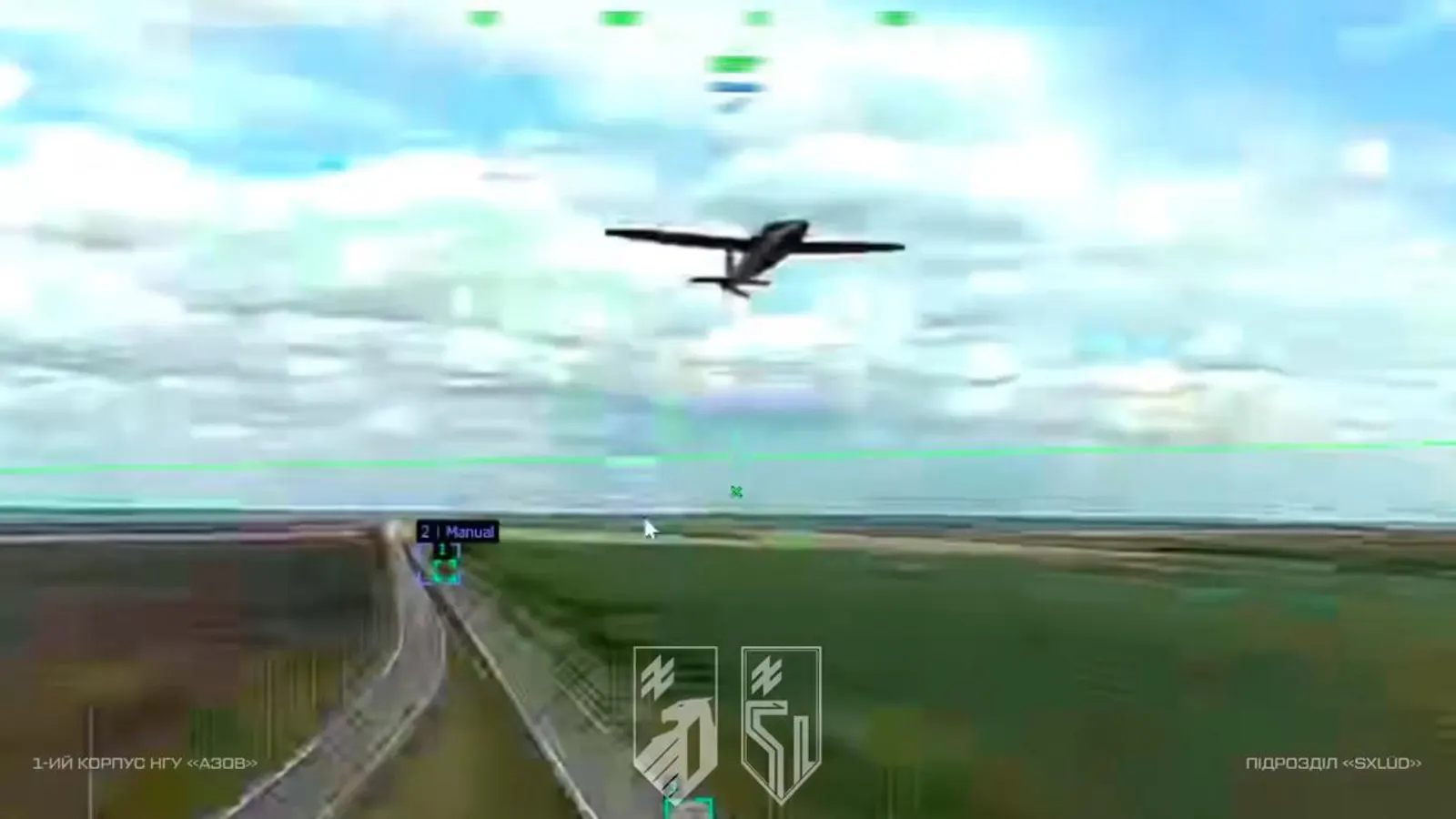

Image captured from drone footage posted on social media by the First Corps Azov of the National Guard of Ukraine. The video shows Ukrainian drones striking Russian logistics targets around Mariupol. The image captures a Ukrainian Hornet strike drone passing another drone that is recording the strike.
Social Media Capture
Since the earliest recorded conflicts, sieges have played a central role in military operations. While sieges have commonly been employed to capture fortified cities, they have also been widely used to disrupt broader campaigns. By isolating key logistics nodes, especially port cities, sieges constrain the flow of supplies to forces operating in the region. Over centuries, sieges have evolved alongside technology, from wooden siege engines to the introduction of cannons that rendered traditional walls obsolete. Today, Ukraine is driving the next transformation of this ancient practice. By using drones to interdict supply lines from a distance, Ukrainian forces can impose the effects of a siege without physically encircling a city, redefining how an opponent can be isolated in modern warfare.
The Ukrainian “Siege” of Mariupol
Ukraine is currently implementing a drone-based siege against Russian forces in Mariupol, in an effort to disrupt the broader Russian operations in the region. Located on the Sea of Azov, Mariupol is a key port and industrial center, vital to Ukraine’s economy, while also important to Russia as part of its land bridge between Crimea and the Donbas. It was the first major Ukrainian city to fall in 2022 after months of intense urban fighting. After capturing the city, Russia transformed it into a major logistics hub supporting operations across southern Donetsk and Zaporizhzhia. It uses the city’s extensive road networks, as well as the restored port, to move fuel, ammunition, personnel, and heavy equipment to frontline units.
In early May, Ukrainian forces began using long-range reconnaissance-strike drones to interdict Russian logistics moving into and through the occupied hub. Ukrainian drones have been spotted patrolling the T-0509/H-20 Mariupol–Donetsk corridor and the M-14/E58 coastal highway linking Mariupol with Berdiansk, Melitopol, and the broader southern front. Along these routes, the drones are targeting fuel trucks, ammunition carriers, troop transports, and other logistics vehicles, degrading supply flows into and out of the city without a traditional ground encirclement.
Image captured from video posted on social media by the First Corps Azov of the National Guard of Ukraine on May 8, 2026. The video shows footage from drones patrolling the roads into Mariupol.
Social Media Capture
Recent reporting and social media footage underscore the scope of this effort. According to a May 8 social media post from the First Corps Azov of the Ukrainian National Guard, Ukrainian drone units are now patrolling roads up to 160 kilometers into Russian-controlled territory, with Mariupol itself appearing in drone surveillance feeds. The post includes a video showing drone strikes on Russian vehicles along key approach routes into the city. Meanwhile, both Russian and Ukrainian military bloggers suggest that Ukrainian drones now control several key roads into and out of Mariupol. Although some supplies may still be getting through, Russia’s logistics are under persistent pressure. In addition to affecting the Russian forces in Mariupol, these strikes are disrupting the flow of supplies to units operating across the region.
This remote sieging tactic has been enabled by advances in Ukrainian drone technology. Ukraine is fielding long-range strike drones that can loiter over roads, identify moving targets, and strike logistics vehicles deep behind the front. Around Mariupol, units are reportedly using the Hornet, a small AI-enabled, fixed-wing loitering munition with a range exceeding 100 kilometers. These platforms combine reconnaissance and strike functions, enabling continuous patrol of supply routes and rapid engagement of targets. Videos of these strikes suggest that, despite many Russian vehicles being equipped with electronic warfare systems, such defenses have been ineffective against these drones.
Ukraine Use Of Drone-Based Sieges Across The Front
Ukraine’s drone-based siege of Mariupol mirrors its broader strategy of targeting Russian logistics channels. Ukrainian forces are using drones to strike fuel trucks, ammunition carriers, and logistics convoys across much of the front, including areas around Tokmak, Melitopol, and key logistics routes in the Donetsk direction. In effect, Ukraine is replicating siege conditions across the wider battlefield, systematically constraining the flow of supplies to Russian forces rather than isolating a single city. Reports from across the front indicate growing shortages of key supplies, including food, water, and ammunition.
Closer to the front, Ukraine is also targeting resupply to smaller Russian units operating in and around Ukrainian “kill zones.” Small Russian units infiltrate these areas and take cover inside destroyed buildings. From these positions, they launch drone attacks and stage assaults on Ukrainian lines. While these units are difficult to target directly, their resupply lines are easier to strike. Here, the same siege logic is applied at the tactical level, as Ukrainian forces isolate these positions rather than assaulting them directly. Ukrainian drones monitor these areas for resupply movement by small trucks, ground robots, or dismounted troops. Once identified, these resupply elements are destroyed by drone strikes or artillery. Without resupply, Russian units cannot hold ground and are eventually forced to abandon their positions.
Image captured from a video posted on social media showing a destroyed Russian UAZ van that had been used as part of resupply. The vehicle had been targeted by a Ukrainian drone between 65 and 100 km behind the front.
Social Media Capture
Ukraine has adopted this approach because it is easier to strike resupply vehicles than entrenched armor, artillery, or dismounted soldiers. As in traditional sieges, the focus is on the vulnerable flow of supplies rather than a defended position. These vehicles are typically lightly armored and constrained to roads, following predictable routes and timing. Because they are already carrying heavy cargo, they are less able to add protective measures such as turtle or hedgehog-style armor. Ammunition and fuel trucks are especially vulnerable, as even a small munition can destroy the entire vehicle.
These strikes are made possible by Ukraine’s diverse and evolving drone fleet. In addition to the long-range, fixed-wing strike systems used around Mariupol, Ukraine fields a wide range of multi-rotor strike and bomber drones tailored for specific missions. Advances in drone technology have further expanded these capabilities, with fiber optic-controlled systems reaching up to 60 kilometers into Russian-held territory and Starlink-supported platforms operating in contested electromagnetic environments. Increasing onboard autonomy also allows many of these systems to continue toward and strike targets even when signals are disrupted, reducing the effectiveness of Russian electronic warfare.
Further Implications Of These Drone-Based Siege Tactics
The implications of this approach extend well beyond Mariupol. Drone-enabled sieges allow Ukraine to be more selective in what it targets and what it allows to pass, which is especially important in occupied cities that still contain Ukrainian civilians. Rather than destroying infrastructure or fully cutting off access, Ukrainian forces can focus on military logistics while limiting broader damage. As drone range and endurance improve, Ukraine may apply this tactic to other Russian-occupied cities such as Melitopol, Berdiansk, Tokmak, and parts of Donetsk, further isolating Russian units.
Image captured from a video posted on social media on May 3, 2026. The video shows a Ukrainian Hornet drone targeting Russian vehicles around Mariupol. However, the drone ends up clipping one of the trucks and crashing.
Social Media Capture
Over the longer term, this approach has broader implications for how wars are fought. Taking an urban area has always been difficult, but holding it may become even harder if supply lines can be persistently targeted from a distance. Any occupying force will have to assume that its logistics are under constant surveillance and attack. It also allows a force to impose siege conditions without massing troops or exposing them to direct fire. Instead of surrounding a city, drones can isolate it. This creates a new way to weaken an opponent over time by depleting supplies, reducing combat effectiveness, and forcing the abandonment of positions without committing large numbers of soldiers.
Ukraine is not just adapting siege warfare; it is redefining it. Control of terrain is no longer required to isolate an opponent. Rather, control of movement is enough. As drones continue to extend range, endurance, and autonomy, this model will likely spread beyond Ukraine, changing warfare. Future sieges may not be marked by encirclement on a map, but by the more subtle collapse of logistics networks under constant attack from drones.















Leave a comment