


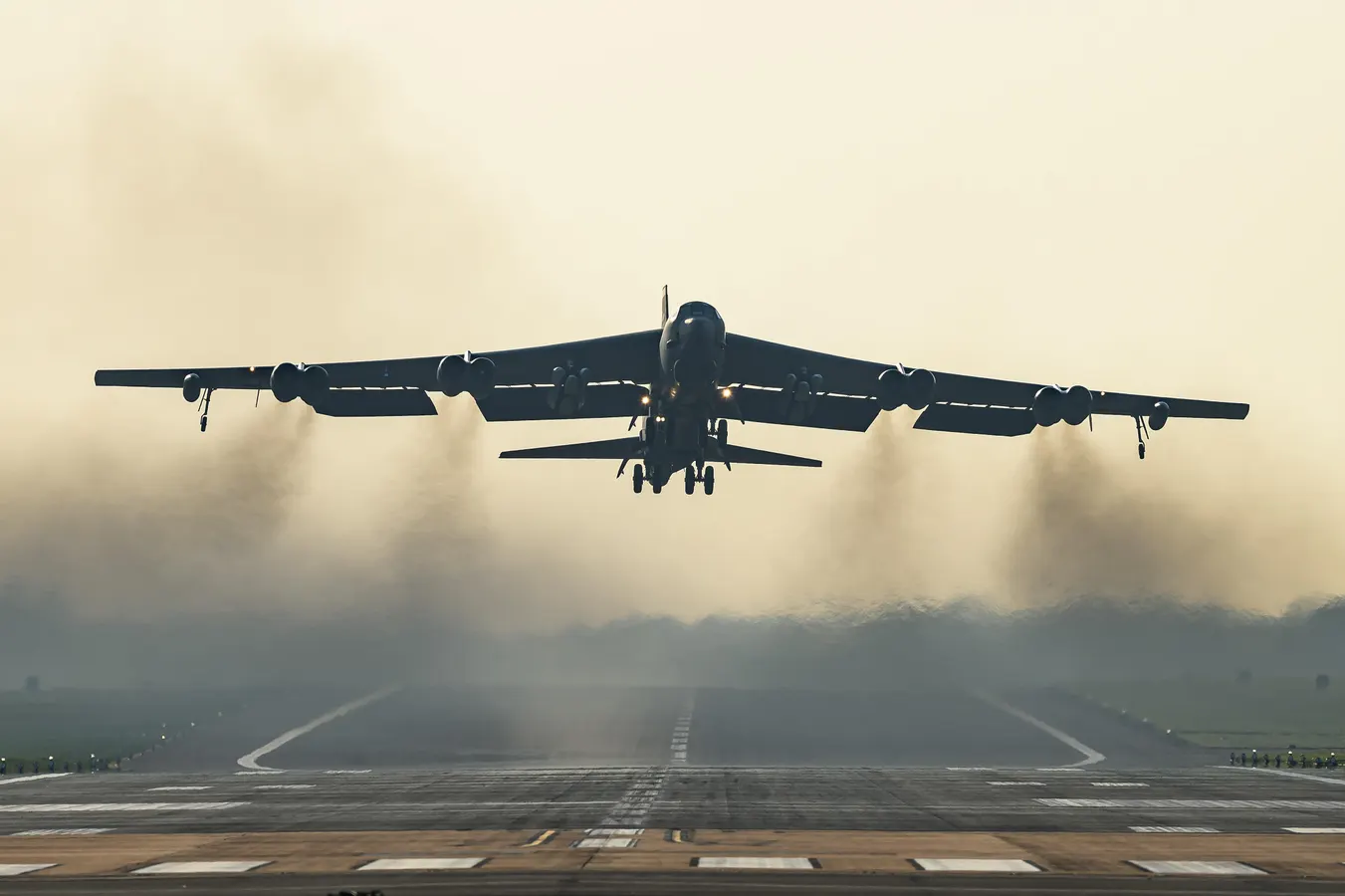

A United States Air Force B-52 Stratofortress strategic bomber takes off from RAF Fairford on March 19, 2026 in Fairford, England. (Photo by Leon Neal/Getty Images)
Getty Images
Flight tracking data released on Tuesday showed that the Boeing B-52 Stratofortress bomber involved in the fiery crash in Southern California on Monday morning nearly completed a 180-degree turn before falling to the ground.
All eight people on board, including mix of military personnel and civilian contractors, were killed.
It remains unclear what caused the bomber to crash shortly after taking off at Edwards Air Force Base, California, and a final investigation could take at least six months.
Almost immediately after the Cold War-era long-range strategic bomber crashed shortly after take-off at Edwards Air Force Base, California, the initial indications were that the crash was not survivable.
“We mourn this loss and honor the service of our Airmen, civilians, and contractors who work every day to advance our mission. I send my sincerest condolences to their families and loved ones,” Secretary of the Air Force Troy Meink said on Tuesday.
“We extend our deepest condolences to the loved ones of the eight crew members who lost their lives in the B-52 crash at Edwards Air Force Base, California,” Boeing said in a statement posted on X. “It is with great sadness that we confirm that two Boeing employees were among those on board.”
Bomber Crashes Are Rare
The most recent previous crash of any U.S. Air Force bomber involved a Rockwell B-1B Lancer, when the aircraft struck the ground about 100 feet short of the runway while making a low-visibility landing attempt at Ellsworth AFB, South Dakota, in early January 2024. All four crewmembers survived the incident, but the aircraft, valued at $317 million, was destroyed.
The most recent fatal mishap involving a B-52 took place in 2008, “when six Air Force personnel were killed after their B-52 crashed into the Pacific Ocean off the coast of Guam while preparing for a parade flyover,” CNN reported on Monday.
However, the crash on Monday also means that another U.S. Air Force bomber is beyond recovery or repair, and can’t be easily replaced.
As of the start of this year, the U.S. Air Force had 76 B-52Hs in its total fleet, even as the bomber aircraft continue to serve as the backbone and workhorse of the bomber force. Of those warplanes, 58 are in the active forces, and 18 more are in the reserve fleet. The Air Force’s B-52s are primarily stationed at Barksdale AFB, Louisiana, and Minot AFB, North Dakota, both under Air Force Global Strike Command. Another dozen B-52s are maintained in long-term storage at the Davis-Monthan AFB “Boneyard” in Arizona.
Current plans call for the Air Force to operate the B-52s alongside the Northrop Grumman B-21 Raider from the late 2030s, when the aging B-1B Lancer and Northrop B-2 Spirit fleets are finally retired. However, due to global operational demands, and the fact that no U.S. Air Force bomber has rolled off the assembly line since production was completed on the B-2 “The Spirit of Louisiana” in 1997, the Pentagon opted earlier this year to upgrade the remaining B-1Bs and B-2 Spirits to keep each flying for another decade.
All three of the current bombers were employed in Operation Epic Fury, the U.S. air and missile campaign launched on February 28, 2026, against Iran. The B-1Bs and B-52s conducted missions operating from Royal Air Force Fairford in the UK, and the B-2s flew CONUS-to-CONUS missions from Whiteman AFB, Missouri, and back to strike the Islamic Republic.
The Century Bomber
By the time the B-52 is retired, it could have served as the workhorse of the U.S. Air Force’s bomber fleet for nearly a century. Production of the Stratofortress ended in 1962, with a total of 744 built.
US Air Force B-52 Stratofortress bomber crashed shortly after takeoff from Edwards Air Force Base in California during a routine test mission, killing all 8 people on board. (Photo by Yasin Demirci/Anadolu via Getty Images)
Anadolu via Getty Images
With a combat range of 8,800 miles without the need to refuel, each B-52 can deliver more than 30 tons of ordnance to a target. The Stratofortress was first employed in combat during the Vietnam War, and later played a critical role in the 1991 Gulf War and again in the 2003 invasion of Iraq.
Keeping the aircraft flying is no easy task, due to a shrinking vendor base and a diminishing supply chain for spare parts. To sustain the long-range bombers, the Air Force relies heavily on depot-level maintenance and structural rebuilds, as well as an extensive modernization program.
The remaining B-52 are set to receive new engines, with the original 1960s-era Pratt & Whitney TF-33 powerplants replaced with the modern Rolls-Royce F130 turbofan engine, a military variant of the commercial Rolls-Royce BR725. The Commercial Engine Replacement Program has been significant enough that the service announced last year that, once completed, the aircraft would be redesignated the B-52J. Part of the reason for the redesignation is that swapping the engines has required some retooling of the aging bombers.
The engine maker worked closely with the aerospace firm to create digital models of the massive bombers, which allowed engineers to run simulations that assessed how the F130 turbofans would interact with other components and systems. It further involved the two companies trading digital models to help engineers ensure the F130 would fit precisely within each B-52 nacelle and then determine where newly added components could be placed.
The B-52 that crashed on Monday was supporting the Air Force’s “radar modernization program,” the other significant update to the aging aircraft.
Old Warbirds Can Only Fly For So Long
The B-52 fleet currently averages over 64 years old, and the loss of even a single aircraft decreases the already limited number of aircraft available.
In addition, the B-52s flying from Edwards AFB serve as vital airborne testbeds for the U.S. Air Force, which explains why two Boeing contractors were on board at the time of the crash.















Leave a comment