


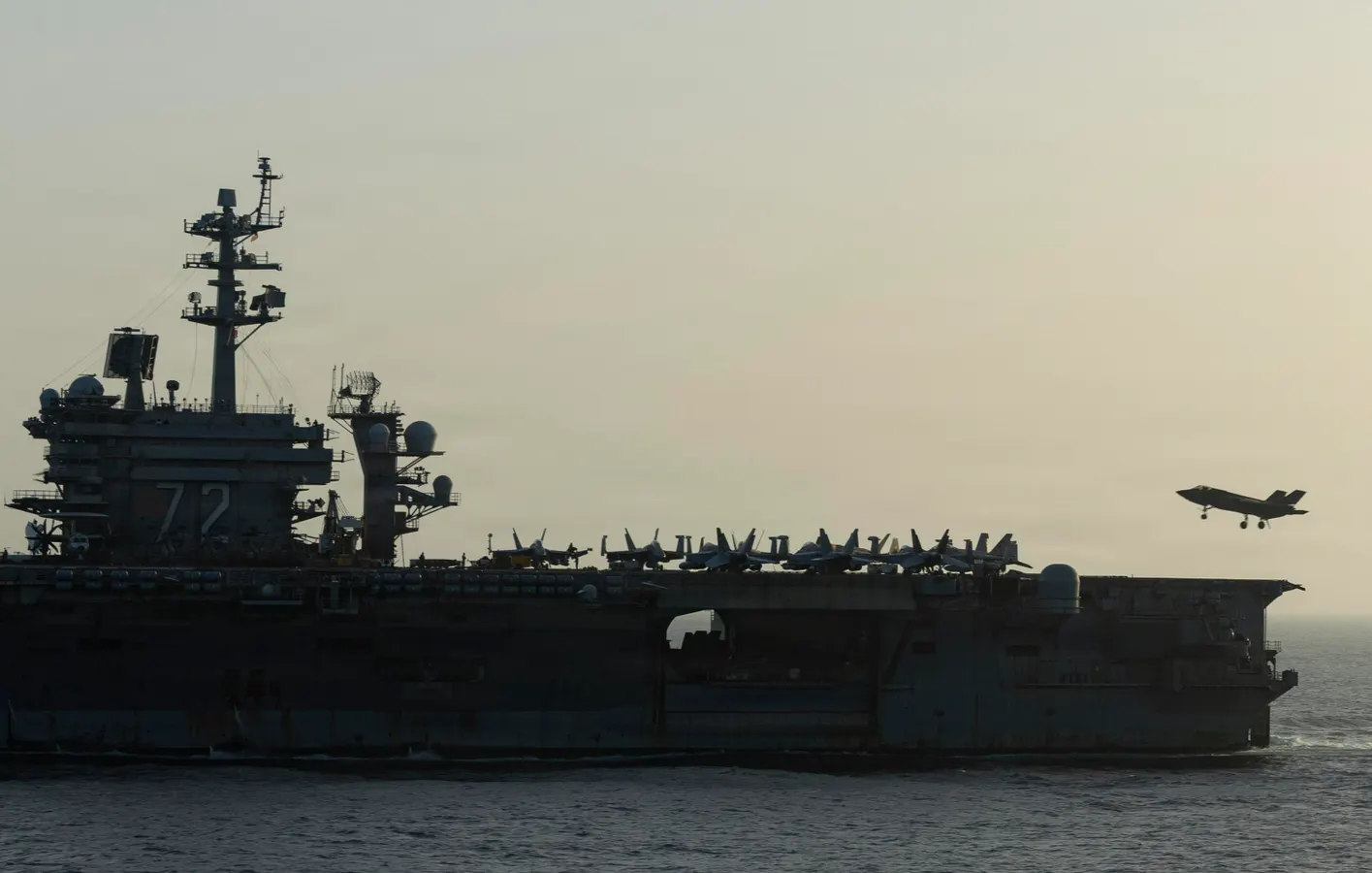

USS Abraham Lincoln (CVN 72) conducts U.S. blockade operations related to the Strait of Hormuz on April 16, 2026 in the Arabian Sea. (Handout Photo by the U.S. Navy via Getty Images)
Getty Images
As of Thursday, the United States Navy’s Nimitz-class aircraft carrier USS Abraham Lincoln (CVN-72) has been at sea for 237 days, making just a single port visit last month, and its current deployment has now lasted 258 days. The nuclear-powered supercarrier departed from Naval Base San Diego with little fanfare on November 21, 2025, and the flagship of Carrier Strike Group 3 visited Oman after 208 continuous days at sea, the longest for a modern carrier and its first since December 12 when it made a similarly short port call at Naval Base Guam.
The total days deployed are still far fewer than the record-setting 326 days of the USS Gerald R. Ford (CVN-78), which saw its deployment last from June 24, 2025, until May 16, 2026.
However, during its 11-month mission, CVN-78 made numerous port visits, and although it was deployed to the Middle East, operating from the Red Sea, much of its time away from its home port at Naval Station Norfolk, Virginia, wasn’t in what could be described as a warzone.
No Pleasure Cruise For USS Abraham Lincoln
The United States military has officially designated parts of the Arabian Sea as a formal combat zone, and even if the USS Abraham Lincoln is in the exact areas that fall under the designation, the entire region could be considered active high-risk operational and combat zones. The warship continues to operate under high-threat conditions, and has been on continuous high alert since the United States launched Operation Epic Fury on February 28, 2026.
When CVN-72 deployed last November from San Diego, it was for an expected and routine seven-month-long mission, but it has already been extended twice.
The time away from port has resulted in far from ideal conditions on the fifth Nimitz-class aircraft carrier. According to a report from MS Now on Wednesday, citing communication with families, sailors are facing moldy showers and food shortages. They are even running out of necessities such as toothpaste, deodorant, and soap.
Aircraft carriers are already seen as dangerous, high-stress workplaces.
The extended deployments and issues with clogged toilets and little time off are only making the situation worse.
“The morale is not good. Apparently, the ship’s doctor or therapist said they need to hit port soon or people are going to start, you know, losing their minds,” Bonnie York, whose stepson is on the USS Abraham Lincoln, told MS Now.
Cmdr. Joseph Hontz, the spokesperson for the Navy’s 5th Fleet, responded to the news outlet that the crew has been able to address the expected wear and tear, but acknowledged that the “deployment is challenging for the crew and their equipment,” and added, “They remain resilient and ready to accomplish any tasking given to them.”
In April, Secretary of Defense Pete Hegseth responded to reports that there were food shortages on CVN-72 and the U.S. Navy’s amphibious assault ship USS Tripoli (LHA-7), calling it “fake news.” The U.S. Navy quickly released images that showed the crews were being fed full nutritionally balanced meals.
Relieving USS Abraham Lincoln Is a Matter of When
As the United States has a limited number of aircraft carriers, and a final peace with Iran has yet to be finalized, it is unclear how long the USS Abraham Lincoln will remain at sea.
Even if the conditions aren’t quite as bad as some of the reports claim, the truth remains that the high tempo isn’t good for crew morale. It also isn’t good for the aircraft carrier, as long deployments typically require even longer maintenance periods, resulting in the next deployed flattop likely spending more time at sea. The problem is only going to get worse, at least until the situation is resolved in the Middle East.
During the peak of 2003’s Operation Iraqi Freedom, the U.S. Navy deployed six total aircraft carriers to the region, and five carrier strike groups actively participated in the initial “Shock and Awe” launch strikes on March 20, 2003.
For only a brief period in late April was the United States Navy able to maintain three supercarriers in the Middle East, and now has just two.
The tenth and final Nimitz-class flattop, the USS George H.W. Bush (CVN-77), arrived in the Arabian Sea on April 23, after departing Naval Station Norfolk on March 31, sailing around the Cape of Good Hope to avoid high-risk chokepoints including the Red Sea and the Bab el-Mandeb Strait.
It is a matter of when CVN-72 could be relieved, but the options are limited.
The East Coast-based USS Dwight D. Eisenhower (CVN-69) continues to prepare for its next deployment, which isn’t likely to occur until sometime this coming fall. Even then, the warship would still have to cross the Atlantic and either transit the Suez Canal from the Mediterranean and possibly conduct operations from the Red Sea as the USS Gerald R. Ford did earlier this year; or take the route of CVN-77 around Africa.
The West Coast-based USS Theodore Roosevelt (CVN-71) was heading back to Naval Air Station North Island, San Diego, after leading the Rim of the Pacific 2026 biennial international exercises near Hawaii, which began in late June and concluded last week. According to the San Diego Union-Tribune, CVN-71 will undergo a brief turnaround before a full deployment that is now expected to begin in September.
It is possible that the forward-deployed USS George Washington (CVN-73), which began its 2026 deployment from Yokosuka, Japan, on May 23, could be dispatched to the Middle East, but that would leave the U.S. Navy without a presence in the Western Pacific.
Given the shortage of available aircraft carriers, the USS Abraham Lincoln is likely to remain deployed and at sea to support potential combat operations against the Islamic Republic for at least another month, and more likely two. CVN-72 could close in on that 326-day record deployment, one that the crew is likely in no hurry to set.
Finally, it should be noted that the USS George H.W. Bush has now been at sea for 128 days, and its six-or seven-month deployment might also be extended as there simply aren’t enough carriers in service to address the multiple global threats.
















Leave a comment