


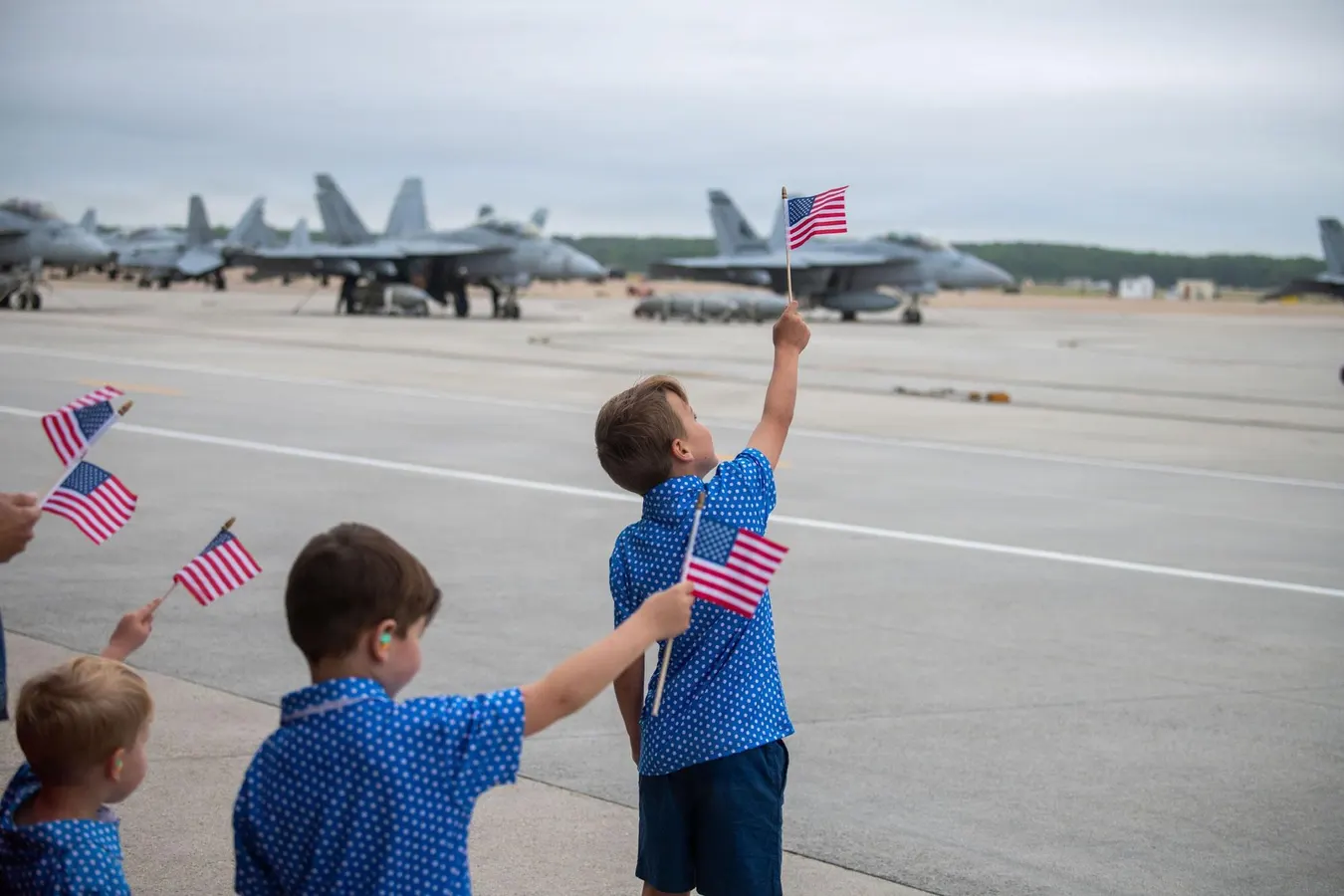

Strike Fighter Squadron (VFA) 37, the “Ragin’ Bulls,” returned to Naval Air Station Oceana, May 11, 2026
(U.S. Navy photo by Mass Communication Specialist Seaman Cierra Middleton).
Although the United States Navy’s newest and largest nuclear-powered aircraft carrier, the USS Gerald R. Ford (CVN-78), may not arrive at Naval Station Norfolk until later this month, on Monday, six squadrons of the warship’s embarked aircraft returned to the base and to Naval Air Station Oceana.
Naval Air Force Atlantic announced in a post on social media that Strike Fighter Squadron 213 (VFA-213) “Black Lions,” VFA-37 “Ragin’ Bulls,” VFA-87 “Golden Warriors,” and VFA-31 “Tomcatters” returned to NS Oceana. Airborne Command and Control Squadron 124 (VAW-124)“Bear Aces,” and Fleet Logistics Support Squadron 40 (VRC-40) “Rawhides” landed at Naval Station Norfolk.
The embarked squadrons deployed with the USS Gerald R. Ford for 11 months and were assigned to Carrier Air Wing 8 (CVW-8).
As of Wednesday, CVN-78 has been at sea for 323 days, the longest deployment of a United States aircraft carrier since the Vietnam War, and the longest deployment of a nuclear-powered supercarrier ever.
During the nearly year-long mission, the Gerald R. Ford Carrier Strike Group (CSG-12) operated in the U.S. 2nd, 4th, 5th, and 6th Fleets’ area of responsibility.
More Than 5,500 Flight Hours
The squadrons logged more than 5,500 flight hours in support of Operation Epic Fury and conducted more than 11,800 launches throughout the 2025-26 deployment.
In addition to operations in the Middle East this winter and spring, CVW-8 conducted sorties in the High North with NATO partners last fall, then operated in the Mediterranean Sea and the Caribbean. The latter included supporting Operation Southern Spear, the United States military and surveillance campaign launched last year to stop the flow of illicit narcotics from Latin America.
While the carrier was underway in the Caribbean Sea, CVW-8 conducted a formation flight over the USS Gerald R. Ford in February as part of the unit’s aerial change of command ceremony.
This week’s “fly-off” allowed the aircraft to return directly to their home stations, but it was also conducted because the aircraft cannot easily take off or land from a stationary aircraft carrier in port. The removal of the aircraft also frees up space in the hangar deck, allowing the crew to load tools, equipment, and even personal belongings onto trucks that can then move everything to shore-side facilities once the warship is back in port.
The “Tomcat” Era
Beginning in 1975, CVW-8 was assigned to the nuclear-powered USS Nimitz (CVN-68), and the wing appeared in the 1980 movie The Final Countdown.
Operating from CVN-68, a pair of CVW-8 Grumman F-14 Tomcats from Fighter Squadron 41 engaged and destroyed two Libyan Sukhoi Su-22 (NATO reporting name “Fitter-C”) during the “Gulf of Sidra” incident. That also marked the first confirmed aerial “kill” by an F-14 Tomcat.
CVW-8 was later embarked on the third Nimitz-class carrier, the USS Carl Vinson (CVN-70), during her maiden deployment in 1982, before embarking again with CVN-68.
The wing was next deployed aboard USS Theodore Roosevelt (CVN-71), where it participated in combat operations during Operation Desert Storm in 1991 and again in 1995 as part of Operation Deny Flight over Bosnia-Herzegovina.
CVW-8 was then embarked on the oldest nuclear-powered carrier, the USS Enterprise (CVN-65), completing a more than six-month-long deployment in 2001 that included the initial strikes during Operation Enduring Freedom in Afghanistan.
A year and a half later, operating from CVN-71, the wing took part in Operation Iraqi Freedom, flying more than 1,000 sorties and 5,000 hours that delivered over 1,000,000 pounds of precision-guided weapons. In 2005, CVW-8 became the last carrier air wing to deploy with the F-14 Tomcat.
In 2011, CVW-8 embarked on CVN-77 during the carrier’s maiden deployment. Operating from USS George H.W. Bush, an F/A-18E shot down a Syrian Air Force Su-22.
CVW-8 And The F/A-18 Super Hornet
An F/A-18E Super Hornet, attached to Strike Fighter Squadron 31, launches from the flight deck of the USS Gerald R. Ford (CVN 78)
(U.S. Navy photo by Mass Communication Specialist 2nd Class Tajh Payne)
The four Strike Fighter Squadrons of CVW-8 all currently operate the F/A-18 Super Hornet. VFA-31, VFA-37, and VFA-72 are assigned the single-seat F/A-18E, with VFA-213 flying the two-seat F/A-18F.
The twin-engine Super Hornet remains the United States Navy’s primary carrier-capable, multirole strike fighter. It is an upgraded, larger variant of the U.S. Navy’s F/A-18 Hornet.
The Super Hornet, which entered service in 1999 to replace the aging F-14 Tomcat and the older F/A-18C/D, features a 20% larger airframe than the legacy Hornet models. That allows it to carry upwards of 33% more internal fuel, increasing its mission range by 41% and its endurance by 50% over the earlier model. Despite being super-sized, the F/A-18E/F has 42% fewer parts than its predecessor, the F/A-18C/D variants.
The twin-engine, mid-wing, multi-mission tactical F/A-18E/F Super Hornet has served as an air superiority fighter and escort, a reconnaissance aircraft, and an aerial refueler. It has also carried out close air support, air defense suppression, and day/night precision strikes, as demonstrated in its recent mission against an Iranian tanker in Operation Epic Fury.
Electronic Attack Squadron (VAQ) 142, “Gray Wolves,” flying the EA-18 Growler, the electronic warfare variant of the Super Hornet
(U.S. Navy photo by Mass Communication Specialist 2nd Class Andy A. Anderson)
In addition to the Super Hornet, CVW-8’s Electronic Attack Squadron 142 (VAQ-142) “Gray Wolves” flies the EA-18G Growler, the electronic warfare variant of the Super Hornet, designed to suppress enemy air defenses using advanced jamming technology; and VAW-124 is assigned the E-2D Hawkeye, the Navy’s carrier-capable, all-weather, tactical Airborne Early Warning and Command & Control aircraft.
CVW-8 is rounded out by Fleet Logistics Support Squadron 40 Det. 2 (VRC-40) “Rawhides,” operating the C-2A Greyhound transport aircraft; with Helicopter Sea Combat Squadron 9 (HSC-9) “Tridents” flying the MH-60S Seahawk, while Helicopter Maritime Strike Squadron 70 (HSM-70) “Spartans” is assigned the MH-60R Seahawk.
The remainder of CVW-8 is expected back home in the coming days, just in advance of the arrival of USS Gerald R. Ford at Naval Station Norfolk, which will finally conclude this record-setting deployment.











Leave a comment