


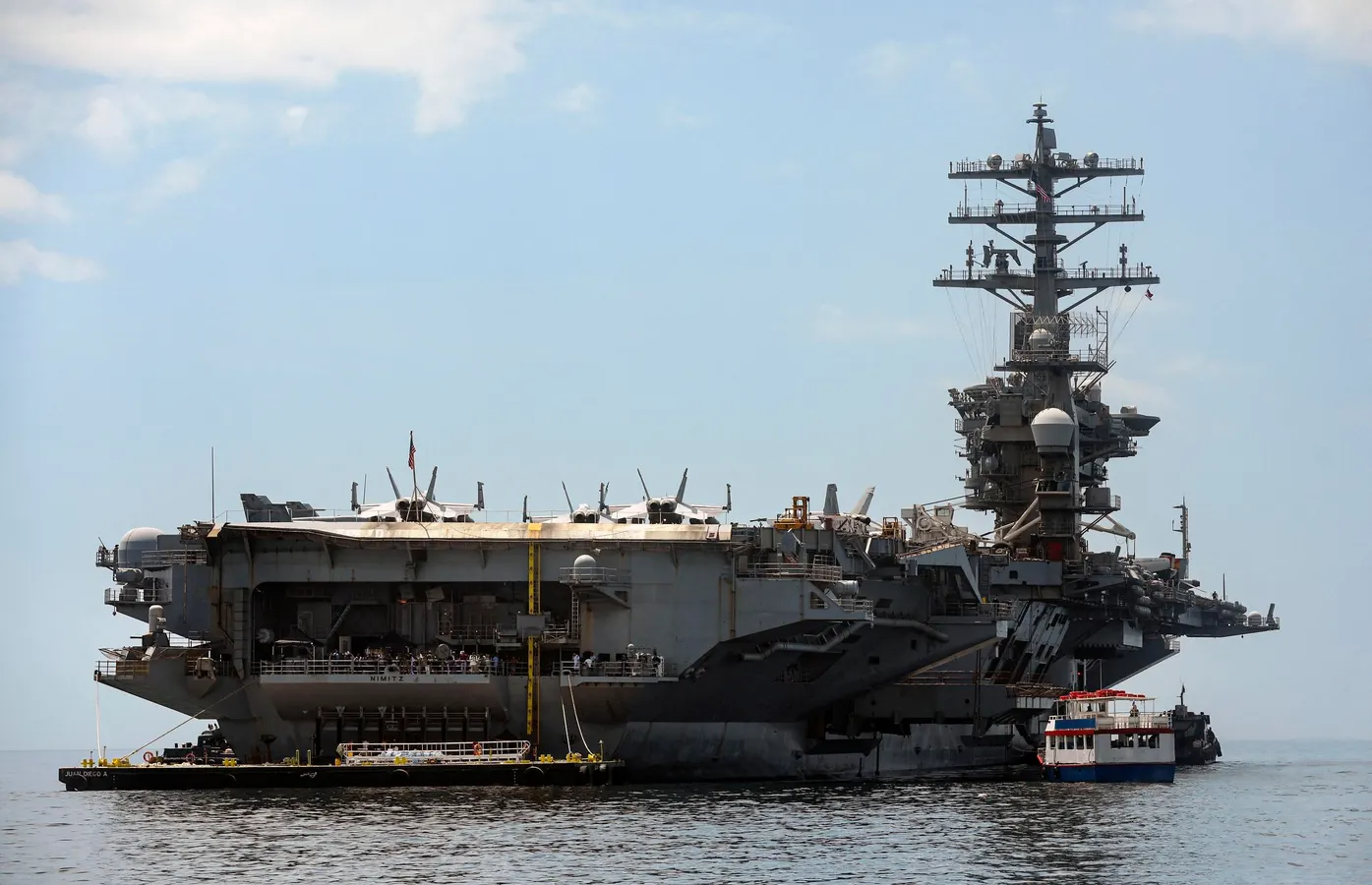

The US Navy aircraft carrier USS Nimitz sails on Panama Bay, in Panama City on March 30, 2026. (Photo by HUGE PERALTA / AFP via Getty Images)
AFP via Getty Images
The oldest active nuclear-powered aircraft carrier, and the longest serving, completed its homeport shift from Naval Base Kitsap in Bremerton, Wash., to Naval Station Norfolk, Va. The USS Nimitz (CVN-68) arrived at what will be its final homeport, completing a four-month underway that took it around South America and included numerous goodwill port calls and visits from foreign dignitaries. The carrier also took part in multiple joint exercises with the maritime forces of U.S. partners throughout Latin America.
The supercarrier, which has been in service since May 1975, departed from Naval Base Kitsap in March as part of a planned relocation in advance of its decommissioning and recycling.
CVN-68 was scheduled to be decommissioned this spring, but delays with the second Gerald R. Ford-class supercarrier, the future USS John F. Kennedy (CVN-79), required that USS Nimitz remain on the U.S. Navy rolls until next March as Congress necessitates the service to maintain at least 11 nuclear-powered aircraft carriers in the active fleet.
As a result, the oldest carrier also undertook an extended farewell/goodwill tour as part of the U.S. 4th Fleet’s Southern Seas 2026 deployment throughout South America as she sailed around the continent and transited the Strait of Magellan in April, being too large to transit the Panama Canal.
The underway also saw USS Nimitz make a port visit to New York City, its first and almost certainly only time in the Big Apple, where it led the International Naval Review, 250 leading a 26-ship in the Atlantic Ocean over the Fourth of July holiday weekend.
CVN-68 departed from New York Harbor on Wednesday, and arrived in Norfolk just a day later.
@WarshipCam shared the first photo of CVN-68’s arrival on Thursday morning.
During the journey, the Nimitz Carrier Strike Group consisted of the flagship aircraft carrier, with Carrier Air Wing 17 (CVW-17) embarked, and Destroyer Squadron 9’s Arleigh Burke-class guided missile destroyer USS Gridley (DDG 101).
Five Decades Of Service
Last year marked the 50th anniversary of service for the warship named for U.S. Navy Admiral Chester Nimitz, who served as Commander in Chief, Pacific Fleet during World War II.
The lead vessel of a new class of nuclear-powered aircraft carriers developed to supplement the U.S. Navy’s conventionally powered Kitty Hawk-class, USS Nimitz, was commissioned into service on May 3, 1976, by then-President Gerald R. Ford.
“I see this great ship as a double symbol of today’s challenging times. She is first of all a symbol of the United States, of our immense resources in materials and skilled manpower, of our inexhaustible energy, of the inventive and productive genius of our free, competitive economic system, and of our massive but controlled military strength,” Ford said in his remarks during the commissioning ceremony.
In December, CVN-68 completed her final global deployment, which lasted nine months. USS Nimitz arrived at Naval Base Kitsap on December 16, 2025.
A Brief Stay In Norfolk
Although CVN-68 was undertaking a homeport shift, it was still a bit of a homecoming for the oldest operational carrier. Much of the CVN-68’s 3,000 crew members and their families have relocated to Norfolk, or soon will, to prepare for the recycling.
For the carrier, the time in Norfolk could be brief.
Sailors spell out “I [Heart] NY” on the flight deck of Nimitz-class aircraft carrier USS Nimitz (CVN 68) after the ship departed New York Harbor following its participation in International Naval Review 250, July 7, 2026.
(U.S. Navy photo by Mass Communication Specialist Seaman Alyssa Boling)
After CVN-79 is formally decommissioned, crews will offload equipment, munitions, and all remaining aviation assets. It will then proceed through five phases that could take up to a decade and cost up to $1 billion to complete,
The decommissioned warship will move to Huntington Ingalls Industries’ Newport News Shipbuilding in Newport News, Va., for defueling of its two A4W nuclear reactors. Removing the spent fuel for secure storage and reprocessing could take approximately 30 months.
Following the removal of the reactors, the carrier will be inactivated and its remaining systems shut down, allowing the removal of all hazardous materials. The hull will then be prepared for towing.
Only by the end of the decade will dismantling and disposal of USS Nimitz begin in earnest, with the former warship cut into sections. Non-nuclear parts will be recycled accordingly, and the reactor compartments will be packaged as low-level radioactive waste and transported to a storage site, likely to the one in Hanford, Wash.
Finally, any usable parts will be salvaged and maintained for use on the remaining nine Nimitz-class aircraft carriers. The remaining materials will be disposed of in accordance with Environmental Protection Agency guidelines.
The entire process has been carefully planned out.
A Solid Symbol Of Strength
Although President Ford could not have known what was to come for CVN-68, his words could be seen as very much on the mark. The carrier has shown the flag in peacetime and delivered U.S. might in multiple conflicts.
“Wherever the United States Ship Nimitz shows her flag, she will be seen as we see her now, a solid symbol of United States strength, United States resolve – made in America and manned by Americans,” said Ford during the commissioning of CVN-68. “She is a movable part and parcel of our country, a self-contained city at sea plying the international waters of the world in defense of our national interests. Whether her mission is one of defense, diplomacy, or humanity, the Nimitz will command awe and admiration from some, caution and circumspection from others, and respect from all.”
It could be said that as USS Nimitz arrived in Norfolk today, it very much completed its missions of defense, diplomacy and humanity over the past five decades













Leave a comment