


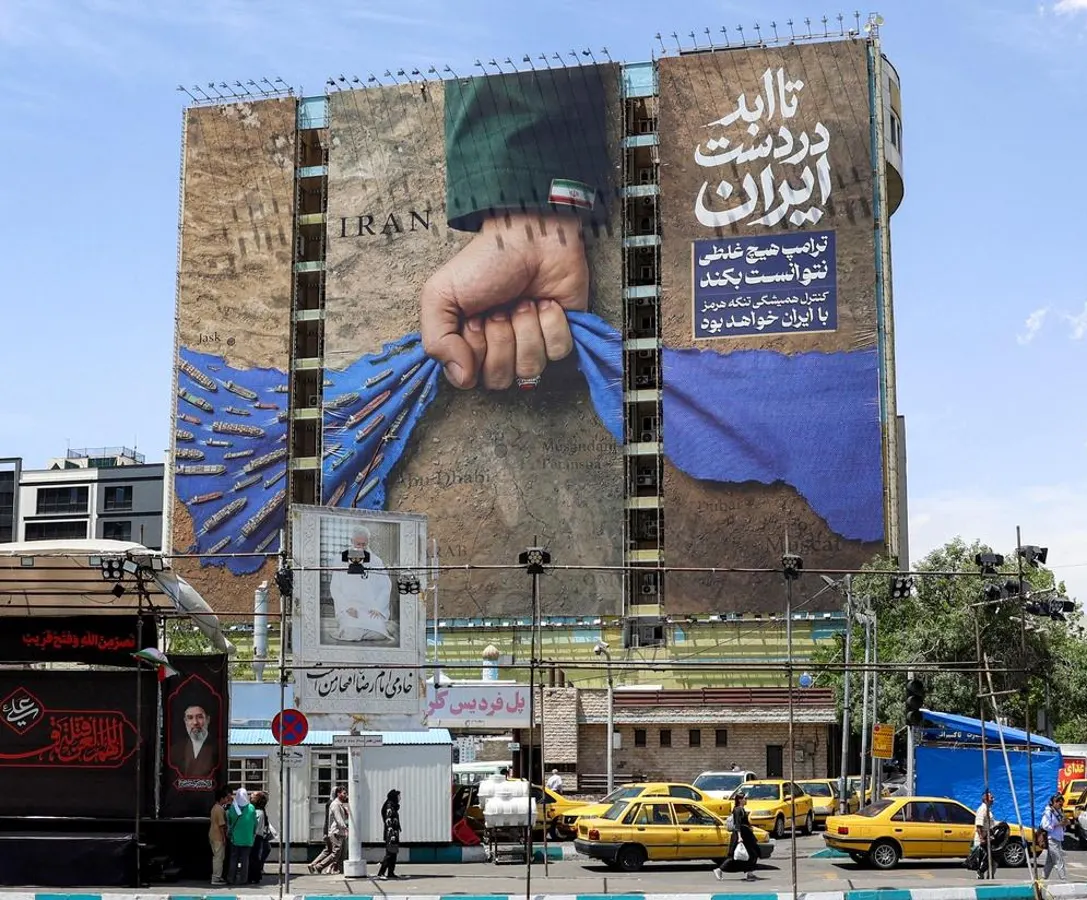

TOPSHOT – A billboard in Tehran on the facade of a building depicting the Strait of Hormuz with the caption in Persian reading “Forever in Iran’s Hand.” (Photo by AFP via Getty Images)
AFP via Getty Images
Year 2026 has witnessed the greatest disruption in global energy and its international relations since the 1973 oil crisis. Were it to continue for several months more, it could well equal or even surpass that traumatic event, which altered forever the role of energy policy in the context of national security.
Like that earlier event, the current crisis has affected all sources of energy. Renewables and nuclear gained much new support as part of the 1970s push for “energy independence,” just as they are being vigorously promoted today. Yet, the crisis is not merely about resources and who controls them—it is no less about the part played by energy itself as a force in geopolitics and leaders who wield it as a hard power weapon.
There have been some excellent commentaries on what the Hormuz Crisis means for different parts of the world in terms of oil and gas. My goal here is to summarize some of this intelligence, while also highlighting other aspects that have received less attention.
Energy Crisis Born of Miscalculation, Felt Around the World
The crisis was created by the US and Israeli aerial attacks on Iran that continued from February 28 to March 5. These were launched in the apparently belief that the regime would collapse and be replaced by a friendlier government. Given that the very opposite has occurred and that Iran has seized a critical choke point for marine energy trade, two essential realities step forward.
First, the world sees the U.S. cannot be trusted to act in ways that support the stability of global energy systems. In its unpredictable threats and use of miliary power against resource-rich states, from Greenland and Venezuela to Iran, as well as poorer nations like Cuba, the Trump Administration has confirmed that it will operate without real concern for impacts on the international community, friend and foe alike.
To say that this introduces a new level of insecurity to markets and to the geopolitics of energy overall would be an understatement at best.
A mural reading ‘blockade,’ referring to the Trump Administration’s 2026 threat to put heavy tariffs on any nation supplying fuel to Cuba (Photo by YAMIL LAGE / AFP via Getty Images)
AFP via Getty Images
Second, the Hormuz Crisis confirms the use of energy as a kinetic weapon—economic, political, military—by exporters and importers both. Far more than in the past, such use defines a core trend of 21st century conflict, utilizing resources (oil/gas, fuels, critical minerals) and technologies (including as targets). Russia cut gas to Europe before its invasion of Ukraine; China restricted rare earth exports to the U.S. and EU; Ukraine has targeted Russian oil infrastructure; the U.S. blockaded fuel to Cuba; Iran has strangled Gulf shipping.
Underlying all this is a reality the world keeps re-learning: oil and gas remain crucial ingredients of modern society, irreplaceable on any short-term schedule. Together with coal, they comprise around 80% of global energy consumption, as data consistently shows. This once gave OPEC considerable power and importance. But this involved huge risk as well—the Persian Gulf has long been a key global source of both active supply and spare capacity. The Hormuz Crisis has choked off both.
Importers, Exporters, and the New Calculus
This connects directly with how experts, activists, decision-makers, and companies are responding. Calls are widespread that this crisis provides pressing reasons to embrace renewables, both for climate and national security. This is not new, to be sure, but it is now given greater urgency.
At the same time, demands are made that oil and gas production must increase where they can. This means the U.S. most of all. American oil and gas companies largely held back in the early months, unsure of whether to take Trump’s promises of an imminent end to the crisis seriously. But by late April – early May, increased drilling was underway.
“We don’t expect prices to go back to where they were prior to the Iran war,” said Harold Hamm of Continental resources, a major player in the Permian Basin.
BEDMINSTER, NJ – AUGUST 7: Continental’s Harold Hamm speaks during a dinner with business leaders hosted by U.S. President Donald Trump at Trump National Golf Club, New Jersey. (Photo by Al Drago/Getty Images)
Getty Images
This partly corresponds with a new forecast of total U.S. crude production provided by the Energy Information Administration, showing a rise from 13.6 million bbls/day in 2026 to a new record of 14.2 Mbbls/d by mid-2027.
An Energy Crisis Can Make Strange Bedfellows
Despite its looming consequences, the crisis has yet to raise oil and gas prices into the stratosphere. Reasons are varied and meaningful.
Where the IEA ordered its members to collectively release 412 million barrels of oil to the market, U.S. companies have elevated exports to their highest level ever, while China, in an act of self-protection, has reduced its imports by 20%. At the same time, Russia has gained an increase in exports due to the crisis and a higher price for its crude. Together with oil sent through Saudi and Emirati pipelines that avoid the Persian Gulf, these measures have kept prices in the $100/bbl range, well below what they otherwise might have been.
This is a tentative and short-term situation, cobbled together (as it were) to stave off calamity. One point that deserves mention is that the value of strategic oil reserves has been strongly confirmed. Together with other government supports these reserves have helped moderate prices while protecting major importers like China, Japan, South Korea, and most EU nations from the worst impacts, at least in the short-term. Conversely, countries that lacked such stocks like those in SE Asia and Africa, were forced to impose emergency measures within the first month. They may well build bigger stocks of their own after the crisis ends.
At the same time, with Qatar’s liquefied natural gas capacity severely reduced by Iranian attacks, U.S. firms are ramping up exports in rapid fashion. These, in fact, are likely to grow 30% by early 2027 and twice that in the next 3 years or less. It now seems undeniable that the Hormuz Crisis will make America the unchallenged epicenter of global gas trade.
Indeed, it is not merely Russia and the U.S. oil industry that benefit from the higher price environment. Every country outside the Persian Gulf with a national oil company has gained new revenue—Algeria and Nigeria, certainly, but also Guyana, Kazakhstan, Brazil, Canada, and Norway, all of whom have found reason to increase or maintain exports.
Image of offshore platform being taken to its final location from Guanabara Bay in Rio de Janeiro. Brazil’s oil production is in the midst of a massive, decades-long boom, having hit record highs that regularly exceed 4.0 million barrels per day., Brazil, AFP PHOTO/Antonio SCORZA (Photo credit should read ANTONIO SCORZA/AFP via Getty Images)
AFP via Getty Images
With natural gas, unlike oil, there are no massive government strategic reserves to deploy. Nations rely on commercial gas stocks (e.g., European underground storage), but these are designed to manage seasonal demand rather than major supply shocks. Such is why importing countries have been switching to coal, solar, and accelerated investment in nuclear.
Despite concerns that a number of coal-consuming nations—China, India, Japan, South Korea, Bangladesh, Germany, and Pakistan—would create a “return” to this source, thus a major growth in emissions, the total rise has been low overall, less than 2% in global coal-fired power. Whether this might expand significantly with continuation of the war and Hormuz Crisis is not clear, yet higher coal prices are also likely to restrain this.
How Are Nations Dealing With The Disruption?
How have nations responded thus far, and what might they do if the crisis does not soon end? More than fuel-switching alone, governments of countries highly dependent on Persian Gulf oil and gas have instituted “survival” measures aimed at lowering demand. This includes reducing the work week to four days, mandating work-from-home for civil servants, restricted use of air conditioning, and even rolling blackouts and rationing for industrial sectors, including power generation.
At least 50 nations, including a number in Europe and SE Asia, have cut taxes on energy products, with another 30 or so providing direct fuel subsidies. As major exports from the Gulf also include fertilizer feedstocks, a number of governments have increased direct support for agricultural inputs to keep food prices low.
According to Brookings, a think tank in Washington D.C., at least 104 countries have put in play emergency measures and policies to mitigate the impact of the crisis. Subsidies (of various kinds) comprise the greatest number of such government actions. As economists often point out, this type of support can promote overconsumption in a very tight market and leash governments to ever-growing levels of debt.
The counterargument to such problems is a powerful one in many countries—social stability. Rapidly rising fuel prices have historically been one of the most frequent triggers for massive civil unrest. They have acted as a flashpoint for deeper public frustrations related to inequality, corruption, and government oppression. Recent examples, like those in Kenya (2026), Kazakhstan (2022), and Iran itself (multiple events), all led to massive arrests, civilian deaths, and widespread breakdown in social order.
Mass demonstrations in January of 2022 took place across Kazakhstan due to a sudden jump in fuel prices when government subsidies were cut. Violence in the capital, Almaty, led to hundreds being shot and killed and thousands arrested. A view of the damage aftermath of protests in Almaty of Kazakhstan, on January 11, 2022. (Photo by Pavel Pavlov/Anadolu Agency via Getty Images)
Anadolu Agency via Getty Images
This, too, is what an oil crisis means in the 21st century, even more than in its predecessor. As middle- and low-income nations have increasingly modernized, they have had little choice but to join the existing global energy landscape. Claiming they could have gone 100% renewable is simply unrealistic. The result is that they, too, have taken on the risk of geopolitical conflict involving oil and gas importers and exporters.
Between 1979 and 1985, advanced nations profoundly altered their energy economies away from oil dependence due to the second oil shock (also due to Iran) and the realization that, after two such crises in only five years, a repeat could be just around the corner. The changes, taken together, were massive—in power generation, industry, residential and commercial heating, oil was replaced by coal, natural gas, and nuclear, while public favor shifted from large, gas guzzling American cars to smaller models from Japan and Europe.
This suggests something similar may be in the works, already underway. Sales of EVs year-on-year have escalated in 2026, by 30% in Europe and 75%-80% in Latin America and Asia. If a “crisis is a terrible thing to waste,” as economist Paul Romer once said, the present one may end up urging the EV revolution into global maturity.
Yet there are counterwinds here too. If oil importers feel the need for energy change, the case may be different for many exporters, whose revenues have surged and who may wish to raise them further by increasing production. We shouldn’t think this crisis, historic as it is, renders the global energy landscape and its future more amenable to simple solutions.
What Should We Expect If The Crisis Continues?
Were the Strait to remain closed, the IEA estimates that by August global oil stocks will be at critical levels. The oil market would then transition from a price-management phase to a physical rationing phase. Demand would be forced to decline in more radical ways, for example by fuel rationing, with priority given to essential services. Without such governmental measures, buyers willing to pay any price to acquire crude or fuel could bid prices to unseen levels, e.g. $200/bbl or more.
The era of “managing the shock” would be over, replaced by an era of “surviving scarcity.” Whether Iran would allow this to happen is unclear but can’t be dismissed. Its leaders probably understand that a coalition military effort would be launched to open the strait. There are more than hints of this already, the UK and Germany ready to deploy minesweepers to the Strait.
Gas and diesel prices in late April (California) reached historic levels in some states. These, however, are only the most obvious consumer costs that have risen, with many products set to become still more expensive whether the Hormuz Crisis ends or not. (Photo by David McNew/Getty Images)
Getty Images
Even so, the price of a great many goods will continue to grow. To coin a phrase, the rising cost of hydrocarbons floods all boats. Society is saturated with the fuels and consumer products created from these sources. As diesel prices rise, the cost to move a crate of produce, a piece of electronics, or a package of clothing increases. Produce must be refrigerated, phones and computers have plastic in them, packaging and many textiles n come from refined petroleum. The list goes on.
Higher oil prices work their way through an economy in waves. They take time to penetrate all sectors. To go through refining, fuel blending and finishing, transport, and delivery to a gas station or other dispensary can take at a month. The stages in creating feedstocks for petrochemicals and then products from these, their transport to the warehouse and then to the sales’ floor, may require 3-5 months, depending on distances involved. All of this means that higher fuel and product prices become part of an economy’s operational structure. Being “baked in,” they don’t fall quickly even if oil prices do.
In the Realm of Insecurity—A Future with Fewer Guideposts
Whether a deal of some kind is struck or not, there is no return to the pre-war realities and assumptions. Briefly put, the global geopolitics of energy has been made less secure and more unpredictable. The same, in fact, can be said for marine transport and trade in general. If this began in other settings, like the attacks on shipping by the Houthis in the Red Sea, it is now confirmed by Iranian and U.S. blockades at Hormuz.
Since 1995, it was believed both straits would be kept open by the threat of action from the world’s most powerful military. But new forms of warfare employing decentralized missiles and drones has made this illusory. The veil has been torn from belief that marine choke points can be safeguarded, with international access kept open, by proximity of conventional forces.
An Iranian Shahed-161 drone (foreground) and mobile missile launchers (background) are displayed during an exhibition in Tehran, 2025. (Photo by ATTA KENARE/AFP via Getty Images)
AFP via Getty Images
A big part of this reflects the changed role of the U.S. itself, whose military (together with that of Israel) have been used to destabilize world oil and gas supply. Together, Israel and Iran have returned the Middle East to the center of global instability. Meanwhile, China’s long-standing anxiety about its own chokepoint vulnerability, the so-called Malacca Dilemma, which includes not only the eponymous straits themselves but the South China Sea as well, now undoubtedly seems to Beijing more urgent and more justified.
What comes next—for energy markets, for global trade, for the international order—will be shaped by how long the crisis runs, and by choices that have not yet been made.











Leave a comment