


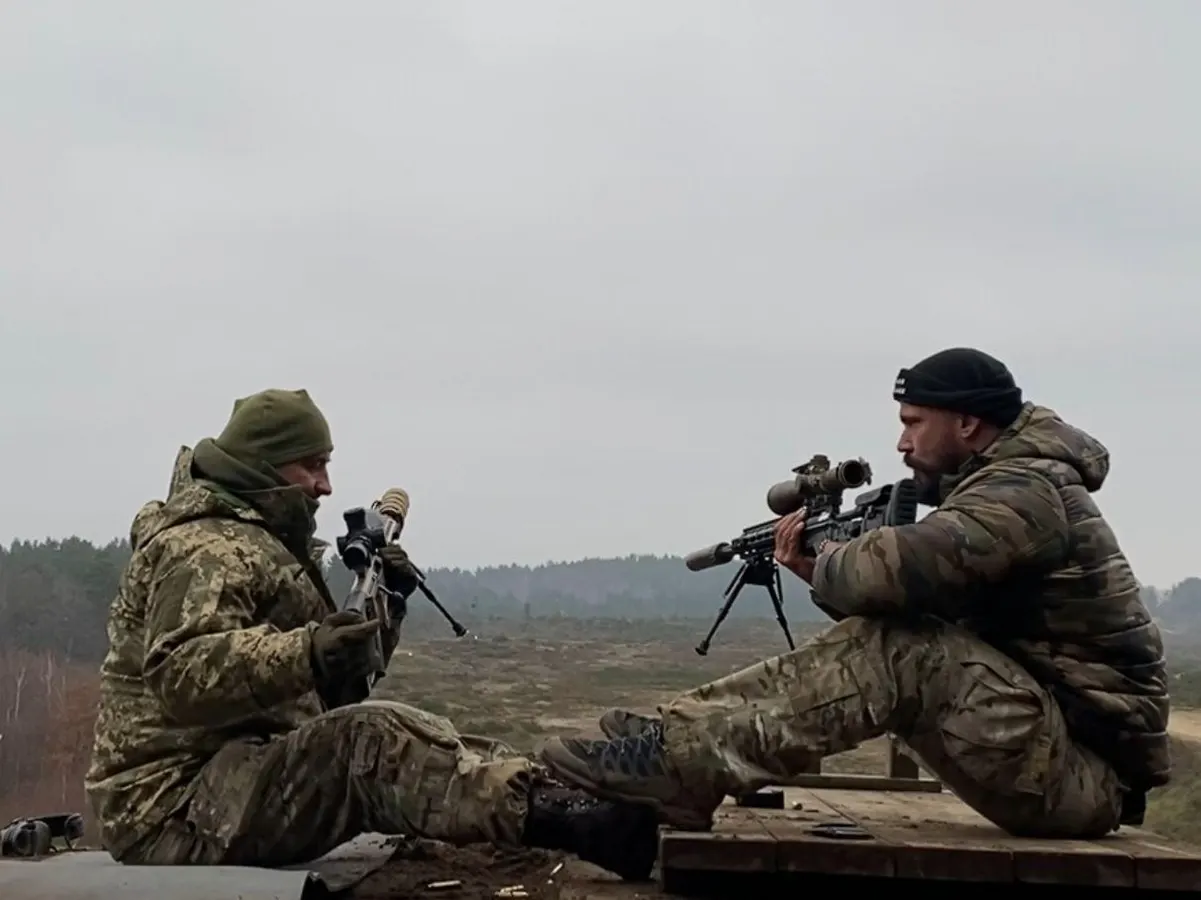

A former Green Beret helps train snipers from Ukraine’s 3rd Special Operations Regiment.
Photo: Bryan Pickens
Matthew Creedican, a former U.S. Special Forces operator who served in Ukraine, spent much of his time helping develop fixed-wing drone capabilities. He occasionally joined sniper missions in support of friends conducting assault operations.
During the final days of the battle for Bakhmut, Creedican recalled lying on his back at night watching high-altitude drones pass overhead through night-vision goggles.
“I called in and none of them were ours,” he told me.
For Creedican, the experience captured how quickly the battlefield was changing. The drones were not simply observing. They were directing artillery fire. Snipers once focused on avoiding enemy soldiers. Increasingly, they must avoid drones.
But the drones themselves are only part of the story.
The lesson many veterans draw from Ukraine is not simply that drones matter. It is that institutions able to adapt quickly now possess a decisive advantage over those that cannot.
Intelligence, surveillance and reconnaissance drones give small units a bird’s-eye view of the battlefield, allowing them to spot movement, locate firing positions and direct strikes in near real time. Attack drones provide precision firepower that once required far more expensive weapons systems.
Bryan Pickens, a former U.S. Army Green Beret who fought alongside Ukrainian special operations forces, believes the implications extend far beyond drones.
“Capability in war can only be added through technological advancement in conjunction with adequate combat-informed training,” he told me. “Without training, all the ideas and tech are irrelevant.”
The Lessons From Ukraine
Ukraine’s reliance on drones accelerated during the battle for Avdiivka as artillery ammunition grew scarce and U.S. military aid stalled in Congress. Ukrainian forces increasingly turned to first-person-view drones as a substitute for conventional firepower.
“Whether Americans want to admit it or not, Ukraine is ahead of us in the employment of modern technology as part of a complete approach to warfare,” Pickens argued. “From strategic to tactical levels, they are innovating doctrinally and technologically faster than anyone in the world.”
Bohdan, a drone pilot with the Unmanned Systems Battalion of Ukraine’s 110th Separate Mechanized Brigade, pilots an FPV drone in Donetsk Oblast.
Photo: David Kirichenko
Ukraine’s drone industry has expanded at a remarkable pace. According to the Kyiv Post, independent estimates suggest Ukraine manufactured roughly four million drones in 2025 and could produce five to six million in 2026.
President Volodymyr Zelensky told Reuters that Ukraine aims to increase production to about 10 million drones in 2026, while Ukrainian officials say capacity could eventually reach 20 million with additional investment.
“Connecting with U.S. special operations leadership and defense industry leaders to communicate the realities of this war, not the assumptions, is incredibly important,” Pickens said. “The drone fight has made a zero-casualty war nearly impossible.”
Those concerns surfaced repeatedly at the Meridian Forge Defense Technology Conference in June, a North Carolina gathering of defense founders, investors, military practitioners and policy analysts.
The Adaptation Problem
Joseph Gagnard, a retired U.S. Army Special Forces operator and Meridian Forge’s lead organizer, argues the challenge is not the technology itself but whether American institutions can adapt quickly enough to exploit it.
“I think the U.S. military is beginning to absorb some lessons from Ukraine,” Gagnard told me. “My concern is which lesson. Right now it reads as, ‘We need drones.’ That has to evolve into something bigger: we need a spirit of innovation, coupled with the authorities and the resources to empower the innovators. The hardware is the symptom; the ecosystem is the point.”
Asked to rate America’s ability to absorb lessons from Ukraine on a scale of one to ten, Gagnard gave it a seven.
“Part of that is the risk of learning the wrong lesson,” he said. “Part of it is that the process is still clunky, because we’re adopting pieces of the innovation ecosystem Ukraine demonstrated rather than the whole of it. Pieces won’t work.”
For Gagnard, that challenge extends beyond military doctrine and into procurement, contracting and industrial policy.
“We’re restarting a system that’s badly broken,” he said. “We need contracting reform, not just more contracts for the same primes and neoprimes. We need domestic supply chain reform, not just more rhetoric about American manufacturing.”
Ukraine’s drone industry evolved through rapid experimentation. Successful ideas were scaled quickly; unsuccessful ones were discarded. Gagnard argues that kind of speed remains difficult within much of the U.S. defense establishment.
“The current system rewards a handful of large players competing over the same ground, and it quietly penalizes the collaboration that actually moves capability forward,” he said.
“Reform isn’t about more of what we already do,” Gagnard said. “It’s about changing what we reward.”
Ukraine’s experience suggests that success depends on more than technology alone. Volunteers, engineers, startups and frontline soldiers all contributed to a wartime innovation ecosystem capable of rapidly identifying problems and testing solutions. For many American special operations veterans, that may be the most important lesson of all.
















Leave a comment