


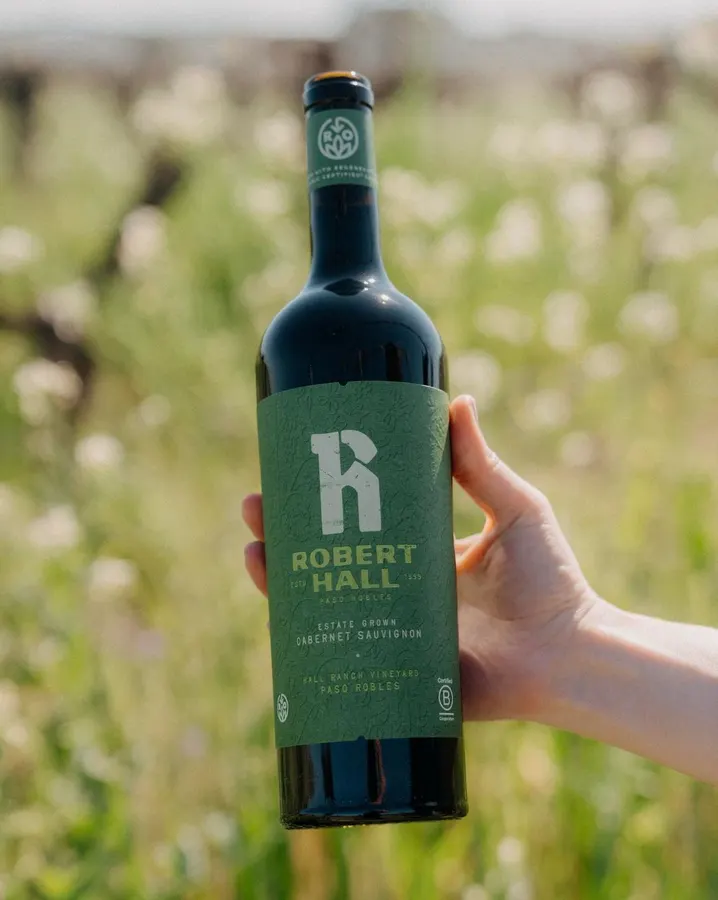

Robert Hall ROC Certified Cabernet Sauvignon
Robert Hall Winery
When Caine Thompson flew out to Austin to pitch Robert Hall Winery’s new Regenerative Organic Certified wines to Whole Foods Market, he arranged a wine tasting for its buyers.
The tasting included only Robert Hall wines, starting with a 2020 cabernet sauvignon from the Paso Robles vineyard. There was one glass per vintage of that same cab on the table. Thompson guided the buyers through each succeeding vintage until they finally arrived at the 2024, asking if they noticed any difference among them as they moved along.
“They got tastier and tastier,” Caitlin Burdick, Whole Foods Senior Category Merchant, who was in that pitch room considering adding the product to shelves, tells me.
The difference lay in the farming practices that changed in that timespan. Starting in 2020, Robert Hall Winery began to transition its farm to regenerative organic. The positive changes in the soil and terroir because of those implemented practices, which have improved each year since, makes for better tasting wine.
“It was fascinating,” Burdick adds, “and also validating that we’re making the right decisions by investing in products that have ROC Certification on the label.”
“They said, ‘we’ll take the whole lot,’” Thompson, Robert Hall Winery’s Head of Sustainability, tells me.
Whole Foods now becomes the retail launch partner for Robert Hall’s ROC Certified cabernet sauvignon and sauvignon blanc, the first domestic ROC Certified wines the natural grocer has ever carried.
“The quality improves as a result of having a healthier soil,” Thompson adds. “The whole wine experience becomes better. Your body actually wants to consume the wine. Drinking it feels good.”
The Regenerative Organic Alliance grants ROC Certification
Robert Hall Winery
The Stamp As A Story
Wine particularly acts as a powerful tool in helping consumers learn about regenerative agriculture given that the first step in the education process is already complete. Beyond just the type of wine like a cab or chardonnay, we often specifically ask for an Italian, Australian or California variety; there is already a general understanding that terroir impacts grape-growing and ultimately the final product.
For a wine shopper who may not necessarily care about the region, but may want a more generic bottle, the look of the label is often what draws them in; it sets the mood. Robert Hall is setting the mood with its label too.
Robert Hall is leaning in, highlighting the Regenerative Organic Certified stamp high up on the neck of the bottle–not just like any certification on a label–boldly stating that Robert Hall wines are different from others sitting on the shelf among them. That ROC Certified stamp is a curious signal that leads to a world of the highest quality consumer products. There is a deep story behind every ROC stamp–not necessarily one that just highlights produce, a typical association with farming, but endless possibilities, even with consumer products like alcohol that we can have a memorable experience with.
“Wine offers one of the most exciting storytelling vehicles…You can taste it. You can learn about it,” Christopher Gergen, Regenerative Organic Alliance CEO, tells me. “The logo is a way for consumers to start connecting dots. What does that symbol mean? And they start to think about what regenerative organic consists of.”
The lower barrier to entry in education extends to the lower barrier to entry in accessibility too.
Robert Hall wines have previously been known to have a more premium price point, upwards of about $100 a bottle. When figuring out how to price the product, Robert Hall initially landed at around $59.99–but the team decided to cut it in half to $29.99. “This is about exposure. It’s about growing the movement,” Thompson says. “If regenerative farming stays a niche, exclusive proposition, it’s not going to change the world.”
The lower price gets more consumers in the playing field who all now have an easier opportunity to fully experience what ROC Certification means. “It goes back to the broader movement of moving from aspiration to accessibility,” Gergen says. “The more accessible price point is a gateway to get people into a suite of products that they ideally start to recognize is so much better for the planet, economies and themselves than the conventional alternative.”
None of that should be a luxury.
“There’s a misconception that ROC Certified wines are naturally more expensive,” Burdick adds. “There’s going to be an initial investment if you’re changing the way that you’re farming, but over the long term, you’re either paying the same for your farming practices or saving money.”
Cover cropping at Robert Hall Winery in Paso Robles, CA
Robert Hall Winery
The Gatekeepers
In 2017, the Rodale Institute joined forces with Dr. Bronners and Patagonia to form the Regenerative Organic Alliance to provide a globally-recognized gold standard certification for such practices.
Under Thompson’s leadership at Robert Hall, the Winery earned its Regenerative Organic Certification and became a reference point for the global mission to scale regenerative organic viticulture in his initiative with the Regenerative Viticulture Foundation, the One Block Challenge.
O’Neill Vintners and Distillers has five primary brands under its umbrella, including Ram’s Gate Winery, which earned its ROC Certification in 2025, and has begun agroforestry practices, like planting apple trees among the grapes, on its Sonoma estate. This helps rebuild habitats and enhances soil health.
“We want to constantly refine and understand better. The desire to want to do better translates into winemaking,” says Joe Nielsen, General Manager and Head Winemaker at Ram’s Gate Winery. “We do all the farming so that we can do less in the winemaking process. You can’t do it the other way around.”
O’Neill’s target is to get all five of its brands certified over the next several years. “Customers want clarity about what is in the bottle,” Jeff O’Neill, CEO of O’Neill Vintners and Distillers, tells me. “I want these wines to be the most attractive alternative that a consumer can think of relating to helping the planet.”
Taste and accessibility are the pillars that O’Neill Vintners works to stand on, but in order to make that a reality, it can’t just sell wines in its tasting rooms. It must work hand-in-hand with the gatekeepers. “One of our jobs is to push the retailers’ agendas with products that will mean something to the consumer,” O’Neill says. “Wines have to be outstanding. We want consumers picking it up and coming back, saying ‘that wine was delicious, and by the way, it’s ROC Certified.’”
Robert Hall’s ROC Certified Wines are going national right at launch in the nation’s largest natural grocer, not a high-end restaurant or boutique wine shop.
“Retail environments are amazing canvases to paint on to uplift and tell the story of Regenerative Organic Certified products,” Gergen says. “Whole Foods is leaning into the Robert Hall partnership, which helps with differentiation because of their relationship with the consumer as the front door where they get their groceries.”
Whole Foods is also making a statement with an Earth Day launch and making Robert Hall’s two ROC Certified wines that first of their kinds the grocer has ever carried. “[Regenerative practices] are a little bit more common in Old World winemaking practices,” Burdick says. “But for an American wine–a California wine–this is really exciting and something new for us.”
Robert Hall ROC Certified Sauvignon Blanc
Robert Hall Winery
The Regenerative Opportunity
From farms who supply wood for corks to barley farmers who grow for whiskey, practically every corner of the wider BevAlc industry faces a humbling moment right now as alcohol sales experience stark declines, largely associated with newfound ways to interact with alcohol, like sober-curiosity and the rise of ready-to-drink formats.
Moments like this require a shift in mindset and force the industry to create new ways to connect with consumers, who want to better understand what’s behind the brands they support with their dollars. ROC Certification provides that connection, as the stories behind the ROC stamp reveal the practices in which each ingredient came to life and found a new home in the bottle.
New SPINS data shows that wines with a ROC certification are actually growing at 9% in dollar sales in the last 52 weeks ending 3/22/26. In that same period, wines without any certification are overall declining by more than 3%. Amid this rocky market, ROC Certification is a strong marketing tool and a good business decision.
ROC Certification is a way to stand out from competition in a time of intense market saturation, whether in wine, spirits or any CPG category. SPINS also released a report in May of 2025 showing that Grocery, Frozen, Refrigerated and Alcohol products with a sustainability certification (like Certified Organic or Non GMO) are growing an average of 22% year-over-year if they also have a ROC Certification.
“Retailers are putting preferential treatment in terms of shelf placement,” Gergen says. “They’re excited to be starting to tell more of these stories because consumers are becoming more aware of what Regenerative Organic is all about.”
Whole Foods’ wine team, including Burdick, provided input to Robert Hall about the types of wines they felt would perform best based upon current consumer sentiment. That’s why Robert Hall’s ROC Certified sauvignon blanc has tropical and aromatic notes along with some citrus–a blend of grapes picked from two different blocks of the same plot a week apart.
Partnerships like ones between Whole Foods Market and Robert Hall Winery set desperately needed examples for our food and beverage supply. They taste the best too.
“Wine is a connector of people. You can hear and feel the story when you drink it,” Burdick says. “It’s a ripple effect…if one person is doing good, others will follow.”















Leave a comment