


Topline
The Trump administration is in talks with AI companies about potentially acquiring a stake in them in order to distribute equity to the American public, multiple outlets report, marking a step forward toward what’s known as “universal basic capital,” a proposal that’s started to attract momentum from politicians on both sides of the aisle as a way to deal with the rise of AI.
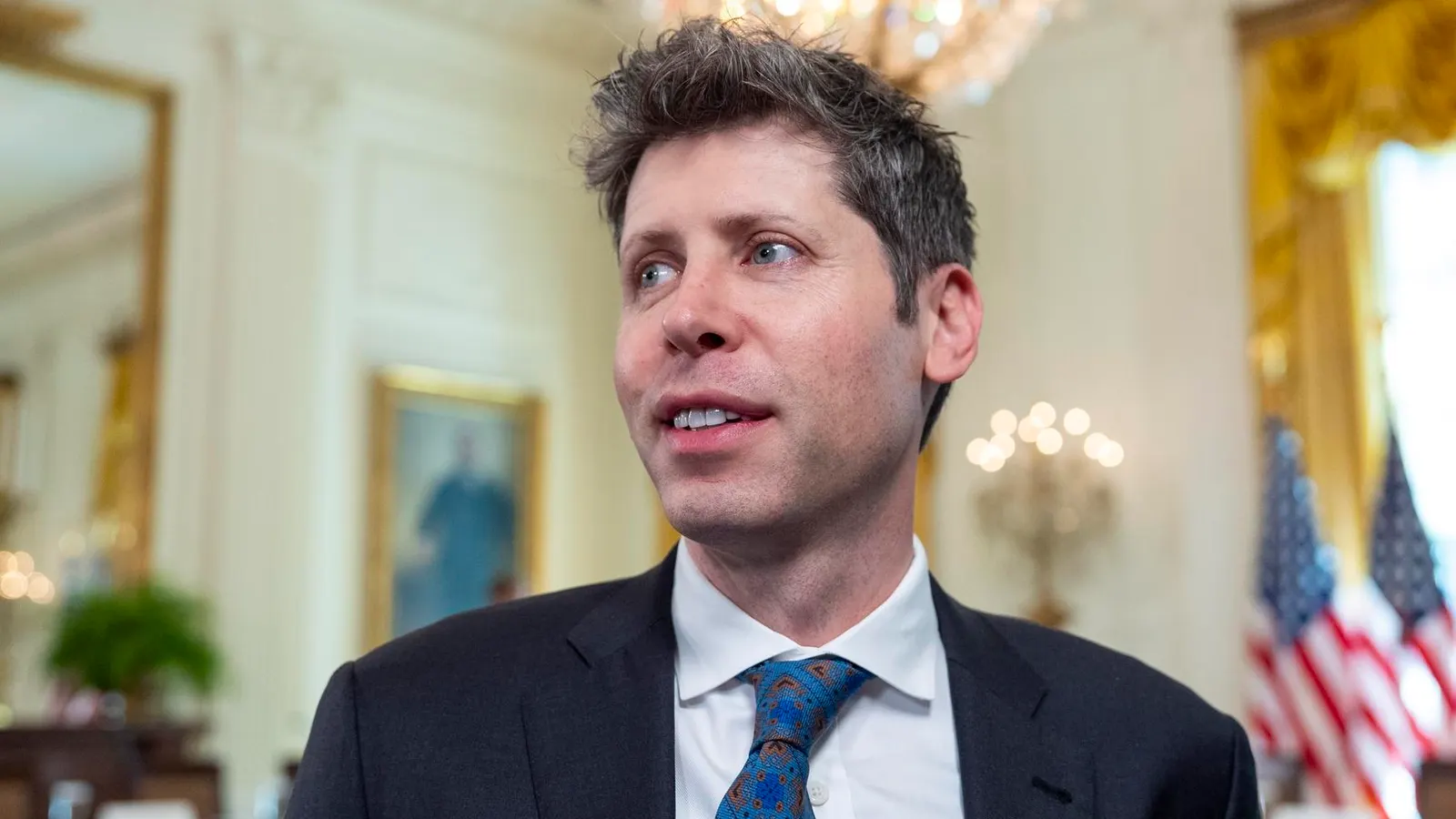
OpenAI CEO Sam Altman attends a White House Task Force on Artificial Intelligence Education meeting at the White House on Sept. 4, 2025.
Copyright 2025 The Associated Press. All rights reserved
Key Facts
“Universal basic capital,” or UBC, broadly refers to giving Americans investment accounts and seeding them with equity—potentially focusing on AI companies, though not necessarily—in order to help people build wealth and stem the potential impacts of AI taking jobs.
The Trump administration has been in talks with OpenAI CEO Sam Altman about an arrangement that would give the U.S. equity in AI companies—likely by the companies handing over shares voluntarily—NOTUS first reported based on anonymous sources and CNBC later confirmed.
The money they collect could then be distributed to Americans through dividend payments, NOTUS reports, or otherwise be used for some “public purpose.”
NOTUS’ reporting comes after politicians on both sides of the aisle had already backed the idea of UBC, with Democratic California Gov. Gavin Newsom signing an executive order in May that includes a directive for California to study implementing it, and Republican Ohio gubernatorial candidate Vivek Ramaswamy cheering the idea in a December op-ed for The New York Times.
Sen. Bernie Sanders, I-Vt., also said Monday he intends to introduce legislation that would establish a similar concept to UBC, in which the government would levy a one-time 50% tax on AI companies that would be used to create a new government sovereign wealth fund.
AI leaders have touted UBC and similar proposals recently as a way to combat criticism of AI and its impact, with Elon Musk pushing what he’s termed “Universal High Income” and OpenAI, separate from its reported discussions with the White House, proposing a “public wealth fund” that would invest people in AI and AI-related companies.
What to Watch for
It’s unclear how far along the Trump administration’s talks with AI leaders about any potential equity-sharing plans are, NOTUS reports, or what companies could be involved beyond OpenAI. The White House has not yet responded to a request for further comment. Sanders is expected to formally unveil his bill for a new AI tax in the coming weeks. The progressive senator’s legislation is likely a long shot to pass the GOP-controlled Congress, though with even some Republicans backing UBC policies, it remains to be seen if it could gain steam. Newsom’s executive order only directs the California government to start studying UBC proposals, so any state-level action on the issue is likely a longer way off, and it remains to be seen if any other states could follow through with similar orders of their own.
How Universal Basic Capital Would Work
It’s different from Universal Basic Income, which refers to the government just giving regular cash payments to people, which has also enjoyed some political popularity in recent years. The Berggruen Institute, a think tank that’s been a vocal champion of UBC, described it broadly as a large wealth fund that people could invest in and get returns from, with some kind of state sponsorship. Beyond that, it’s unknown how the investments would be focused: OpenAI’s proposal for a Public Wealth Fund suggests every citizen should receive a fund with “diversified, long-term assets that capture growth in both AI companies and the broader set of firms adopting and deploying AI,” and get regular returns off the AI industry’s success, while NOTUS’ reporting suggests the federal government would acquire stakes in a few specific individual companies. Other UBC proposals have taken a less AI-focused approach and instead suggested more generally providing investments in broad index funds like the S&P 500. Separate from his reported talks with the Trump administration, Altman has also proposed the idea of “universal basic compute,” in which people would own a fraction of the processing power behind a model like ChatGPT. They could then use that processing power to fuel their own work with AI, or sell it off for a profit.
Who Would Pay For Universal Basic Capital?
NOTUS’ reporting suggests AI companies could hand over shares to the federal government voluntarily—but noted that arrangement could pose legal issues, so it remains to be seen how any final plan could be structured. The Berggruen Institute has suggested a few other ways UBC could be funded, including through a tax on major tech companies’ data-centric activities, like targeted ads or selling personal data. Another idea would treat the money the government puts into people’s individual funds as an interest-free loan, which people would then pay back once their wealth compounds. Sanders’ proposal suggests levying a 50% tax on AI companies that would be paid in the form of stock into a potential sovereign wealth fund, where it would appreciate in value. While taxing AI companies has so far been the most popular suggestion for funding UBC, it’s also raised some concerns: State-based UBC plans could struggle if AI companies simply moved to another state to avoid paying any tax, for instance, the Berggruen Institute noted.
Which Democrats Support Universal Basic Capital?
“We don’t need charity, we need ownership—Universal Basic Capital,” Newsom said at an event in May, claiming voters are “demanding” a more wealth-based model. “You cannot save democracy unless we democratize the economy.” Sanders touted the concept of redistributing wealth back to Americans in an op-ed for The New York Times on Monday that rolled out his plan for a new AI tax, with Sanders arguing a wealth sharing-based model “would guarantee that the trillions of dollars potentially generated by AI are used to improve the lives of all of us — not simply to make the richest people in the world even richer.” The Vermont senator’s AI announcement this week also came after he previously proposed a “robot tax” on AI companies that would be redistributed back specifically to workers whose jobs were displaced by AI, along with a requirement for businesses to give workers a substantial stake in their employer. Other Democrats have sponsored pro-universal basic income legislation that would guarantee income to Americans, including Reps. Ilhan Omar, D-Minn., and Rep. Bonnie Watson Coleman, D-N.J. But many of the progressive Democrats who have favored these policies also expressed skepticism that tech leaders like Musk and Altman would ultimately support them. Rep. Alexandria Ocasio-Cortez, D-N.Y., told Semafor in April, “I am skeptical about their willingness to pay or incur the taxes necessary to sustain such proposals, which would have to target AI,” while Watson Coleman told the outlet she believed billionaires’ support isn’t “out of charity,” but rather “out of business.”
Which Republicans Support Universal Basic Capital?
Former Trump advisor Steve Bannon touted the Trump administration’s talks with OpenAI in comments to NOTUS, though he agreed with Sanders that the government should levy a large tax on AI companies rather than work out an arrangement that’s more beneficial to the companies. The government “should not take ‘tip money’” from AI companies “but force them to cough up 50% of the equity — to be dispersed to American citizens,” Bannon told NOTUS. Ramaswamy wrote in his Times op-ed that government-backed investment funds would be a “practical solution” to combat social unrest against the wealthy, because “instead of lambasting millionaires,” people “would be on the way to becoming millionaires” through compounding wealth. The Trump administration and Congress also enacted “Trump Funds” last year that follow a similar principle, which Ramaswamy described as an “early positive step,” giving children a $1,000 fund that will compound as they grow up. That plan was pushed through Congress by Republicans like Sen. Ted Cruz, R-Texas, who said the funds allow “every child in America [to] experience the miracle of compound growth.” For Republicans—who have historically been more opposed to government assistance—the allure of these programs appears to lie in how they could use capitalism to help unseat other government benefits. Cruz suggested the “Trump Funds” could be a new form of Social Security, and Ramaswamy similarly insisted such investment accounts could eventually replace other government payouts and be a way for people to “[wean] themselves off the federal welfare state.” The general concept of state-backed investment funds has also been touted by Trump-friendly billionaires like hedge fund manager Bill Ackman, who has supported giving children investment accounts that will compound as they grow.
What Have AI Leaders Said About Universal Basic Capital And Income?
Numerous tech leaders have pushed for some kind of universal income program, with Musk calling in April for “Universal HIGH INCOME” consisting of regular checks from the government. Anthropic CEO Dario Amodei, who said last year that AI could wipe out half of all entry-level white-collar jobs, has similarly called for a total economic upheaval, floating both a “large universal basic income” and “a capitalist economy of AI systems” in which AI companies dole out resources to people “based on some secondary economy of what the AI systems think makes sense to reward in humans.” In a policy paper last year, Anthropic as a company also floated creating an AI-based “sovereign wealth fund,” similar to Sanders’ proposal, or alternatively levying a business-based wealth tax on high-earning tech companies. Altman previously was a prominent supporter of UBI, giving $14 million of his own money toward funding a pilot program for it, but said more recently in April he “no longer believe[s] in universal basic income as much as I once did.” The OpenAI chief told The Atlantic in an interview he’s “much more interested in ways where we think about kind of collective ownership,” such as shared equity or stakes in compute, because UBI “does not get at what we’re really going to need for this next phase” as AI revenue goes up and the labor force gets displaced.
Who Are The Biggest Critics Of Universal Basic Capital?
Pope Leo XIV warned about the impacts of AI in his encyclical released last month, cautioning against it causing widespread unemployment, which he called a “grave evil.” The “pursuit of greater profits cannot justify choices that systematically sacrifice jobs,” Leo wrote. Though he broadly decried universal financial assistance—standing in contrast to former Pope Francis, who was a proponent of UBI—Leo did acknowledge that governments should create new “taxation, social protection and industrial policies” in order to “correct the imbalances created by the concentration of wealth and power” that AI will create. While many tech leaders have spoken out in favor of universal income or capital proposals, there have also been some notable detractors, such as venture capitalist Marc Andreessen, who wrote in his 2023 “Techno-Optimist Manifesto” that universal basic income would “turn people into zoo animals to be farmed by the state.” The broader premise of state-sponsored payouts has also come under fire from many conservatives, with the right-wing Heritage Foundation arguing basic income proposals would both unnecessarily add to federal spending and decrease Americans’ incentive to work. Jennifer Huddleston, a senior fellow in technology policy at the right-leaning Cato Institute, also told NOTUS that having the government acquire stakes in specific AI companies would “intrude” on the free market.
What Have Economists Said?
Some have criticized UBC, as it remains unclear what the exact terms of it would be—particularly whether shares could be bought and sold. Giving people investments rather than just plain cash, as with UBI, could be “riskier” for those who don’t know much about investing, University of Pennsylvania professor and Anthropic Economic Advisory Council member Ioana Marinescu told Politico. That’s because people could be persuaded to sell shares off to wealthy investors for a quicker payout, rather than holding on to them and letting their wealth compound. If Americans can’t sell their shares for any reason, the funds could also be used to benefit certain companies over others. “If I own OpenAI shares that I can never sell, we just made OpenAI last forever, whereas maybe I want to be able to sell my shares to buy Anthropic,” Betsey Stevenson, a former chief economist for the Department of Labor, told Politico. Economists surveyed by experts at the Federal Reserve Bank of Chicago also reported broadly preferring more targeted measures to combat AI-related job losses like job retraining over more broad-based measures, such as universal income or redistributing tax revenue from AI companies to Americans.
Surprising Fact
A new study by the Web3 Foundation suggests AI and tech companies are making significant money off their users, boosting the argument that people should be able to also benefit from the industry’s successes through universal capital plans. The study found Americans’ personal data is worth some $393,785 per person to tech companies over the course of the person’s lifetime, which goes up to more than $830,000 when adjusted for inflation. “If personal data is one of the most valuable resources in the modern economy, the people who generate it should no longer be treated as passive raw material,” the study’s authors wrote.
Big Number
49,135. That’s how many jobs have already been lost to AI so far in 2026 through April, according to an analysis from career services firm Challenger, Gray and Christmas. That comes after nearly 55,000 job losses were previously attributed to AI through all of 2025.
Further Reading
Elon Musk Touts Universal Income As Remedy To AI-Driven Unemployment (Forbes)
Tech Industry Loses 123,000 Jobs This Year—AI Is The Most Cited Reason For Layoffs (Forbes)














Leave a comment