


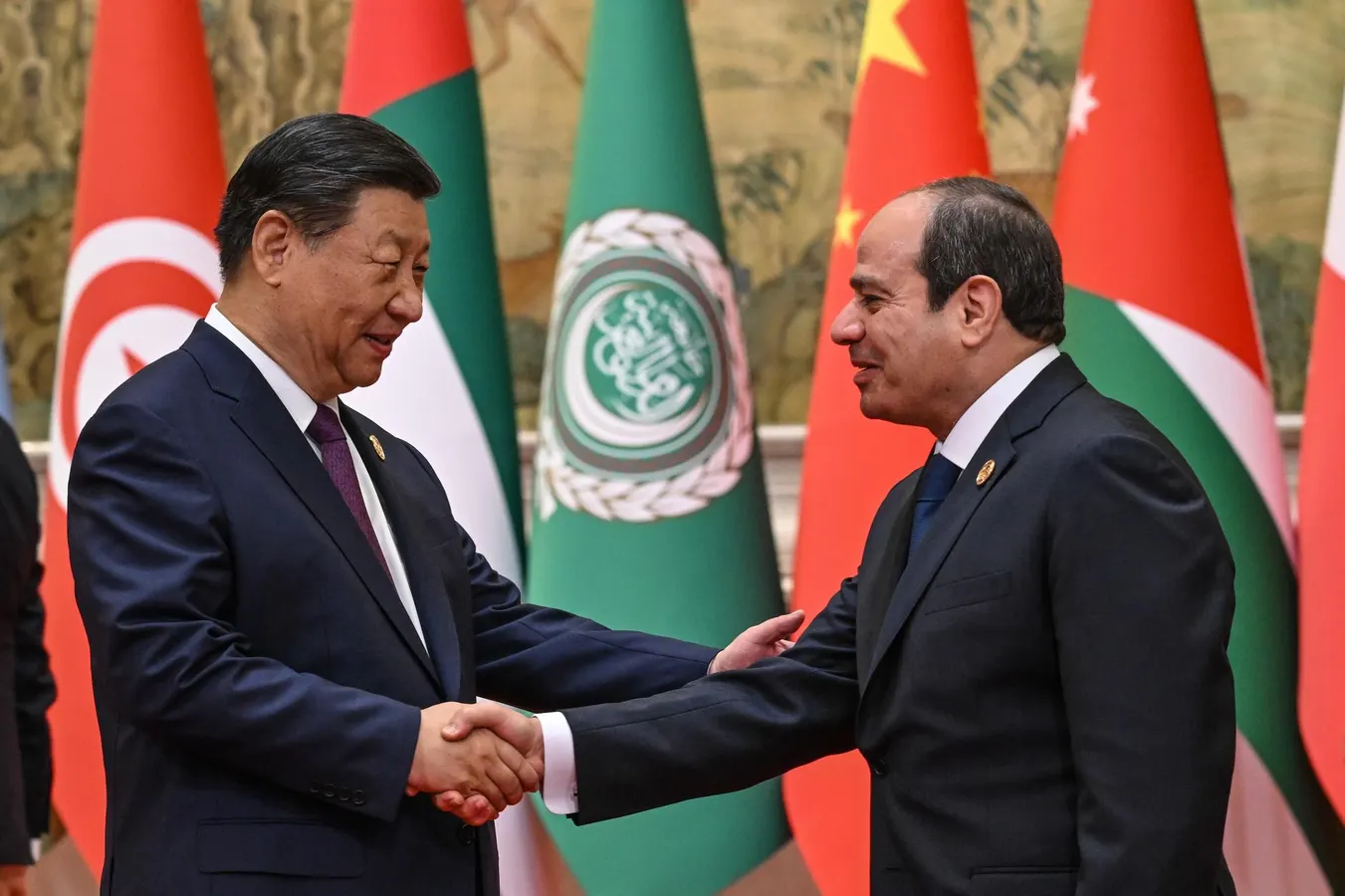

(Photo by Jade Gao -Pool/Getty Images)
Getty Images
Earlier this month, Chinese President Xi Jinping made a very public state visit to Egypt. Officially, the three-day trip, the first of its kind by a Chinese leader in at least a decade, was intended to commemorate 70 years of bilateral ties between Cairo and Beijing. In practice, however, it served to highlight something else: the extent to which Egypt has drifted decisively into the Chinese orbit in recent years.
That represents a relatively new development. For some four decades after the 1979 Camp David Accords, Egypt was a reliable cornerstone of America’s Mideast strategy. Over those years, lavish American assistance (in the form of significant annual economic aid appropriations as well as foreign military financing totaling some $1.3 billion a year) tethered the country closely to the United States. And, despite temporary disruptions during the “Arab Spring,” that assistance continues. Increasingly, however, China’s economic, political and military inroads are beginning to alter Egypt’s strategic calculus.
The numbers tell the story. China is now Egypt’s largest single trading partner – a position it has occupied for over a decade. Last year, two-way trade between the countries totaled nearly $21 billion, almost all of it made up by the westward flow of Chinese goods. That imbalance has made Egypt heavily dependent on Chinese wares; in 2025, Cairo imported close to $20 billion from China and exported well under $1 billion the other way.
The PRC’s investment in Egypt is burgeoning as well. Chinese companies have poured more than $10 billioninto the country, with much of it flowing into the industrial zone near the Suez Canal. The China-Egypt TEDA Suez Economic and Trade Cooperation Zone in Ain Sokhna now hosts some 200 firms and has received several billion dollars in investments from companies like Chinese steel conglomerate XinFeng and tire giant Linglong. A third phase for the zone was unveiled during Xi’s stop in Cairo: an expansion aimed at expanding the park’s worth via work in areas such as next-gen automobiles and renewable energy.
But Beijing has made clear that it wants an even deeper stake. Xi’s visit saw the signing of some 20 new agreements on things like manufacturing, artificial intelligence, and supply chains. The two governments also blessed a larger fiscal partnership, including currency swaps.
Moreover, the relationship is no longer strictly commercial. In recent weeks, for the second year in a row, Egypt’s military drilled with elements of the People’s Liberation Army in the “Eagles of Civilization” air exercise. The maneuvers saw Chinese fighters, tankers and early warning aircraft deployed to Egyptian bases to train in air combat tactics and search and rescue. In other words, an air force underwritten to a great extent by American financing is now practicing with the very military Washington considers its main strategic competitor.
For Egypt, this eastward turn makes strategic sense. A decade ago – the same year Saudi Arabia rolled out its own version – the government of President Abdel Fattah al-Sisi launched “Vision 2030”: an ambitious national development strategy built around industry, infrastructure, logistics, energy and digital economy.
This focus has made Egypt a natural element of China’s sprawling Belt & Road Initiative, through which China has made major inroads in the developing world over the past dozen years. Vision 2030 outlines a plan to transform the Suez into an economic hub and engine for economic revival. The PRC has made clear that it can help with all that – and do so without the pesky conditions relating to governance, transparency and human rights that accompany American assistance.
To be sure, U.S. aid and financing still matter. But increasingly, the longtime assumption in Washington that Cairo’s geopolitical orientation was settled is no longer a given. Beijing’s outreach of recent years has made sure of that.















Leave a comment