


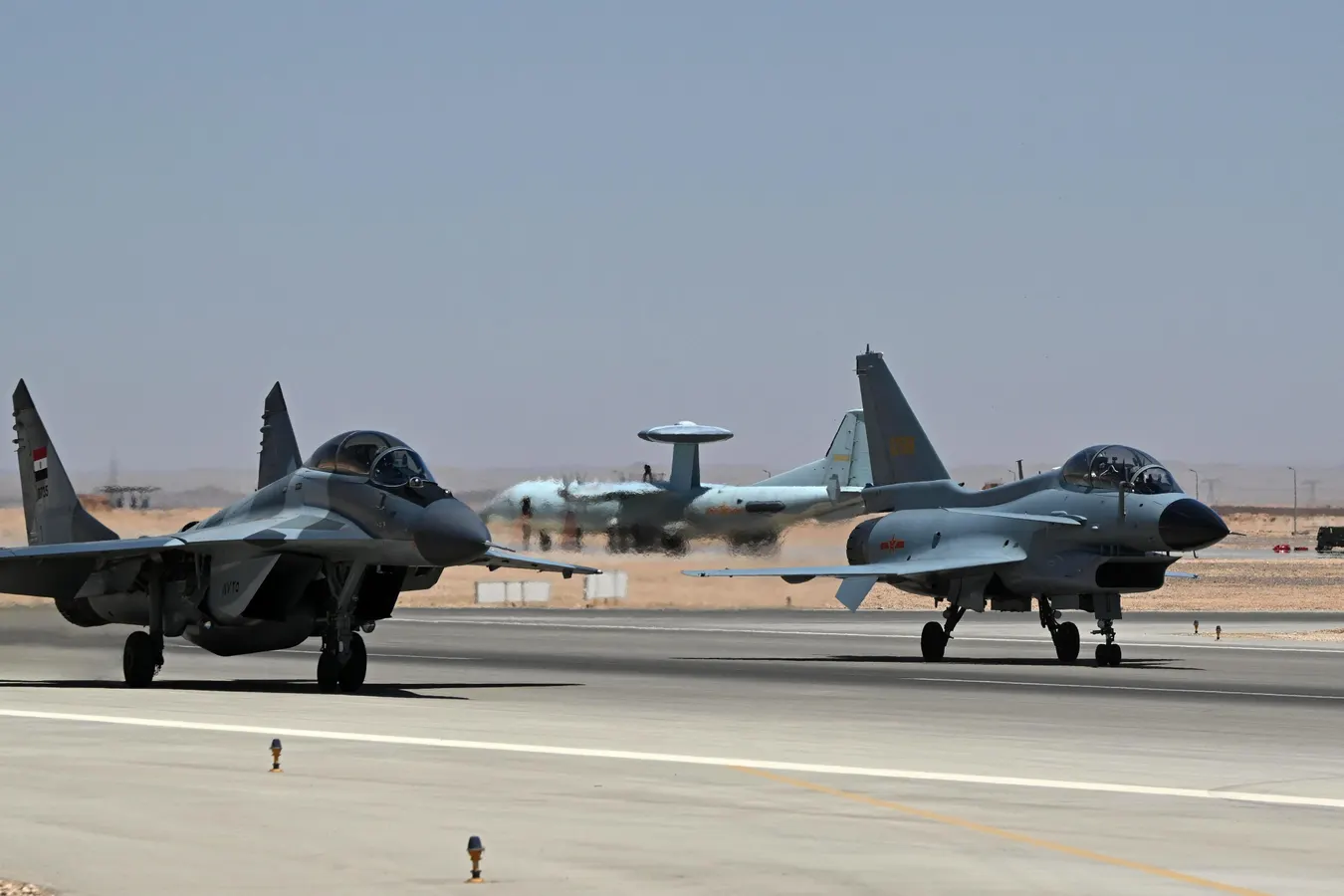

J-10 fighter jet of the Chinese PLA Air Force (right) and MiG-29 of Egyptian armed force take part in the China-Egypt joint air force training code-named “Eagles of Civilization 2025” at an airbase on April 19, 2025 in Egypt. (Photo by Yu Hongchun/VCG via Getty Images)
VCG via Getty Images
Israel’s latest war with Iran and its war of words with Turkey have understandably grabbed headlines throughout this year. A less noticed development has been Israel’s recent concerns about another regional power, its southern neighbor, Egypt.
Operation Roaring Lion, the latest Israeli air campaign against Iran fought alongside the United States, was the most consequential to date. It came amid recurring speculation and fears over the past year that Israel and Turkey may eventually clash militarily in the future. Even before Roaring Lion, which followed Israel’s then-unprecedented Rising Lion 12-day air war in June 2025, former Israeli Prime Minister Naftali Bennett bluntly warned that “a new Turkish threat is emerging.”
“Turkey,” he declared in February, “is the new Iran.”
A few days after Roaring Lion came to a halt with the U.S.-Iran ceasefire that went into effect on April 8, Turkish Foreign Minister Hakan Fidan charged that, “After Iran, Israel cannot live without an enemy.”
“We see not only (Israeli Prime Minister Benjamin) Netanyahu’s administration but also some figures in the opposition – though not all – are seeking to declare Turkey the new enemy,” he said in clear reference to Bennett.
Israel and Turkey are at odds over a multitude of issues: from the Gaza Strip to the future of post-Assad Syria. While a war or military clash between them is almost certainly not imminent, it cannot be ruled out in the long term. Relations between the two countries have declined since 2010 and reached their present low point after Israel’s latest war in Gaza and the regional wars that ensued. Prior to 2010, they maintained close ties, including military cooperation. No longer.
Amidst its wars with Iran and its proxies and tensions with Turkey, Israel has also started expressing concerns about Egypt and its military. Despite maintaining peace since the landmark 1979 treaty, Israel has recently expressed concerns about Cairo’s military stength, suggesting it fears that it could become a threat in the near future.
Under the 1979 treaty, the Egyptian Sinai Peninsula bordering southern Israel was largely demilitarized. Israel, which had occupied it since the June 1967 war, withdrew all of its soldiers and settlers there by April 1982. Cairo agreed to limits on the numbers and types of forces it could deploy across different parts of the peninsula: designated Areas A, B, and C, the latter bordering Israel. In the 2010s, when Cairo faced an Islamist insurgency in Sinai, including a local branch of the infamous Islamic State, Israel acceded to Egypt’s deployment of additional forces beyond what was permitted in that historical agreement to combat the mutual threat. Israel even conducted covert airstrikes against these Sinai militants for at least two years with Egyptian authorization.
During that period, satellite images showed that Egypt had deployed drones and refurbished old Sinai airbases, even building hardened shelters for potential use by its F-16s.
Flash-forward to the present day, and some in Israel are angered by Egypt’s military conducting live-fire drills near the Israeli border. While the Israeli military approved the exercises beforehand, residents near the border expressed alarm. Some even went so far as to say it recalled the conditions presaging Hamas’s October 7, 2023, attacks, the deadliest in Israel’s history.
In a May 9 Jerusalem Post editorial, David Ben-Basat, citing reports from “intelligence sources and international reports,” warned that “the Egyptian presence is moving closer and closer to the border with Israel.”
“This is a quiet process, almost imperceptible, but one with deep strategic significance,” he wrote. “When large, well-equipped forces are located near the border, a situation is created in which any political change or regional crisis could lead to rapid escalation.”
But it’s not only Egyptian military movements in the Sinai that have raised eyebrows in Israel.
Netanyahu reportedly warned in a closed-door parliamentary committee meeting early February that “the Egyptian army is getting stronger and we need to monitor it.”
While he correctly noted that the two countries still “have a relationship and common interests,” he reportedly added that Israel “needs to prevent it [Egypt’s army] from becoming too strong.”
Under the 1979 treaty, the United States has provided billions of dollars in military aid to both Israel and Egypt. Since that year, Israel and Egypt have, among other things, built up the second- and fourth-largest F-16 fleets worldwide. Nevertheless, Israel’s fleet was always qualitatively, in addition to being quantitatively, better than its Egyptian counterpart. For decades, the U.S. refused to sell Egypt AIM-120 air-to-air missiles, severely undercutting the air defense potential of these jets. Former U.S. Army Special Forces Colonel David Witty, who served in Egypt, even went so far as to describe Egyptian F-16s as “civilian aircraft.”
Israeli objections have also prevented Egypt from acquiring more sophisticated F-15s, which Cairo has sought since at least 1980. With Israel poised to receive a total of 100 fifth-generation F-35 Lightning II stealth jets, that could change in the not-too-distant future, since an Egyptian F-15 acquisition would no longer undermine Israel’s qualitative military edge over the region. It’s worth noting that Cairo sought 20 F-35As in 2018 during Trump’s first presidency, but pressure from the U.S. Defense Department and Israel prevented the deal from going forward.
In other cases, Israel didn’t appear overly concerned by Egypt building up a large, predominantly American-equipped military arsenal in the decades after the 1979 treaty. For example, in 1999, during Netanyahu’s first term in office, the Israeli premier described a possible sale of American MIM-104 Patriot air defense missile systems to Cairo as “nothing particularly new.”
Sixteen years later, when reports emerged of Egypt acquiring the strategic S-300 air defense missile system from Russia, Israel’s air force commander, Maj. Gen. Amir Eshel dismissed that the military had any concerns: “Are you kidding me?” he said. “We’re at peace with them.”
Still, some Israeli military personnel discreetly expressed reservations over the acquisition, noting that the system had nothing to do with supporting counterterrorism operations in Sinai. While Egypt isn’t known to have deployed its S-300s in that peninsula at any point over the last decade, it reportedly deployed its newly acquired HQ-9B systems, China’s equivalent, in September 2025. The purported move occurred after Israel made the unprecedented move of targeting Hamas’ political leadership in an airstrike on Qatar’s capital, Doha. That same month, Egyptian Prime Minister Abdel Fattah el-Sisi suggested at an emergency summit that Israel was an “enemy” for the first time.
Additionally, Egypt’s warming ties with Turkey, which include growing military cooperation, are also raising concerns in Israel, particularly agreements to manufacture Turkish-designed drones in Egypt. Aside from being combat-proven in multiple modern conflicts, Turkish homegrown drones are also a leading competitor of Israel’s on the international arms market.
It’s also possible that Netanyahu’s comment reflects Israel’s long-term concerns about the direction of Egypt’s military procurement in the coming years and even decades. Israel is presently taking steps to gradually end decades of annual U.S. military aid. A recent Foreign Policy article argued that military aid to Egypt should face similar reassessment, scrutiny, and possible end.
Longstanding Egyptian frustrations with Washington’s withholding of certain weapons systems, such as the F-35, could lead Cairo to turn elsewhere for equivalent systems, a move that gives Israel significantly less leverage over what its southern neighbor acquires. Cairo has always sought to diversify its military acquisitions. But when it turned to countries like France for the Dassault Rafale fighter in 2015, Israel and the U.S. could convince Paris not to sell the advanced Meteor missile, similarly limiting their air-to-air potential like those F-16s without AIM-120s.
There are already potentially early signs that Egypt is seeking advanced weaponry from a state that Israel has much less influence over. A 2025 Pentagon report to Congress on military and security developments related to China revealed that Egypt has expressed interest in fourth-generation J-10C and even stealthy fifth-generation FC-31 (J-35) fighter jets. It’s conceivable that these could ultimately serve as an alternative to F-15s and possibly even F-35s.
China held its first joint air force training exercise in Egypt in April-May 2025, which notably included Chinese J-10Cs, the same aircraft in Pakistani service that shot down an Indian Rafale with a PL-15 long-range missile that same May.
Israel has no doubt taken note of all of that, and it may well have been what was on Netanyahu’s mind earlier this turbulent year.
















Leave a comment